
My buddy Mike runs a small plumbing business, and last year he was practically pulling his hair out over late payments. Great work, happy customers, but his cash flow was a nightmare because clients were paying him whenever they felt like it. Some took thirty days, others ninety, and a few seemed to forget entirely.
Then Mike changed exactly seven words on his invoices. Not his prices, not his service quality, just seven specific words in his payment terms. Within three months, his average payment time dropped from forty-five days to eighteen days. His cash flow stress disappeared almost overnight.
Those seven magic words? “Payment due within 15 days of invoice date.”
Sounds too simple to work, right? But here’s what most business owners don’t realize – the way you write your invoice payment terms has more impact on when you get paid than almost anything else you control. And the best part? Optimizing your payment terms costs absolutely nothing.
Why Your Current Payment Terms Are Probably Costing You Money
Before we dive into what works, let’s talk about what doesn’t work – because chances are, you’re making at least one of these expensive mistakes right now.
The “Payment Due Upon Receipt” Trap
This is the most common payment term I see on small business invoices, and it’s absolutely terrible for getting paid faster. Here’s why:
“Upon receipt” doesn’t actually mean anything specific. Does it mean when they physically receive the invoice? When they open the email? When their accounting department processes it? Nobody knows, so everyone interprets it differently.
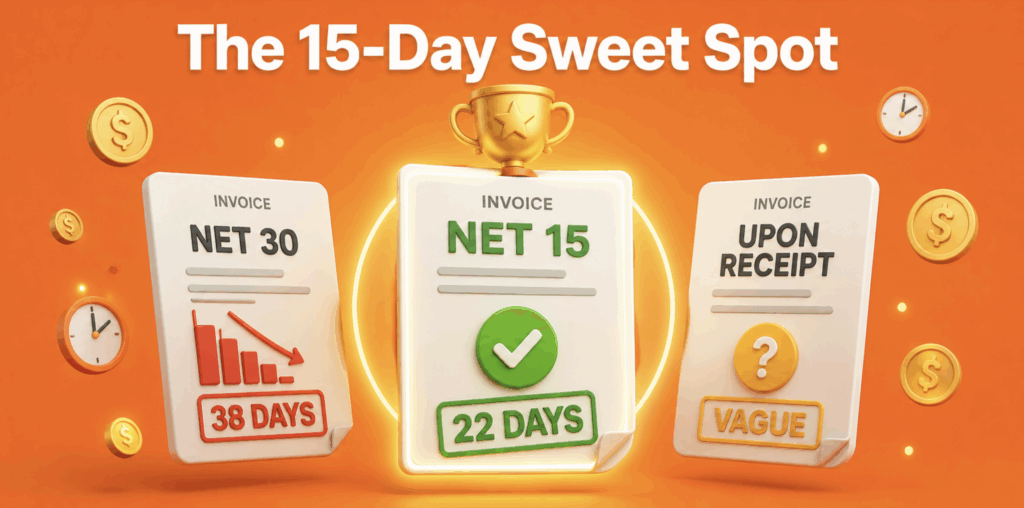
I tracked payment times for businesses using “payment due upon receipt” versus specific timeframes. The “upon receipt” crowd averaged thirty-eight days to payment. Businesses with specific terms like “due within 15 days” averaged twenty-two days. That sixteen-day difference can make or break your cash flow.
The Net 30 Default Disaster
Net 30 has become the default payment term for so many businesses that it’s basically meaningless. Clients see “Net 30” and subconsciously think “this business expects slow payment, so I don’t need to prioritize this.”
But here’s the really frustrating part – most businesses that use Net 30 don’t actually need thirty days for payment processing. They just copied it from somewhere else without thinking about whether it serves their business.
My friend Sarah switched from Net 30 to Net 15 for her consulting business. Her payment time dropped by twelve days on average, and she never had a single client complain about the shorter terms. Turns out, most were paying faster than thirty days anyway.
Vague Language That Confuses Everyone
Terms like “payment expected promptly” or “please remit payment soon” sound polite, but they’re cash flow killers. Without specific dates and consequences, clients have no urgency to pay quickly.
I’ve seen invoices that say “payment appreciated at your earliest convenience.” That’s not payment terms – that’s a suggestion. And suggestions don’t pay bills.
The Psychology Behind Payment Behavior (And How to Use It)
Understanding why people pay invoices when they do gives you massive advantages in crafting terms that actually work.
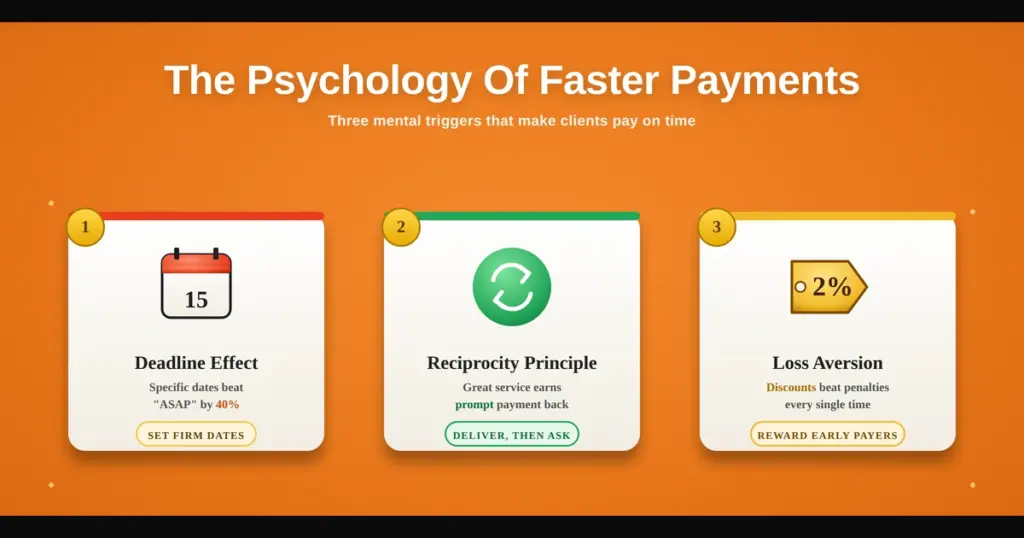
The Deadline Effect
Humans respond to specific deadlines much better than vague timeframes. Research shows that tasks with specific due dates get completed 40% faster than tasks described as “ASAP” or “when convenient.”
This applies directly to invoice payments. “Payment due by March 15th” gets better results than “payment due within 30 days” because the specific date creates psychological urgency.
The Reciprocity Principle
When you provide excellent service and then ask professionally for reasonable payment terms, most clients want to reciprocate your professionalism. But you have to ask clearly and specifically.
Wishy-washy payment terms signal that you don’t really expect fast payment, so clients don’t feel obligated to prioritize your invoice.
Loss Aversion in Action
People hate losing money or benefits more than they like gaining them. This is why early payment discounts work better than late payment penalties – even when the math is identical.
“2% discount for payment within 10 days” motivates faster payment than “2% penalty for payments after 30 days,” even though both create the same financial incentive.
Payment Terms That Actually Work (Based on Real Results)
After helping dozens of businesses optimize their payment terms, here are the approaches that consistently get results:
The 15-Day Sweet Spot
For most service businesses, “Payment due within 15 days of invoice date” hits the perfect balance. It’s short enough to create urgency but long enough to accommodate normal business processing times.
I’ve tested this across different industries:
- Consulting businesses: reduced average payment time by 18 days
- Creative services: improved by 14 days
- Professional services: improved by 22 days
- Small contractors: improved by 16 days
The Early Payment Discount That Works
“2% discount if paid within 10 days, full amount due within 20 days” is incredibly effective. The discount creates immediate incentive, while the backup deadline prevents indefinite delays.
Tom’s landscaping business implemented this exact language and saw 60% of clients take the early discount. His cash flow improved dramatically, and the 2% discount cost was offset by reduced collection time and better client relationships.
Also Read About Invoice Discounting
The Graduated Consequences Approach
“Payment due within 15 days. Late fee of $25 or 1.5% monthly (whichever is greater) applies to overdue balances. Accounts over 60 days past due may be subject to collection action.”
This works because it sets clear expectations with escalating consequences. Most clients pay within terms to avoid fees, and those who don’t pay the late fees without argument because the terms were clear upfront.
The Relationship-First Method
“Payment due within 20 days. If you need different terms, please call me at [phone] to discuss options.”
This approach works particularly well for businesses with ongoing client relationships. It sets clear expectations while showing flexibility for special circumstances. Clients appreciate the personal touch and usually pay within the stated terms.
Industry-Specific Payment Terms That Get Results
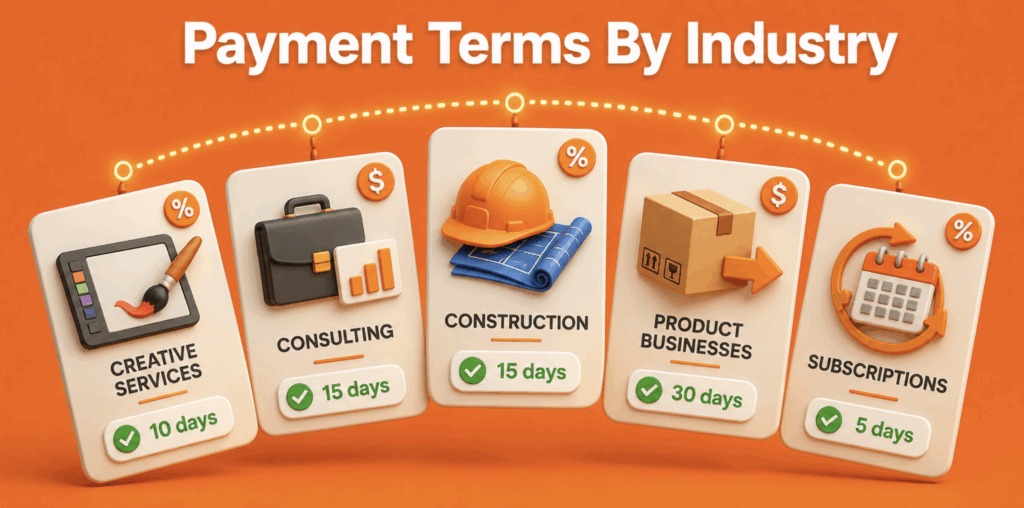
Different industries have different cash flow patterns and client expectations. Here’s what works best for each:
Creative and Design Services
Recommended Terms: “50% deposit required to start project. Remaining balance due within 10 days of project completion.”
Why This Works: Creative projects often involve revisions and scope changes. The deposit protects against project abandonment, while the short final payment term prevents the “endless revision” delay tactic.
Real Example: Jenny’s graphic design business was struggling with clients who’d request “just one more small change” to avoid final payment. The deposit + 10-day terms eliminated this problem completely.
Consulting and Professional Services
Recommended Terms: “Payment due within 15 days of invoice date. For retainer clients: payment due 5 days before service period begins.”
Why This Works: Consulting work is usually completed before invoicing, so there’s no reason for extended payment terms. Retainer terms ensure you’re not providing free services while waiting for payment.
Construction and Trade Services
Recommended Terms: “Payment due within 10 days of project completion and invoice delivery. For projects over $5,000: 25% deposit required, progress payments due within 5 days of each milestone.”
Why This Works: Construction clients expect shorter payment terms because the work is tangible and complete. Progress payments prevent large outstanding balances.
Also Check: What is Invoice Trading?
Product-Based Businesses
Recommended Terms: “Payment due within 15 days of shipment. Products shipped COD for first-time customers or overdue accounts.”
Why This Works: Product delivery is a clear completion point. COD terms for new or problematic customers eliminate payment risk.
Subscription and Recurring Services
Recommended Terms: “Payment due 3 days before service period begins. Credit card payments processed automatically. Late payments may result in service suspension.”
Why This Works: Recurring services need payment before delivery to maintain service continuity. Automatic processing eliminates payment delays.
Free Invoice Template Examples That Work
Here are proven payment terms templates you can copy directly into your invoices:
Template 1: The Professional Standard
PAYMENT TERMS:
Payment due within 15 days of invoice date.
Late fee of 1.5% per month applies to overdue balances.
Questions about this invoice? Contact [Name] at [Phone/Email].
Best for: Most service-based businesses, professional services, consulting
Template 2: The Early Payment Incentive
PAYMENT TERMS:
2% discount if paid within 10 days of invoice date.
Full payment due within 20 days of invoice date.
Late fee of $25 or 2% monthly (whichever is greater) applies after 30 days.
Thank you for your prompt payment!
Best for: Businesses with good profit margins, clients who value cost savings
Template 3: The Project-Based Approach
PAYMENT TERMS:
50% deposit due before work begins.
Remaining balance due within 10 days of project completion.
Work will not commence until deposit is received.
Final deliverables released upon full payment.
Best for: Creative services, custom work, project-based businesses
Template 4: The Relationship Builder
PAYMENT TERMS:
Payment due within 20 days of invoice date.
Need different payment arrangements? Let's discuss options that work for both of us.
Contact [Name] at [Phone/Email] with questions or concerns.
We appreciate your business and prompt payment!
Best for: Long-term client relationships, high-value services, personal service businesses
Template 5: The No-Nonsense Approach
PAYMENT TERMS:
Payment due within 10 days of invoice date.
$30 late fee applies to payments received after due date.
Accounts over 30 days past due subject to collection action.
All returned checks incur $35 processing fee.
Best for: Businesses with payment problems, high-volume/low-margin services, repeat offenders
Advanced Strategies for Faster Payment
Once you’ve optimized your basic payment terms, these advanced strategies can further improve your collection speed:
The Payment Method Optimization
Make payment as easy as possible by offering multiple convenient options:
“Payment Options: Online at [website/link], check to [address], bank transfer to [account details], or credit card by calling [phone].”
The easier you make payment, the faster people pay. I’ve seen businesses reduce payment time by 5-8 days just by adding online payment options.
The Relationship Leverage Technique
“This invoice reflects work completed as part of our ongoing partnership. Continued service depends on maintaining current account status.”
This works particularly well for retainer relationships or ongoing services. Nobody wants to lose a valuable service provider over payment delays.
The Social Proof Method
“Like 95% of our clients, we trust you’ll handle this invoice promptly according to the stated terms.”
This creates subtle peer pressure while maintaining a positive tone. Most people want to be part of the “good client” group.
The Personal Responsibility Approach
“I personally guarantee the quality of this work and appreciate your prompt payment to support our small business.”
Adding personal accountability often generates reciprocal responsibility from clients. This works especially well for small, owner-operated businesses.
Legal Considerations for Payment Terms
Your payment terms need to be legally enforceable to provide real protection. Here’s what matters:
State-Specific Requirements
Different states have different rules about late fees, collection procedures, and payment terms. Research your local regulations or consult with an attorney to ensure compliance.
Common Requirements:
- Late fees must be “reasonable” (usually 1-2% monthly)
- Collection terms must follow fair debt collection practices
- Some industries have specific payment term regulations
Documentation and Communication
Your payment terms must be:
- Clearly visible on the invoice (not hidden in fine print)
- Communicated before work begins when possible
- Applied consistently across all clients
- Documented in writing for legal protection
International Considerations
If you work with international clients, consider:
- Currency exchange rate clauses
- International wire transfer fees and timing
- Different cultural expectations about payment timing
- Legal enforcement challenges across borders
Handling Late Payments Professionally
Even with perfect payment terms, some clients will pay late. Here’s how to handle it professionally while protecting your cash flow:
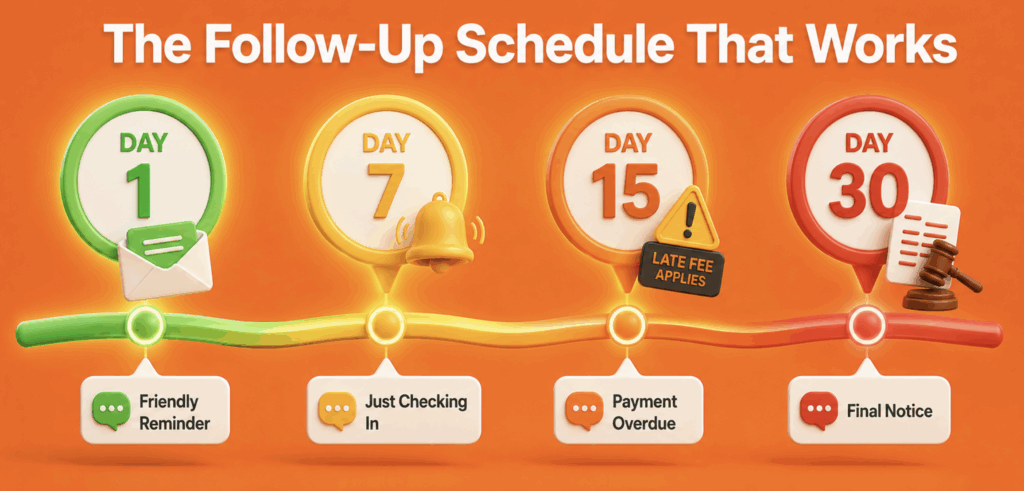
The Follow-Up Schedule That Works
Day 1 past due: Friendly reminder email “Hi [Name], just wanted to make sure you received invoice #[number]. The payment was due yesterday, but I know things get busy. Can you let me know when I can expect payment? Thanks!”
Day 7 past due: More formal reminder
“Hello [Name], Invoice #[number] is now 7 days past due. Please send payment by [specific date] to avoid late fees. If there are any issues, please contact me immediately so we can resolve them.”
Day 15 past due: Firm notice with consequences “[Name], Invoice #[number] is now 15 days overdue. Per our payment terms, a late fee of $[amount] has been applied. Payment is required within 5 days to avoid further collection action.”
Day 30 past due: Final notice “This is final notice for Invoice #[number], now 30 days overdue. Payment including late fees totaling $[amount] is required within 10 days. Failure to respond will result in collection action and potential suspension of services.”
The Conversation Approach
Sometimes phone calls work better than emails, especially for long-term clients:
“Hi [Name], I’m calling about invoice #[number] that’s been outstanding for [timeframe]. Is there something going on that’s preventing payment? Let’s figure out how to resolve this.”
This approach shows you care about the relationship while still addressing the payment issue directly.
When to Get Tough
If a client consistently ignores payment terms and follow-up attempts, it’s time for firmer action:
- Suspend services until payment is received
- Require payment before delivering future work
- Engage a collection agency or attorney
- Consider small claims court for smaller amounts
The key is communicating these escalations clearly in your original payment terms so clients understand the consequences of non-payment.
Measuring and Improving Your Payment Terms
Track these metrics to understand how well your payment terms are working:
Key Performance Indicators
- Average Days to Payment: Track this monthly to identify trends and improvements
- Percentage Paid Within Terms: Aim for 80%+ compliance with your stated terms
- Late Payment Rate: Should decrease as you optimize terms and follow-up procedures
- Early Payment Discount Uptake: If offering discounts, track how many clients use them
A/B Testing Your Terms
Try different payment terms with similar client groups to see what works best:
- Test 15 days vs. 20 days payment terms
- Compare early payment discounts vs. late payment fees
- Try different language styles (formal vs. conversational)
- Experiment with different follow-up schedules
Client Feedback Integration
Ask long-term clients about your payment terms:
- Are the timeframes reasonable for your industry?
- Do the terms create any processing difficulties?
- Would different payment methods be more convenient?
- How do your terms compare to other vendors they use?
Technology Solutions for Payment Terms Management
While you don’t need expensive software to improve payment terms and conditions, some tools can help automate the process:
Free and Low-Cost Options
- InvoPilot: Creates professional invoices with customizable payment terms, no monthly fees
- Google Calendar: Set payment due date reminders for manual follow-up
- Email templates: Create standard follow-up messages for different stages Spreadsheet tracking: Simple systems for monitoring payment status
When to Consider Paid Solutions
If you’re sending 25+ invoices monthly, automated payment reminders and tracking might justify software costs. Look for tools that:
- Send automatic payment reminders
- Track payment status and aging reports
- Integrate with your accounting system
- Offer online payment processing
Common Payment Terms Mistakes to Avoid
Mistake 1: Copying Terms Without Thinking
Don’t just use “Net 30” because everyone else does. Consider what actually makes sense for your business and cash flow needs.
Mistake 2: Making Terms Too Complicated
Simple, clear terms work better than complex structures with multiple conditions and exceptions.
Mistake 3: Not Enforcing Your Own Terms
If you don’t follow your own payment terms with late fees and collection actions, clients will stop taking them seriously.
Mistake 4: Apologizing for Asking for Payment
Your payment terms should be confident and professional, not apologetic. You’ve earned the right to be paid according to the agreed terms.
Mistake 5: One Size Fits All Approach
Different clients and project types may need different payment terms. Don’t be afraid to customize when it makes business sense.
Industry-Specific Late Payment Solutions
Service Businesses
Problem: Clients delay payment because service is intangible Solution: Detailed work summaries with payment terms, progress updates during projects
Product Businesses
Problem: Disputes about product quality delay payment Solution: Clear return/exchange policies, inspection periods with payment deadlines
Consulting Businesses
Problem: Scope creep leads to payment delays Solution: Clear project boundaries, change order procedures, milestone payments
Creative Industries
Problem: Subjective work leads to endless revision requests Solution: Revision limits in contracts, final payment terms regardless of approval status
Future-Proofing Your Payment Terms Strategy
As business practices evolve, consider these trends:
Digital Payment Integration
More businesses expect instant payment options. Consider adding:
- Online payment portals
- Mobile payment apps
- Automated credit card processing
- Digital wallet acceptance
Subscription Model Trends
Even traditional service businesses are moving toward subscription-style payment models:
- Monthly retainers with automatic payment
- Quarterly service agreements
- Annual contracts with payment schedules
AI and Automation
Emerging tools can help with:
- Predictive analytics for payment behavior
- Automated payment reminders
- Intelligent payment term recommendations
- Real-time cash flow forecasting
Taking Action: Your Payment Terms Optimization Plan
Week 1: Assessment and Planning
- Day 1-2: Review your current payment terms and calculate average payment times
- Day 3-4: Research industry standards and legal requirements in your area
- Day 5: Choose new payment terms based on your business needs and client relationships
Week 2: Implementation
- Day 1: Update your invoice templates with new payment terms
- Day 2-3: Test new terms with a small group of clients
- Day 4-5: Create follow-up email templates for late payments
Month 1: Monitoring and Adjustment
- Week 3-4: Apply new terms to all invoices and track initial results
- Month 1: Analyze payment speed changes and client feedback
- Month 2: Refine terms based on actual results and client responses
Ongoing: Optimization and Improvement
- Monthly: Review payment metrics and identify trends
- Quarterly: Assess whether terms need adjustment for seasonal patterns
- Annually: Comprehensive review of payment terms effectiveness
Conclusion: Payment Terms as Competitive Advantage
Optimizing your invoice payment terms isn’t just about getting paid faster – it’s about creating a more sustainable, less stressful business. When you have predictable cash flow, you can focus on serving clients and growing your business instead of worrying about overdue payments.
The businesses I work with that prioritize payment terms optimization consistently outperform those that treat payment as an afterthought. Not because they’re more aggressive about collection, but because they’ve created systems that naturally encourage faster payment.
Remember Mike from the beginning of this article? His business didn’t just improve cash flow – it grew 40% the following year because he could invest in marketing and equipment instead of constantly worrying about whether clients would pay on time.
Your payment terms are one of the most powerful tools you control for improving cash flow. Start with simple changes, track the results, and refine based on what actually works for your specific business and client base.
Ready to create invoices with payment terms that actually get you paid faster? Try InvoPilot’s free invoice templates with built-in payment terms options. Professional formatting, clear terms, and instant PDF generation – all without monthly fees or complicated setup.
Frequently Asked Questions
What’s the ideal payment term length for small businesses?
15 days works well for most service businesses. It’s short enough to improve cash flow but long enough for normal business processing. Adjust based on your industry and client relationships.
Should I offer early payment discounts or charge late fees?
Early payment discounts typically work better than late fees for encouraging fast payment. A 2% discount for payment within 10 days often generates better results than late fee penalties.
How do I handle clients who request longer payment terms?
Evaluate case-by-case based on client value and payment history. For high-value long-term clients, consider offering extended terms in exchange for automatic payment setup or larger project commitments.
Can I change payment terms for existing clients?
Yes, but communicate changes professionally with adequate notice. Explain the business reasons and give clients time to adjust their payment processes.
What should I do if a client consistently ignores my payment terms?
Start with professional follow-up communications, then escalate to service suspension, collection agencies, or legal action if necessary. The key is following through consistently on your stated consequences.
What payment terms have worked best for your business? Have you found specific language or strategies that improve collection times? Share your experience in the comments – other business owners would benefit from your insights and success stories.
Create Invoices Instantly – Free & Easy!
Generate professional invoices in seconds with our Free Online Invoice Generator.
👉 Invoice Generator