- What Is Invoice Trading?
- How Does Invoice Trading Work?
- Types of Invoice Trading
- Invoice Trading vs Invoice Factoring
- Benefits of Invoice Trading
- Who Can Use Invoice Trading?
- Key Players in Invoice Trading
- What Is The Cost Of Invoice Trading?
- Getting Started with Invoice Trading
- Conclusion
- Frequently Asked Questions
Invoice trading is a type of short-term finance where businesses sell their unpaid invoices to investors or platforms in return for cash – usually customers will be paid between 70-90% of the invoice value upfront within 24 to 72 hours. This enables businesses to gain working capital without having to wait 30-90 days for customer payments, and lets them keep cash flow smooth without liabilities incurred with traditional credit.
In addition to invoice financing or online invoice crowdfunding, this bank product is particularly useful for small- and medium-sized businesses (SMBs) that want funds to cover cash flow gaps, fund daily activities, or take advantages of growth prospects.
What Is Invoice Trading?
Invoice finance is a funding method that allows businesses to effectively sell their accounts receivable at a discount in exchange for financing. Instead of waiting weeks or even months to get customers to pay their bills, companies can receive up to 90% the value of an invoice right away.
Key Features:
- Quick Funding: Borrowers can expect to receive money the same day or within 24-72 hours
- No Security needed: Invoices are the only asset required to provide as a guarantee.
- Flexible: Decide which invoices to sell and when.
- Non-debt Financing: Shows up as not a loan in the balance sheet
This type of funding has particularly risen in popularity during 2026 as digital platforms make the process easier, more transparent, and obtainable for all-size businesses.
How Does Invoice Trading Work?
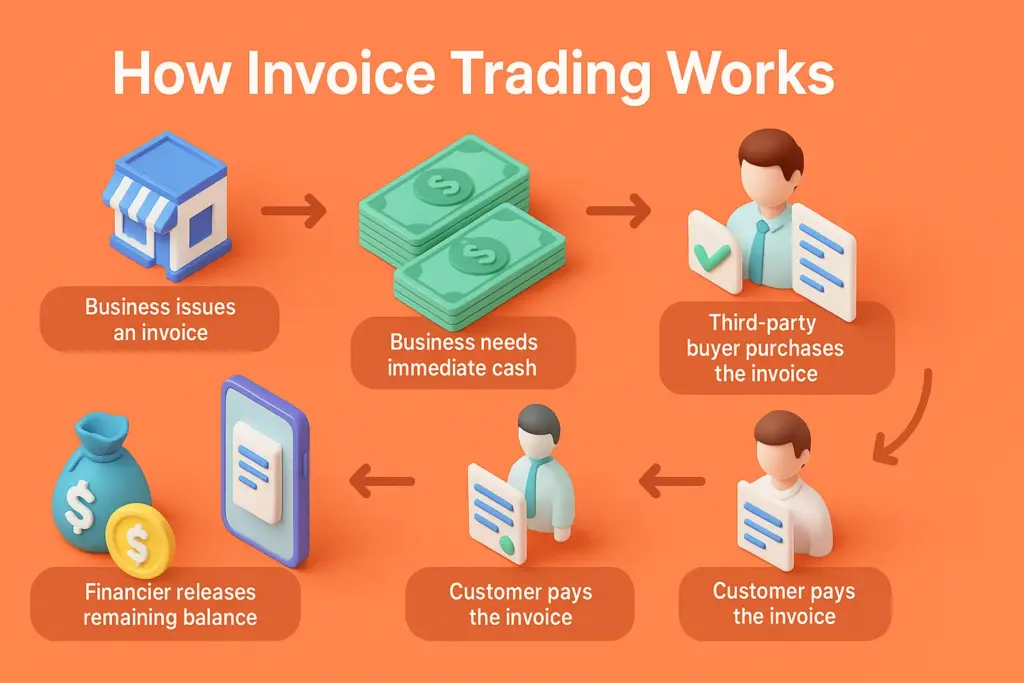
Knowing more about invoice trading makes it easier for businesses to decide whether or not it’s the right type of financing for their circumstances. Here’s a detailed step-by-step breakdown:
Step 1: The Business Issues an Invoice
When a business provides goods or services to a customer, it issues an invoice with the amount due and itemized list of details and payment terms — 30, 60 or 90 days. Until you get paid, this open invoice is revenue the business hasn’t collected.
Example: A development shop finishes a $10,000 project and issues an invoice with payment terms of 60 days.
Step 2: Business Requires Money Right Now
Instead of waiting until the due date on an invoice (net terms), the company realizes it needs working capital now to pay operating costs, pay suppliers or capture an opportunity.
Example: A software company requires $7,000 right now to pay contractors or purchase another project.
Step 3: Invoice Listed on a Trading Platform
Business either uploads the invoice to an invoice trading platform or directly connects with a finance provider. The receivables are being uploaded to the platform, where they are checked for authenticity and customers’ credit standing so as to safeguard investors.
Verification includes:
- Invoice legitimacy check
- Customer payment history review
- Credit score assessment
- Business documentation
Step 4: Vendor Sells the Invoice to a Third-Party Buyer
The invoice is sold to an investor or financier at a discount and the business gets paid 70-90% of the invoice immediately. The rest (less fees) is kept aside.
Example: A financier purchases the $10,000 invoice at a discount of $500. The business receives $8,500 upfront.
Step 5: Payment of the Invoice by Customer
At maturity, the customer returns the financing either directly to the financier or to an escrow account operated by the platform.
Example: After 60 days, the customer pays the financier $10,000 in full.
Step 6: Release of the Remainder by Financier
The financier will collect full payment, subtract their service fee (between 1-5% of invoice value) and return the remaining amount back to the business.
Example: If it receives $10,000, the financier subtracts a $500 fee and transfers the remaining $1,000 to the business.
Step 7: Never Stops — a Great Solution (Ongoing Solution)
Companies with predictable cash flow requirements can choose to use invoice trading as a flexible, scalable form of financing. This is one piece in a longer-term plan for cash flow.
Types of Invoice Trading
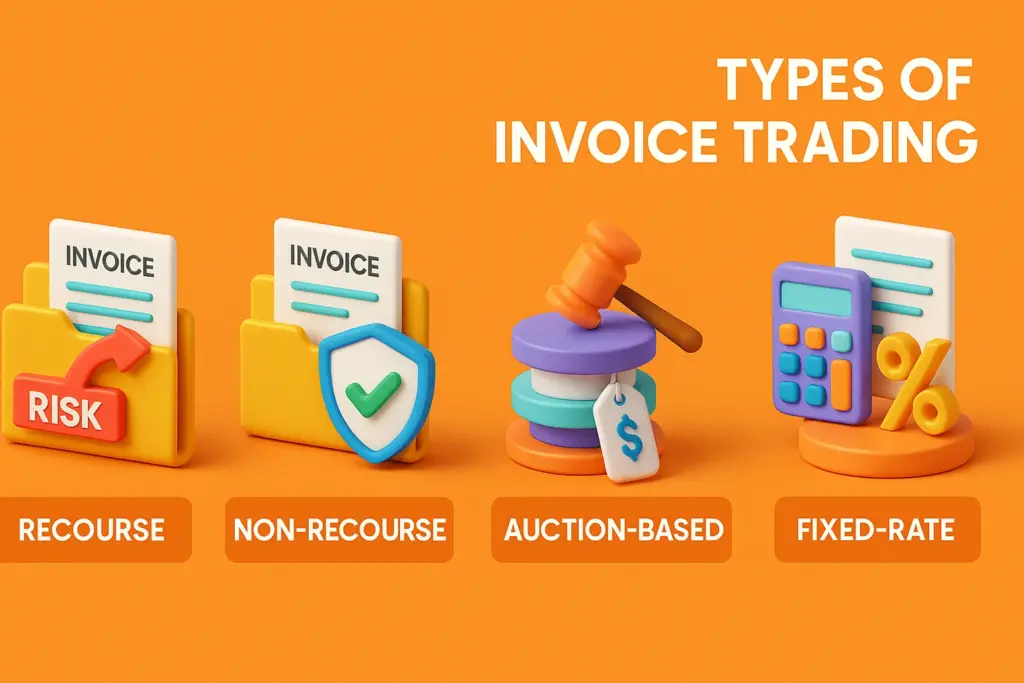
Invoice trading structures (and therefore risk and cost) can vary. Knowing the difference between the two types can help companies determine which one is best:
1. Recourse Invoice Trading
How it works: If the client defaults, the business remains on the hook. If the invoice goes unpaid, the company must repurchase the invoice or pay the investor back.
Pros:
- Lower fees (typically 1–3%)
- Easier approval process
- More investors willing to participate
Cons:
- Business retains payment risk
- May be required to pay back loan if customer defaults
Best for: Companies with good customers and a solid payment history.
2. Non-Recourse Invoice Trading
How it works: The investor takes the risk of customers failing to make payments. If the customer reneges, the business is not required to return money to the investor.
Pros:
- Protection against bad debt
- Removes collection burden
- Transfers credit risk to investor
Cons:
- Higher fees (typically 3–6%)
- Stricter approval requirements
- May require stronger customer credit
Best for: Businesses with new customers or that play in industries prone to financial instability.
3. Auction-Based Invoice Trading
How it works: Multiple investors compete to buy invoices being offered on a platform. The seller picks the highest offer by price, terms or investor reputation.
Pros:
- Competitive pricing through bidding
- Greater control over terms
- Transparency in pricing
Cons:
- It is slower in process (1–5 working days)
- May require active management
- Not guaranteed to receive bids
Good for: Companies that have time to wait and want the best rate possible.
4. Fixed-Rate Invoice Trading
How it works: A company sells invoices at a discount that is established beforehand. No bidding or auction was necessary.
Pros:
- Fast, predictable funding
- Simple, streamlined process
- Consistent pricing
Cons:
- May not receive the most competitive rate
- Less flexibility in terms
Best for: Companies looking more at speed and simplicity than best possible pricing.
5. Selective Invoice Trading
How it works: Businesses select certain invoices to sell, as opposed to their whole invoice book. Offers maximum flexibility.
Pros:
- Full control over what invoices to sell
- No long-term contracts
- Use only when needed
Cons:
- May have higher per-transaction fees
- Less relationship-building with financiers
Best for: Businesses with occasional cash flow needs or seasonal fluctuations in an otherwise stable industry.
Invoice Trading vs Invoice Factoring
While similar, invoice trading and invoice factoring differ in key ways:
| Feature | Invoice Trading | Invoice Factoring |
| Control | Business maintains customer relationships | Factor takes over collections |
| Process | Online platform with investor marketplace | Direct relationship with factoring company |
| Flexibility | Choose specific invoices to sell | May require entire invoice book be sold |
| Customer Awareness | Confidential, customer unaware of process | Customer notified of arrangement |
| Fees | Usually 1-5% per invoice | Usually 1-5% plus monthly service fees |
| Speed | 24-72 hours | 24-48 hours |
| Relationship | Transaction-based, no long-term commitment | Often requires ongoing relationship |
| Best For | Discretion and Flexibility | Outsourcing collections |
Key Insight: With invoice trading, you receive more control and choice; with factoring, more complete management of accounts receivable.
Benefits of Invoice Trading
Invoice trading provides a range of benefits that make it an affordable and flexible form of finance:
1. Quick Access to Working Capital
Turn unpaid invoices into cash, not in 30-90 days but rather in 24-72 hours! This speed allows companies to capture time-sensitive opportunities and fulfil immediate financial obligations.
2. Improved Cash Flow Management
Ensure consistent working capital for daily operations such as payroll, supplier payments and overheads. Steady cash flow makes it easier to plan financially and alleviates stress.
3. No Collateral Required
Whilst banking industry uses physical assets as collateral, invoice trading uses the value in the invoices themselves. This makes funding available to asset-light businesses or startups.
4. Flexible and On-Demand
Choose how much to sell, and when, depending on your current cash flow requirements. No long-term contract or borrowing fixed amount—use only what you need, when you need it.
5. Faster Growth Opportunities
So employees don’t have to wait for customer payments and can invest cash in new inventory, marketing campaigns, equipment or expansion plans. This agility provides competitive advantage.
6. Maintains Customer Relationships
Most platforms are run confidentially, so customers often never know their invoice was traded. It would maintain trust and routine business relationships.
7. Better Financial Planning
The quicker cash is in the bank, the more accurate the forecast for income and expenses. Better predictability benefits strategic decision making and budgeting.
8. Credit Risk Transfer
Non-recourse purchases pass the credit risk of customer non-payment onto investors; this means that businesses are insured against default and risk is limited.
9. Simple Online Platforms
Today, you can use invoice trading platforms that are online, easy to access and minimal paperwork. Upload invoices, receive quotes and access funding in secure dashboards.
10. Alternative to Bank Loans
A viable alternative for companies that don’t want to, or are unable to qualify for traditional financing because they do not have an established credit history, any collateral or unflattering credit profile.
11. Scalable Solution
And as your business expands and issues more invoices, so too does the amount of funding available to you. No more need to renegotiate credit limits or terms.
12. Non-Debt Financing
Invoice trading is technically a sale of assets (not a loan) and thus doesn’t increase debt on your balance sheet or impact the debt-to-equity ratios.
Who Can Use Invoice Trading?
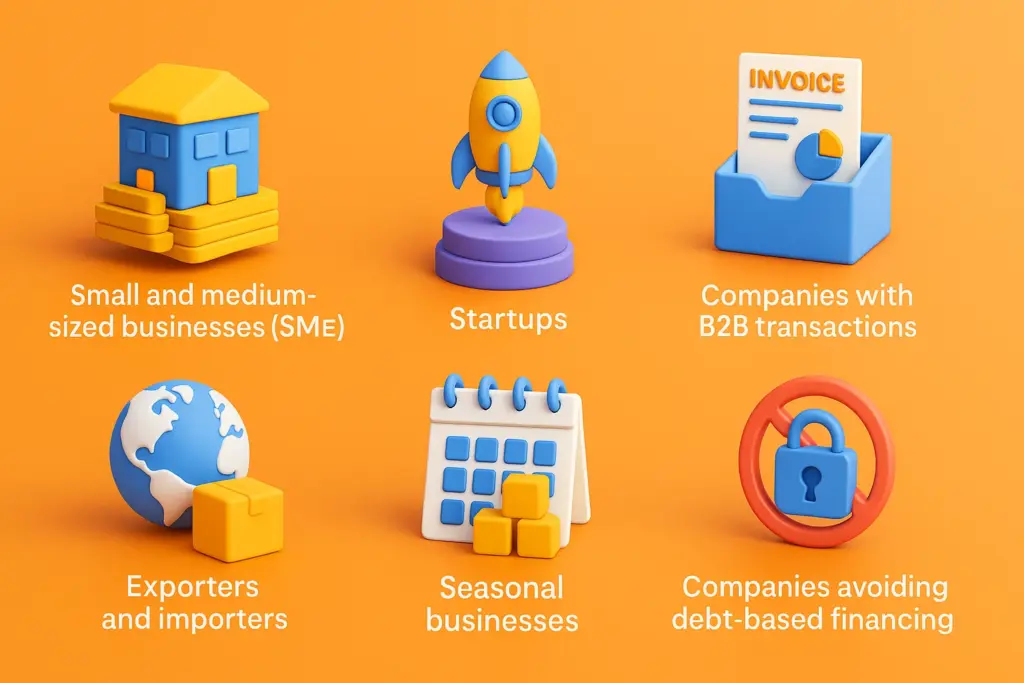
Invoice trading benefits various business types and situations:
Small and Medium-Sized Businesses (SMBs)
It’s no secret that small businesses are regularly cash short due to long payment cycles. With invoice trading, funds are available for working capital needs immediately and there is no bank loan qualification necessary.
Startups and Early-Stage Companies
Historically, financing is scarce through traditional channels for companies with little operating history or credit. Invoice trading is based on customer credit rather than business credit.
B2B Service Providers
Businesses that consistently invoice other businesses on net 30, net 60, or net 90 terms can access cash tied up in payment processes.
Seasonal Businesses
Companies that swing in and out of profitability as they follow seasonal demand can smooth things out by trading invoices with their customers at peak times, enabling them to finance off-peak expenses this way.
Exporters and Importers
Companies involved in international trade are frequently subject to payment collection delays caused by shipping and customs procedures. Invoice trading bridges the gap between delivery and payment.
Fast-Growing Companies
Fast-growing businesses require working capital to fund expansion, hire new staff, and buy inventory—often faster than they collect revenue.
Businesses Avoiding Traditional Debt
For companies that do not wish to borrow money or increase their debt, invoice trading offers an alternative form of non-debt financing.
Industries with Long Payment Cycles
These include manufacturing, wholesale distribution, staffing agencies, professional services, and construction—sectors where invoice trading can be especially valuable for meeting supplier payments.
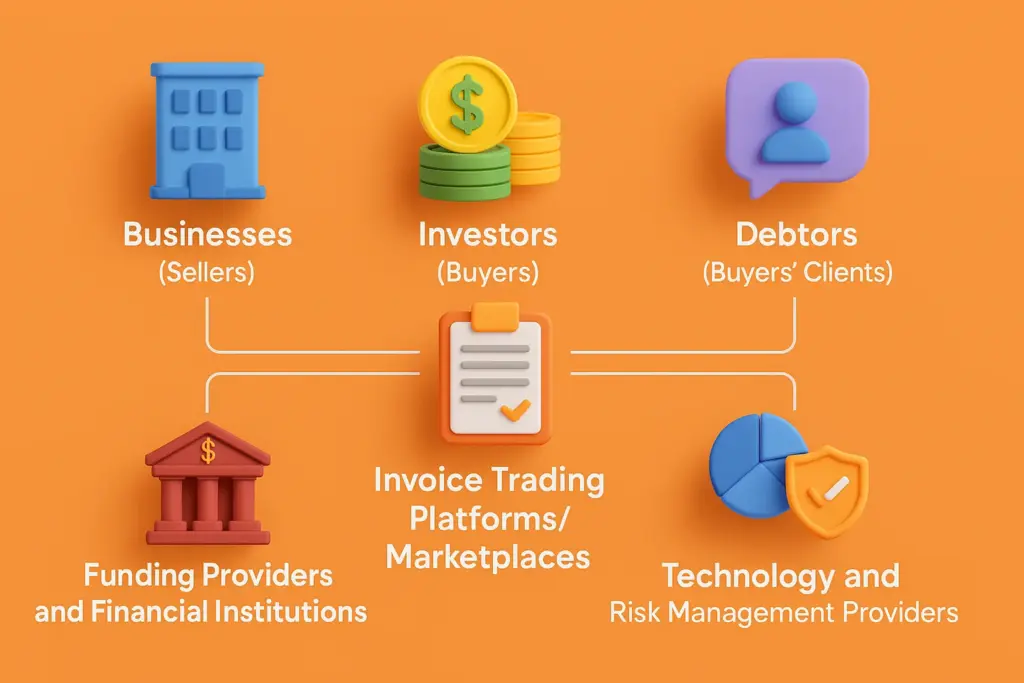
Key Players in Invoice Trading
The supplier financing ecosystem comprises a number of key stakeholders:
Businesses (Sellers)
Companies that generate invoices and require immediate cash flow. The invoices can be uploaded on platforms or financiers can also be approached directly to enter the trading process.
Investors (Buyers)
These include individuals, institutional lenders, or hedge funds that purchase invoices at a discount and earn returns when customers pay. They weigh risk and supply the capital that underwrites invoice trading.
Invoice Trading Platforms
Online marketplaces that connect sellers and buyers, like MarketInvoice, Fundbox, and C2FO. These platforms validate invoices, determine credit risk, help execute transactions, and often handle payment processing.
Debtors (Customers)
The companies or persons that are indebted on the invoices being traded. They are usually unaware of the trade agreement, but their payment behavior ultimately drives investors’ risk and returns.
Financial Institutions
Banks and alternative lenders that inject liquidity into the platforms or do invoice financing themselves. They bring credibility and capital scale to the invoice trading market.
Technology Providers
A number of fintech firms provide software platforms, credit scoring tools, fraud detection systems, and payment automation that make invoice trading efficient and secure.
What Is The Cost Of Invoice Trading?
It’s good for businesses to know how their fees work when assessing if invoice trading is financially viable:
Typical Fee Range
Between 1 and 5% of the value of the invoice, in relation to:
- Amount of invoice (better rates available on larger invoices)
- Terms of payment (shorter terms mean lower fees)
- Creditworthiness of customer (stronger credit = lower fees)
- Recourse vs non-recourse (non-recourse is more expensive)
- Platform or provider used
Example Cost Calculation
- Invoice Value: $10,000
- Payment Terms: 60 days
- Fee: 3% ($300)
- Amount Received: $9,700 upfront
- Total Cost: Around 18% APR
Additional Considerations
- Some platforms have monthly fees and subscription costs
- Late payment penalties may apply
- Early payment discounts sometimes available
- Volume discounts for regular users
Getting Started with Invoice Trading
Ready to take the reins of your cash flow? Here’s how to begin:
- Evaluate Your Requirements: Exactly how much money do you need and which are the invoices that qualify?
- Research Invoice Trading Platforms: Read our guide to the best invoice trading providers for more information on fees, features, and user reviews.
- Get Your Paperwork Together: Put together invoices, client information, and business documentation.
- Apply and Apply: Sign up and upload your first invoice for review.
- Review Proposals: Compare rates, terms & next steps from interested investors.
- Get Funded: Accept an offer and receive money in 24–72 hours.
Conclusion
Invoice trading is a mighty financial instrument for contemporary businesses that wish to succeed in managing their cash flow without being tied down by old-fashioned borrowing methods. Turning unpaid invoices into instant cash has enabled companies to remain liquid, take advantage of growth opportunities and meet the demands of a highly competitive marketplace.
Whether you are a new company, struggling with slow-paying S&Ds / SMBs or a growing business experiencing delays between billing and revenue realization, invoice trading is providing an alternative for fast, accessible and scalable source of finance. In 2026 it’s easier than ever to trade invoices, with easy-to-use digital platforms and some of the best rates for working capital you’ll find.
Looking to get a handle on your business finances and make invoicing easier? With InvoPilot you get the ability to produce professional invoices in no time – the first step towards efficient cash flow management.
Frequently Asked Questions
Think of invoice trading as when businesses sell their unpaid customer invoices to get immediate cash. Typically, they receive around 70–90% of the invoice value upfront, with the rest paid once the customer settles the bill. It’s a way for companies to access money tied up in invoices without waiting for customers to pay, helping improve cash flow quickly.
Most invoice trading platforms release funds within 24–72 hours after verifying and approving invoices. Some providers offering fixed-rate trading can even offer same-day funding for established clients with pre-approved terms.
Fees usually range from 1–5% of the invoice value, depending on factors like invoice size, payment terms, customer reliability, and whether it’s recourse or non-recourse trading. Larger invoices from creditworthy customers with shorter terms tend to receive better rates.
Not exactly. Invoice trading allows businesses to sell specific invoices online while keeping customer relationships private. Invoice factoring, on the other hand, usually involves selling your entire book of invoices to a factoring company that then handles collections and notifies your customers.
With recourse invoice trading, the business must repay the investor if the customer fails to pay, meaning lower fees but higher risk. Non-recourse trading shifts that risk to the investor—protecting your business from bad debt but at a slightly higher cost (typically 3–6% instead of 1–3%).
Yes. Even with limited credit history, startups can qualify because platforms focus more on the creditworthiness of your customers rather than your company’s credit score. This makes it ideal for early-stage businesses with reliable clients.
No, because invoice trading is a sale of assets, not a loan. It doesn’t usually impact your personal or business credit score. However, if you’re using recourse trading and fail to repay after a customer default, your credit could be affected.
Industries with long payment cycles gain the most—manufacturing, wholesale, staffing and recruitment, consulting, IT services, construction, import/export, and B2B service providers.
Usually, no. Many platforms keep the process confidential, so your customers continue paying as usual, often into an escrow account managed by the platform. Some providers, though, do notify customers depending on their policy.
Invoice trading involves selling your invoices (assets), so it doesn’t add debt to your balance sheet or require collateral beyond the invoices themselves. Loans, however, involve borrowing money, credit checks, collateral, interest payments, and fixed repayment schedules regardless of cash flow.
That depends on whether you chose recourse or non-recourse trading. In recourse trading, you’re responsible for repaying or buying back the invoice. In non-recourse trading, the investor absorbs the loss from non-payment, protecting your business from bad debt.
Yes, most platforms set minimums between $1,000 and $10,000 per invoice. Some cater to smaller businesses with invoices as low as $500. Very large invoices ($100,000+) may qualify for special rates.
Consider factors like fees, recourse options, funding speed, invoice size limits, industry focus, reputation, customer support, ease of use, and whether they offer confidential or disclosed trading.
Regulations vary by country. In the U.S., platforms may fall under securities and consumer protection laws, as well as state lending regulations. Always choose a provider transparent about their licensing and compliance.
Yes, many platforms accept international invoices but may charge higher fees due to added risks like currency exchange and overseas payment verification. Customer creditworthiness in foreign markets also plays a role in approval and pricing.
Create Invoices Instantly – Free & Easy!
Generate professional invoices in seconds with our Free Online Invoice Generator.
👉 Try the Invoice Generator Now