
Think of a purchase invoice as the bill you receive after buying something for your business on credit. It confirms what was bought, how much it costs, who you owe the money to, and by when you must pay. Every purchase invoice creates a temporary debt on your books until you process payment.
What Is a Purchase Invoice? (Definition & Meaning in Accounting)
A purchase invoice is the formal document a supplier sends to a buyer after delivering goods or services, listing everything that needs to be paid. It is the supplier’s official request for payment and the buyer’s trigger to record a liability in their accounting system.
In accounting, the term “purchase invoice” is used from the buyer’s perspective. When you purchase office supplies, raw materials, or professional services on credit, your supplier sends you this document. You then record it as an accounts payable entry (money you owe but haven’t yet paid).
Quick Facts
- Issued by the supplier
- Received by the buyer
- Recorded as Accounts Payable
- Used for GST/VAT claims
- Retained for 6–7 years
- Also called a vendor bill
Key Distinction
A purchase invoice and a sales invoice are the same physical document but named from opposite sides. Your supplier calls it their sales invoice (they’re recording revenue). You call it your purchase invoice (you’re recording an expense or liability).
Is a Purchase Invoice the Same as a Bill?
Yes “purchase invoice” and “bill” are used interchangeably in most business contexts. Accounting software like QuickBooks and Tally labels incoming supplier invoices as “bills” in the accounts payable module. The document is identical; only the label differs. Both represent an obligation to pay a supplier by a specific date.
Create Invoices Instantly
📄 Need to create a purchase invoice? Use InvoPilot’s free invoice generator — no signup required.
👉 Try the Invoice Generator NowKey Components of a Purchase Invoice
Every valid purchase invoice must include certain fields to be legally recognised and useful for accounting. Here are the mandatory and recommended components:
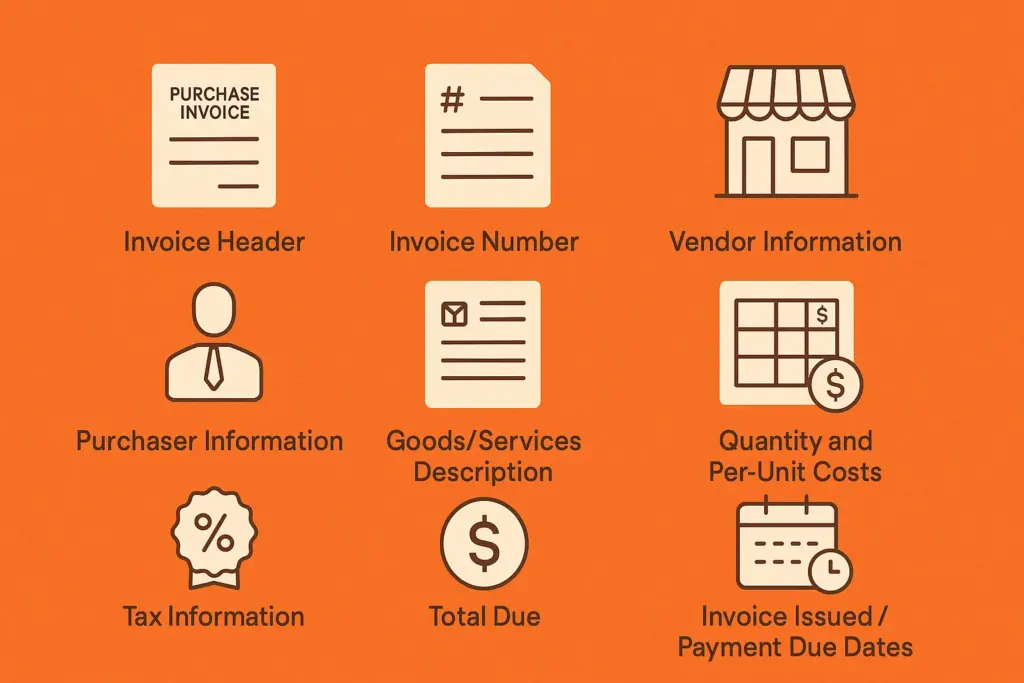
1. Invoice Header & Number
The document must be clearly labelled as an “Invoice” and carry a unique, sequential invoice number (e.g., INV-2026-0047). This number is critical for tracking, three-way matching, and dispute resolution. Never accept an unnumbered invoice, it creates audit risks.
2. Invoice Date & Due Date
The invoice date is when the document was issued. The due date determines the payment deadline, usually expressed as payment terms: Net-15, Net-30, Net-60, or 2/10 Net-30 (2% discount if paid within 10 days). Your AP team uses the due date to schedule payment runs.
3. Supplier (Vendor) Details
The supplier’s full legal name, business address, contact information, and for GST-registered businesses in India, their GSTIN (GST Identification Number). This is mandatory for input tax credit (ITC) claims.
4. Buyer Details
Your company’s name, billing address, GSTIN, and any purchase order reference number you issued. Matching these details is the first step of invoice verification.
5. Line-Item Description, Quantity & Unit Price
Each product or service must be listed separately with a description, quantity, unit of measurement, and unit price. This line-item breakdown is what the AP team checks against the purchase order during three-way matching.
6. Tax Information (GST / VAT)
Applicable taxes must be broken out separately in India this means CGST, SGST, or IGST with the correct rate (5%, 12%, 18%, or 28%). An invoice without proper tax breakdown is not a valid GST invoice and cannot be used for ITC claims.
7. Subtotal, Discounts, and Total Amount Due
The invoice must show the subtotal before tax, any discounts or credits applied, the tax amount, and the final total amount due. This is the number your AP team records and your finance controller approves.
8. Payment Terms & Instructions
Clear payment terms, accepted payment methods (bank transfer, UPI, cheque), and the supplier’s bank account details. Some invoices also include a late payment penalty clause, read this before filing.
| Component | Why It Matters | Required for GST? |
|---|---|---|
| Invoice Number | Tracking, audit trail, 3-way match | Yes |
| Invoice Date | Determines tax period, due date | Yes |
| Supplier GSTIN | ITC eligibility | Yes |
| Buyer GSTIN | ITC eligibility | Yes |
| HSN/SAC Code | GST classification | Yes |
| Line-item breakdown | Three-way matching | Yes |
| CGST / SGST / IGST split | Correct tax filing | Yes |
| Payment terms | Cash flow planning | Recommended |
| Bank details | Payment processing | Recommended |
| PO Reference Number | Three-way matching | Recommended |
Purchase Invoice Example With Sample
Here is a real-world purchase invoice example relevant to Indian businesses, including GST calculations and journal entry treatment:
Scenario: ABC Stationery Co. (Mumbai) delivers office supplies to XYZ Enterprises (Delhi) and issues the following invoice:
When XYZ Enterprises receives this invoice, their AP team verifies it against PO-XYZ-2026-112 and delivery note DN-2026-0089, then records the following journal entry:
Journal Entry on Invoice Receipt (June 10, 2026)
| Account | Debit (₹) | Credit (₹) |
|---|---|---|
| Office Supplies Expense | 4,000.00 | — |
| Input Tax Credit – IGST | 720.00 | — |
| Accounts Payable – ABC Stationery | — | 4,720.00 |
What Is Purchase Invoice Processing? 5 Step Workflow
Purchase invoice processing is the end-to-end accounts payable workflow a business follows from the moment it receives a supplier invoice to when payment is confirmed. It is also called AP invoice processing or vendor invoice processing.
For businesses processing dozens or hundreds of invoices per month, a structured workflow prevents duplicate payments, overpayments, and fraud. Here is the standard 5-step process:
1. Receive the Invoice
The supplier sends the invoice by email, post, or directly through an ERP integration (e-invoicing). The AP team verifies that all mandatory fields are present – invoice number, date, GSTIN, line items, tax breakdown, and total. Invoices missing key information are returned to the supplier immediately to avoid payment delays.
2. Three-Way Matching
This is the most critical step. The AP team compares three documents side by side:
- the purchase order (what was ordered),
- the goods receipt note / delivery challan (what was actually received), and
- the purchase invoice (what the supplier is billing).
All three must match in quantity, unit price, and terms. Discrepancies trigger a hold and a query to the supplier.
3. Internal Approval
Once the invoice clears three-way matching, it is routed for approval. Small invoices may be auto-approved below a threshold (e.g., under ₹10,000). Larger invoices require sign-off from the department manager or finance controller. Multi-level approval workflows are common in mid-sized and large businesses.
4. Record in the Accounting System
Once approved, the bookkeeper posts the journal entry in the accounting software (Tally, QuickBooks, Zoho Books, or SAP). The entry debits the relevant expense or asset account and credits Accounts Payable. The invoice is now a formal, auditable liability on the balance sheet. In GST-registered businesses, the IGST/CGST/SGST amounts are split into the ITC ledger.
5. Schedule & Process Payment
The invoice is queued for payment according to the agreed payment terms. On the scheduled date, payment is made via NEFT/RTGS, UPI, cheque, or virtual card. The AP entry is then cleared: Accounts Payable is debited and the Cash/Bank account is credited. The invoice is stamped “Paid” and archived. In India, maintain the record for a minimum of 6 years under GST rules.
Automation Tip
Manual invoice processing costs ₹150–₹800 per invoice in labour. AP automation software can reduce this by up to 80% and eliminates manual matching errors.
Purchase Invoice in Accounting – Journal Entry
Every purchase invoice received on credit creates two accounting entries: one when you record the liability, and one when you clear it with payment.
Entry 1: When You Receive the Invoice (Create the Liability)
Debit – Expense/Asset Account | Credit – Accounts Payable
| Account | Debit | Credit | Explanation |
|---|---|---|---|
| Purchases / Expense Account | ₹4,000 | — | Records the cost of goods bought |
| Input Tax Credit – IGST | ₹720 | — | GST claimable as ITC |
| Accounts Payable (Supplier) | — | ₹4,720 | Liability owed to supplier |
Entry 2: When You Pay the Invoice (Clear the Liability)
Debit – Accounts Payable | Credit – Cash/Bank
| Account | Debit | Credit | Explanation |
|---|---|---|---|
| Accounts Payable (Supplier) | ₹4,720 | — | Clears the liability |
| Cash / Bank Account | — | ₹4,720 | Cash goes out |
Cash Purchase (No Credit – Single Entry)
If you pay immediately at the time of purchase (no credit period), the accounts payable step is skipped. The journal entry is simply:
Cash Purchase – Single Journal Entry
| Account | Debit | Credit |
|---|---|---|
| Purchases / Expense Account | ₹4,000 | — |
| Input Tax Credit – IGST | ₹720 | — |
| Cash / Bank Account | — | ₹4,720 |
GST Note
The IGST/CGST/SGST amount on a valid purchase invoice can be claimed as Input Tax Credit (ITC) in your GST return, reducing your GST liability on sales. This only works if the supplier has filed their GSTR-1 and the invoice appears in your GSTR-2B. Always reconcile your purchase invoices against your GSTR-2B before claiming ITC.
Purchase Invoice vs Purchase Order Key Differences
These two documents work in sequence but serve very different purposes. Confusing them is one of the most common errors in procurement departments.
A purchase order (PO) is created by the buyer before any goods change hands. It is the buyer’s formal offer to a supplier: “We want these items, at this price, by this date.” It does not request payment, it initiates the transaction.
A purchase invoice is created by the supplier after delivery. It is the supplier’s formal request for payment: “We delivered what you ordered — now please pay us.” It closes the transaction.
| Feature | Purchase Order (PO) | Purchase Invoice (PI) |
|---|---|---|
| Issued by | Buyer | Supplier |
| Timing | Before goods are delivered | After goods are delivered |
| Purpose | Authorise and request supply | Request payment for supply |
| Contains | Ordered quantities & agreed prices | Delivered quantities & billed prices |
| Accounting effect | Creates an open commitment | Creates an Accounts Payable liability |
| Who files it? | Buyer (procurement records) | Buyer (AP records) + Supplier (AR records) |
| Required for ITC? | No | Yes |
| Legally binding? | Yes (on acceptance) | Yes (on receipt) |
Purchase Invoice vs Sales Invoice – What’s the Difference?
This is one of the most-asked questions in accounting, and the answer is elegantly simple: a purchase invoice and a sales invoice are the same document viewed from opposite sides of the transaction.
When ABC Stationery sells supplies to XYZ Enterprises, ABC raises a document. ABC calls it their sales invoice because they made a sale. XYZ receives the same document and calls it their purchase invoice because they made a purchase.
| Feature | Sales Invoice | Purchase Invoice |
|---|---|---|
| Issued by | Supplier (seller) | Received by buyer (same doc) |
| Perspective | Seller’s perspective | Buyer’s perspective |
| Accounting entry | Debit Accounts Receivable, Credit Sales Revenue | Debit Purchases/Expense, Credit Accounts Payable |
| Effect on books | Creates an asset (money owed to you) | Creates a liability (money you owe) |
| Tax treatment | GST output liability | GST input tax credit (ITC) |
| Document itself | Identical — only the label changes | |
Purchase Invoice vs Receipt Key Distinction
A purchase invoice and a payment receipt are often confused, but they represent different moments in the transaction:
- A purchase invoice is issued before payment. It is a request for payment, it confirms what was delivered and what is owed.
- A receipt is issued after payment. It confirms that payment has been received and the transaction is settled.
In accounting terms: a purchase invoice creates an accounts payable liability. A receipt clears that liability. Both should be retained for audit purposes.
Full Comparison – Purchase Order vs Purchase Invoice vs Sales Invoice vs Receipt
| Feature | Purchase Order | Purchase Invoice | Sales Invoice | Receipt |
|---|---|---|---|---|
| Issued by | Buyer | Supplier | Supplier | Supplier |
| Timing | Before delivery | After delivery, before payment | After delivery, before payment | After payment |
| Purpose | Request goods/services | Request payment | Confirm sale & request payment | Confirm payment received |
| Accounting entry (buyer) | Open commitment | Accounts Payable ↑ | Accounts Payable ↑ | Accounts Payable ↓, Cash ↓ |
| Legally binding? | Yes | Yes | Yes | Yes |
| Required for ITC? | No | Yes | N/A | No |
| Retention period (India) | 6 years | 6 years | 6 years | 6 years |
Tips for Managing Purchase Invoices Effectively
1. Assign a Unique Reference Number to Every Invoice
Even if a supplier does not include a reference to your PO, create an internal reference number and stamp it on the invoice when you receive it. This makes three-way matching, dispute resolution, and year-end audits significantly easier.
2. Set Up a Standard Approval Workflow Before You Need It
Waiting for an approver when an invoice is already overdue is expensive. Define approval thresholds in advance. For example, any invoice under ₹25,000 is approved by the team lead, anything above requires the finance manager. Document this in writing.
3. Reconcile Against GSTR-2B Monthly
For GST-registered businesses in India, your ITC claims are only valid if the supplier has filed their GSTR-1. Check your GSTR-2B portal every month and flag any purchase invoices that do not appear. Follow up with suppliers promptly delayed GSTR-1 filing by them costs you ITC.
4. Digitise and Centralise Invoice Storage
Paper invoices get lost. Store all purchase invoices in a single, searchable digital system. Cloud accounting tools like Zoho Books, QuickBooks, or Tally Prime make this straightforward. Under India’s GST rules, digital copies are legally acceptable provided they are legible and tamper-proof.
5. Pay On Time, Or Communicate Early
Late payments damage supplier relationships and can result in penalties or loss of early-payment discounts. If you cannot pay on time, contact the supplier before the due date. Most suppliers prefer a payment plan to silence followed by a missed deadline.
6. Retain Invoices for the Required Period
In India, GST law requires purchase invoices to be retained for 6 years from the end of the relevant financial year. Income tax law may require even longer retention for capital purchases. When in doubt, keep for 7 years.
Summary
A purchase invoice is the foundational document in any business’s accounts payable process. It records what was delivered, what is owed, to whom, and by when. Understanding how to read, process, and record purchase invoices correctly including the journal entries, GST treatment, and three-way matching workflow is essential for accurate financial reporting, clean audits, and healthy supplier relationships.
For businesses looking to streamline this process, InvoPilot’s free tools handle invoice creation, tracking, and management so you can focus on running your business.
Frequently Asked Questions About Purchase Invoices
These are the most-searched questions about purchase invoices, answered directly:
What is a purchase invoice?
A purchase invoice is a financial document issued by a supplier to a buyer, requesting payment for goods or services that have been delivered. It lists item descriptions, quantities, unit prices, applicable taxes (GST/VAT), total amount due, and payment terms. The buyer records it as an accounts payable entry in their accounting system.
What is purchase invoice processing?
Purchase invoice processing is the end-to-end accounts payable workflow for handling a supplier invoice. The standard 5-step process is: (1) receive and validate the invoice, (2) three-way matching against the purchase order and delivery note, (3) internal approval, (4) recording the journal entry in the accounting system, and (5) scheduling and processing payment. The goal is to ensure invoices are legitimate, accurately recorded, and paid on time.
What is a purchase invoice in accounting?
In accounting, a purchase invoice is the source document that triggers an accounts payable journal entry: Debit to the Purchases or Expense account, and Credit to Accounts Payable. It creates a short-term liability on the buyer’s balance sheet. For GST-registered businesses, it also enables Input Tax Credit (ITC) claims. Every purchase invoice must be retained for the period required by tax law — 6 years in India.
What is the difference between a purchase invoice and a purchase order?
A purchase order (PO) is created by the buyer before delivery to formally request goods or services. A purchase invoice is created by the supplier after delivery to request payment. The PO initiates the transaction; the invoice closes it. During three-way matching, both documents must agree on quantities and prices.
What is the difference between a purchase invoice and a sales invoice?
A purchase invoice and a sales invoice are the same physical document, named from opposite sides of the transaction. The supplier issues it as a sales invoice to record revenue. The buyer receives it and calls it a purchase invoice to record an expense or accounts payable. The document’s content is identical only the accounting treatment differs.
Is a purchase invoice the same as a bill?
Yes. “Purchase invoice” and “bill” are interchangeable in most business contexts. Accounting software like QuickBooks, Tally, and Zoho Books label incoming supplier invoices as “bills” in the accounts payable module. Both refer to a supplier’s request for payment that creates a liability in the buyer’s books.
Who creates a purchase invoice?
The supplier (seller) creates and issues the purchase invoice after delivering goods or services. The buyer does not create the purchase invoice, they receive it and record it. What the buyer creates is a purchase order (before delivery) and a payment remittance advice (after payment).
How long should purchase invoices be kept?
Retention requirements vary by country. In India, GST law requires purchase invoices to be retained for at least 6 years from the end of the financial year. For capital goods, longer retention may be required for depreciation records. In the UK, HMRC requires 6 years. In the US, the IRS recommends 3–7 years depending on the nature of the expense. When in doubt, retain for 7 years to cover all scenarios.