
E-invoicing is no longer a “nice-to-have” — it is fast becoming a legal requirement in over 80 countries and the default standard for B2B transactions globally. Whether you are a CFO preparing for a national mandate, a compliance officer tracking GSTN’s latest advisory, or a business owner wondering why your EU buyer suddenly demands XML invoices, the data tells one unambiguous story: the e-invoicing era is fully underway.
This resource compiles 110+ verified e-invoicing statistics from Billentis, IMARC Group, Business Research Company, OpenPeppol, GSTN India, the European Commission, and other authoritative sources — organized so you can find exactly the number you need, with context to understand what it means for your business.
If you are new to the topic, our Complete Guide to Electronic Invoicing covers the fundamentals. This page focuses entirely on data.
- $24.18B Global e-invoicing market value in 2025
- $68.7B Projected market size by 2033
- 560B Total invoices issued globally per year (2024)
- 60–80% Cost savings vs. paper invoicing (Billentis)
- 80+ Countries with active/upcoming e-invoicing mandates
- 1.4M Organizations on the PEPPOL network
E-Invoicing Market Size & Growth Statistics
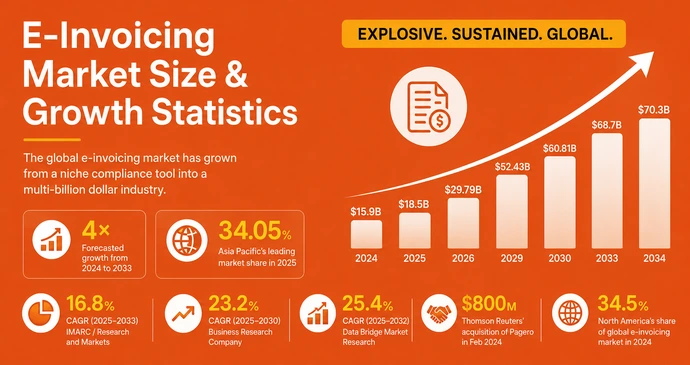
The global e-invoicing market has grown from a niche compliance tool into a multi-billion dollar industry. Multiple research firms track this market, and while their methodologies vary slightly, they all point in the same direction: explosive, sustained growth.
- $15.9 billion — Global e-invoicing market size in 2024 (IMARC Group / Research and Markets)
- $18.5 billion — Global e-invoicing market size in 2025 (IMARC Group 2026 report)
- $24.18 billion — Alternative 2025 market valuation (Business Research Company); grew from $19.64B in 2024 — a 23.1% jump
- $29.79 billion — Projected market in 2026 at a CAGR of 23.2% (Business Research Company)
- $52.43 billion — Forecast market value by 2029 (Business Research Company, 21.3% CAGR)
- $60.81 billion — Alternate 2030 projection at a CAGR of 19.5% (Business Research Company)
- $68.7 billion — Forecast market value by 2033, growing at 16.8% CAGR (IMARC Group / Research and Markets)
- $70.3 billion — Alternate 2034 projection by IMARC Group at 15.96% CAGR
- 16.8% — CAGR for the e-invoicing market from 2025–2033 (IMARC / Research and Markets)
- 23.2% — Higher CAGR estimate from Business Research Company (2025–2030)
- 25.4% — CAGR projection from Data Bridge Market Research (2025–2032)
- 4× growth — The e-invoicing market is forecast to quadruple in size from 2024 to 2033
- $800 million — Thomson Reuters’ acquisition of Pagero Group AB in February 2024, signaling the commercial value of e-invoicing infrastructure
- 34.5% — North America’s share of the global e-invoicing market in 2024 (Data Bridge Market Research)
- 34.05% — Asia Pacific’s leading global market share in 2025 (Maximize Market Research), up from 15–20% historically
Why the Wide Range in Market Estimates?
Different research firms define “e-invoicing market” differently. Some count only pure-play e-invoicing software vendors; others include AP/AR automation, EDI networks, and tax compliance platforms. All agree on the direction: rapid, regulatory-driven growth.
Global Invoice Volume Statistics
To appreciate the scale of what e-invoicing mandates are trying to digitize, you first need to understand how many invoices the world actually processes each year.
- 560 billion — Total invoices (paper + electronic) issued globally in 2024 (OpenPeppol 2025 report estimate)
- 280 billion — Estimated B2B, B2G, and G2B invoice exchanges out of the 560B total (OpenPeppol)
- ~90 billion — Of B2B/B2G/G2B volume, the approximate number that are electronic (roughly one-third), including PDFs that are not structured machine-readable invoices
- Less than 10% — Cross-border invoices as a share of total global invoice volume (OpenPeppol)
- 55 billion — Estimated e-invoices in 2019 (Billentis); by 2024 the number had more than doubled
- 125 billion — Estimated e-invoices processed in 2024 (Billentis), representing a CAGR of ~17.84% since 2019
- 20–30% — Share of all paper/traditional invoices that must be treated as “exceptions” during processing due to errors or discrepancies (Billentis)
- 30 days — India mandates that businesses with turnover above ₹10 crore report invoices to IRP within 30 days of issue date (from April 2025)
- 24 hours — ZATCA Saudi Arabia requires B2C simplified invoices to be reported to FATOORA within 24 hours of issuance
E-Invoicing Adoption Statistics by Region
Global
- 80+ countries have active or upcoming e-invoicing mandates as of 2026
- 65%+ of large-scale enterprises globally have already implemented e-invoicing solutions (Reanin Research)
- 74% of all EU businesses achieved a basic level of digital intensity in 2024 (Eurostat), accelerating e-invoicing uptake
Europe
- $1.78–1.9 billion — Europe e-invoicing market size in 2024 (IMARC Group)
- $5.93 billion — Europe e-invoicing market forecast for 2033 (Market Data Forecast)
- 14.31–14.77% — CAGR for Europe e-invoicing market 2025–2033
- 27% — Growth in cross-border B2B e-invoicing transactions in Europe between 2020 and 2022 (European Commission)
- 18% — Share of Croatian SMEs with certified e-invoicing solutions by early 2024 (Croatian Chamber of Economy) — highlighting the SME gap
- 99%+ — Share of businesses in Bulgaria and Croatia that are SMEs, meaning SME adoption lags are a systemically important problem in Eastern Europe
Asia Pacific
- 34.05% — APAC’s share of global e-invoicing market in 2025 (Maximize Market Research) — now the largest regional share
- 30% — Projected APAC market share by 2026
- $445.2 million — Australia’s e-invoicing market size in 2024 (IMARC Group)
- 410,000+ — Australian businesses registered on the PEPPOL network as of January 2025
- 129 — Australian government entities using the PEPPOL network as of January 2025
- Singapore, New Zealand, Malaysia, and Japan have adopted PEPPOL with “steep growth rates” (TrueCommerce)
- Singapore mandated GST InvoiceNow (PEPPOL-based) for GST-registered businesses from November 2025 onwards
Latin America
- Since 2019 — E-invoicing has been mandatory for all businesses in most Latin American countries (Brazil, Mexico, Chile, Peru, Ecuador, Colombia, Costa Rica)
- 10–15% — Latin America’s current share of global e-invoicing market
- ~50% — Reduction in VAT gap achieved by Brazil, Mexico, and Chile after rolling out continuous transaction control (CTC) e-invoicing
- Latin America is considered the world’s most mature e-invoicing ecosystem due to early government mandates starting in the early 2000s
United States
- The US has no federal B2B e-invoicing mandate as of 2026
- Adoption is voluntary and market-driven, primarily through the DBNAlliance (Digital Business Networks Alliance) — a PEPPOL-style four-corner network operational since 2024
- 35% — North America’s projected share of the global e-invoicing market (Reanin Research)
- Early adoption of procurement automation has laid groundwork for eventual mandate implementation
E-Invoicing Mandates by Country — 2026 Complete Reference Table
This is the most referenced table in this article. It maps every major mandate, its status, format, and key deadline. For compliance and legal decisions, always verify with official government sources.
| Country | Status | Scope | Format / Platform | Key Deadline | Penalty |
|---|---|---|---|---|---|
| India | LIVE | B2B + Exports (AATO > ₹5 Cr) | JSON via GSTN IRP · IRN + QR Code | Mandatory Aug 2023; 30-day IRP reporting from Apr 2025 | ₹10,000–25,000 per invoice; invalid ITC |
| Saudi Arabia | LIVE | All VAT-registered businesses | UBL 2.1 XML via FATOORA (ZATCA) | Phase 1: Dec 2021; Phase 2 (waves): 2022–2026; Wave 24 by Jun 2026 | Financial penalties; invoice invalidity |
| Italy | LIVE | All B2B + B2C (SdI platform) | FatturaPA XML via SDI | Mandatory since January 1, 2019 | Fines per non-compliant invoice |
| Romania | LIVE | B2B mandatory | e-Factura via ANAF | Mandatory since January 2024 | Fines for non-compliance |
| Belgium | LIVE | All B2B transactions | UBL 2.1 via PEPPOL | Mandatory from January 1, 2026 | €1,500–€5,000 per violation |
| Germany | LIVE (receive) | B2B; receiving mandatory since Jan 2025; issuance phased | XRechnung / ZUGFeRD | All must receive Jan 2025; large (>€800K) issue Jan 2027; all Jan 2028 | Grace period through 2026; penalties from 2027 |
| Poland | 2026 | All VAT-registered businesses | KSeF clearance system | Large (>PLN 200M): Feb 1, 2026; All others: Apr 1, 2026 | Fines for non-compliance |
| France | 2026 | All VAT-registered businesses (phased) | PDP certified platforms / Factur-X | Receive: Sep 1, 2026 (all); Issue large + mid: Sep 1, 2026; All: Sep 1, 2027 | Fines per non-compliant invoice |
| UAE | 2026 | B2B + B2G transactions | PINT AE (XML) via FTA-Accredited ASPs / 5-Corner PEPPOL | B2B + B2G mandatory from July 2026 | Up to AED 5,000/month for non-compliance |
| Spain | 2026–2027 | B2B mandatory (phased) | Verifactu / SIF | Large companies: July 2026; SMEs: Jan 2027 | Penalties apply from go-live dates |
| Croatia | LIVE | B2B mandatory | PEPPOL | Mandatory from January 2026 | Fines for non-compliance |
| Greece | LIVE | All VAT entities (myDATA) | myDATA real-time CTC | Mandatory March 2026 | Fines for non-reporting |
| Brazil | LIVE | All businesses (mandatory) | NF-e (Nota Fiscal Eletrônica) | Mandatory since 2008 for most sectors | Invoice invalidity; tax penalties |
| Mexico | LIVE | All taxpayers | CFDI (Comprobante Fiscal Digital por Internet) | Mandatory for all since 2013 | Tax penalties; deductibility loss |
| Singapore | LIVE | GST-registered businesses | InvoiceNow (PEPPOL) | GST InvoiceNow mandatory from Nov 2025 | Compliance obligations under IRAS |
| USA | VOLUNTARY | No federal mandate | DBNAlliance (PEPPOL-based) | No mandate date set | No penalties |
| UK | PLANNED | B2G (Making Tax Digital); B2B under consultation | MTD platform; PEPPOL B2B under review | Moving toward mandate to combat VAT fraud | MTD penalties apply; B2B TBD |
| Australia | B2G Live / B2B Voluntary | B2G mandatory for government suppliers; B2B voluntary | PEPPOL (PINT A-NZ) | B2G live; B2B no mandate date yet | B2G compliance requirements apply |
Sources: eInvoice.Global compliance tracker, ZATCA, GSTN India, European Commission, national tax authority publications. Always verify current status with the relevant authority before making compliance decisions.
GST E-Invoicing India — Complete Statistics
India’s GST e-invoicing mandate is one of the world’s most significant by taxpayer volume. Introduced in October 2020, the system has been progressively extended to cover smaller businesses every few months — making India a case study in phased regulatory rollout.
What GST E-Invoicing Is (and Is Not)
E-invoicing under GST does not mean the government generates invoices for you. It means your business-generated invoice must be submitted to the Invoice Registration Portal (IRP), validated, and returned with a unique Invoice Reference Number (IRN) and a QR code. Only after this can it be legally issued to your customer. An invoice without a valid IRN is treated as invalid under Rule 48(4) and the recipient cannot claim ITC.
India E-Invoicing Threshold Rollout Timeline
- October 2020 Mandatory for businesses with AATO above ₹500 crore
- January 2021 Extended to AATO above ₹100 crore
- April 2021 Extended to AATO above ₹50 crore
- April 2022 Extended to AATO above ₹20 crore
- October 2022 Extended to AATO above ₹10 crore
- August 1, 2023 Extended to AATO above ₹5 crore — current threshold
- November 2023 Mandatory 30-day IRP reporting window for AATO ≥ ₹100 crore
- April 1, 2025 30-day reporting extended to AATO ≥ ₹10 crore; 2FA mandatory for AATO > ₹100 crore
India E-Invoicing Key Statistics
- ₹5 crore (INR 50 million, ~€56,000) — Current annual aggregate turnover threshold triggering mandatory e-invoicing (since August 1, 2023)
- ₹10 crore — Turnover threshold above which businesses must report to IRP within 30 days of invoice date (from April 1, 2025)
- 30 days — Maximum time allowed for IRP submission under the latest rules for AATO ≥ ₹10 crore
- ₹10,000 — Minimum penalty per invoice for non-compliance under Section 122 of CGST Act 2017
- ₹25,000 — Maximum penalty per incorrect invoice under CGST rules
- 100% — Penalty as a percentage of tax amount (whichever is higher between ₹10,000 and 100% of tax)
- 5 IRPs — India operates through five Invoice Registration Portals to distribute the load across large invoice volumes
- September 2019 — GST Council first approved the e-invoicing standard at its 37th meeting
- September 2024 — GST Council (54th meeting) recommended a voluntary pilot for B2C e-invoicing, with a view to mandating if successful
- November 2024 — GSTN published Advisory No. 461 with a comprehensive e-invoicing glossary and step-by-step implementation guide
- JSON format — Required for IRP submission (not PDF or paper)
- An invoice without a valid IRN is treated as an invalid tax invoice — the recipient has no ITC entitlement
- E-invoicing data auto-populates GSTR-1 and triggers auto-generation of E-Way Bills for qualifying goods movement
- Businesses can use the GST Calculator on InvoPilot to compute GST liability before generating their e-invoice
Who Is Exempt from GST E-Invoicing?
Banks and financial institutions, insurance companies, GTA (Goods Transport Agencies) for specific services, passenger transport, multiplex cinema admissions, SEZ units (as suppliers), and government departments are currently exempt regardless of turnover. B2C invoices are also not covered under the current mandate.
Understanding the difference between a tax invoice and a standard invoice is crucial — see our comprehensive Tax Invoice Guide for the complete breakdown.
EU & PEPPOL E-Invoicing Statistics
EU ViDA (VAT in the Digital Age) Statistics
- March 11, 2025 — EU ViDA directive formally adopted by the Council of the EU
- April 14, 2025 — ViDA directive came into legal force
- 27 member states — All EU countries covered by ViDA’s unified digital reporting framework
- 2035 — Target year for full implementation of the ViDA framework across all member states
- Before ViDA — EU member states had to obtain a derogation from Brussels before mandating domestic B2B e-invoicing; ViDA removed this requirement
- 27% — Growth in cross-border B2B e-invoicing transactions in Europe between 2020 and 2022 (EU Commission)
PEPPOL Network Statistics
PEPPOL (Pan-European Public Procurement OnLine) is the backbone of e-invoicing interoperability across Europe and increasingly the world. It is governed by OpenPeppol, a non-profit organization.
- 46 — Countries and territories that are members of OpenPeppol as of November 2025
- 98 — Countries where the PEPPOL network connects organizations (broader than formal membership)
- 1.4 million — Organizations currently registered in the PEPPOL network globally
- 300+ — Certified PEPPOL Access Points that connect businesses to the network
- 20 — Countries that have their own national PEPPOL Authority (as of 2025)
- 40+ — Countries that have integrated PEPPOL into their national e-invoicing systems
- 80% — Share of companies in Flanders (Belgium) that hold a PEPPOL ID as of late January 2026
- 70% — Share of companies in Wallonia and Brussels (Belgium) with a PEPPOL ID as of late January 2026
- PEPPOL uses a 4-corner or 5-corner model — sender → sender’s Access Point → receiver’s Access Point → receiver (5-corner adds the tax authority)
- Common PEPPOL formats: UBL 2.1, UN/CEFACT CII, PINT (for international cross-border), PINT AE (UAE), PINT A-NZ (Australia/New Zealand)
- Italy’s SDI — Not PEPPOL-based; uses the centralized Sistema di Interscambio (SdI), processing 100% of B2B and B2C invoices since 2019
- France (DGFiP) — Designated as national PEPPOL Authority in July 2025, ahead of its September 2026 B2B mandate
Country-Specific EU Highlights
- Italy — First large EU economy with a full B2B + B2C e-invoicing mandate (since January 2019); widely considered the EU’s proof-of-concept
- Belgium — Over 1 million PEPPOL recipients registered by January 2026; B2B mandatory from January 1, 2026
- Germany — All businesses must receive e-invoices since January 2025; large companies (>€800K turnover) must issue from January 2027; universal issuance by January 2028; formats: XRechnung and ZUGFeRD
- Poland KSeF — Centralized clearance system; large taxpayers (>PLN 200M / ~€47M) from February 1, 2026; all VAT-registered from April 1, 2026
- France — All businesses must be capable of receiving e-invoices from September 1, 2026; large enterprises must also issue from that date; universal by September 2027
- Nordic countries (Sweden, Norway, Denmark, Finland) — Already require e-invoicing for B2G via PEPPOL; Norway pioneered B2G e-invoicing as early as 2012
For businesses receiving cross-border invoices, understanding the structure of a VAT-compliant invoice is critical — see our VAT Invoice Guide.
ZATCA Saudi Arabia E-Invoicing (FATOORA) Statistics
Saudi Arabia’s ZATCA (Zakat, Tax and Customs Authority) has built one of the world’s most technically sophisticated e-invoicing clearance systems, called FATOORA (also spelled Fatoorah). It is mandatory for all VAT-registered businesses in the Kingdom.
- December 4, 2021 — Phase 1 (Generation Phase) of FATOORA went live; all VAT-registered businesses required to generate structured electronic invoices
- 2022 onwards — Phase 2 (Integration Phase) began rolling out in waves; requires real-time clearance of invoices via ZATCA’s platform before delivery to buyers
- 23 waves — ZATCA had announced 23 Phase 2 integration waves by July 2025
- Wave 24 — Begins no later than June 30, 2026; applies to all VAT-registered taxpayers with VAT-taxable revenue exceeding SAR 750,000 in 2022, 2023, or 2024
- SAR 3 billion — Revenue threshold for the first Phase 2 integration wave (Wave 1, effective January 2023); showing the top-down rollout strategy
- SAR 750,000 — The threshold drops down to this level by Wave 24, bringing the vast majority of Saudi businesses into compliance
- 100% — Share of VAT invoices requiring a QR code and cryptographic stamp; B2B invoices additionally require ZATCA clearance before reaching the buyer
- 24 hours — Maximum time for B2C simplified invoice data to be reported to FATOORA after issuance
- UBL 2.1 — The XML format required by FATOORA (aligned with EN 16931 European standard)
- Real-time clearance — B2B invoices must be submitted to ZATCA, validated, cryptographically stamped, and cleared before they can be sent to the customer
- Near-real-time reporting — B2C simplified invoices use an e-reporting model (issued first, reported to FATOORA within 24 hours)
- The FATOORA system makes Saudi Arabia one of a small number of countries globally with a full clearance model for B2B transactions
ZATCA FATOORA: Two Invoice Types
Saudi e-invoicing distinguishes between Tax Invoices (B2B and B2G — full clearance required before delivery) and Simplified Tax Invoices (B2C — issued directly to customer, then reported to FATOORA within 24 hours). Both require QR codes and cryptographic stamps.
Latin America E-Invoicing Statistics
Latin America is the world’s most mature e-invoicing jurisdiction. These economies moved first — and the results have been transformative for tax collection and economic efficiency.
- Early 2000s — Latin America began mandating e-invoicing, with Mexico pioneering CFDI and Brazil pioneering NF-e
- Since 2019 — E-invoicing has been mandatory for all businesses in most Latin American countries (Brazil, Peru, Ecuador, Colombia, Costa Rica)
- ~50% — Reduction in VAT gap achieved collectively by Brazil, Mexico, and Chile after full continuous transaction control (CTC) e-invoicing rollout
- Brazil NF-e — One of the world’s oldest mandatory e-invoicing systems; has processed billions of invoices annually for over a decade
- Mexico CFDI — Comprobante Fiscal Digital por Internet; mandatory for all taxpayers since 2013; real-time SAT (tax authority) validation required
- 100% of e-invoices in Latin America require digital signatures from an accredited certification authority
- The success of Latin American CTC models — particularly the dramatic VAT gap reductions — has directly influenced Europe’s ViDA design and Middle East implementation
- 10–15% — Latin America’s current share of the global e-invoicing market, but it punches above its weight in transaction volume and mandate maturity
E-Invoicing Cost Savings & Efficiency Statistics
The business case for e-invoicing is not just about compliance — it’s one of the most effective cost-reduction levers in finance operations. Billentis, the world’s leading independent e-invoicing research firm, has documented these savings across hundreds of enterprise case studies.
- 60–80% — Cost reduction in invoice processing compared to traditional paper-based invoicing (Billentis)
- €6.40 per invoice — Average savings for invoice issuers switching from paper to e-invoicing (Billentis)
- ~€10 per invoice — Average savings for invoice receivers switching from paper to e-invoicing (Billentis)
- 59% — Cost saving for invoice issuers in a Billentis case study of a company with 5,000 employees
- 64% — Cost saving for invoice receivers in the same 5,000-employee Billentis case study
- 6–18 months — Typical payback period (ROI recovery) after implementing e-invoicing (Billentis; stated as 0.5–1.5 years)
- 32% — Average reduction in Days Sales Outstanding (DSO) from automating accounts receivable with e-invoicing at its core (cited by Pagero)
- 19 days — The actual number of days saved on average in DSO from that AR automation (translating the 32% reduction)
- 20–30% — Share of traditional (paper or PDF) invoices that must be treated as exceptions during processing due to errors or missing data (Billentis)
- Zero manual data entry — E-invoices auto-populate ERP and accounting systems via structured XML fields, eliminating re-keying
- Fewer disputes — Because e-invoices are validated at point of creation, discrepancy rates drop sharply, reducing collection cycles
- Faster payments — Buyers receive clean, validated invoices that can be auto-matched to POs, reducing approval cycles from days to hours
What Does 60–80% Savings Really Mean?
If your business currently spends €15 per invoice processed (a common mid-market benchmark including labor, postage, storage, exceptions, and approval cycles), switching to e-invoicing could reduce that to €3–€6 per invoice. At 500 invoices per month, that’s a saving of €4,500–€6,000 monthly, or €54,000–€72,000 per year.
E-invoicing is also transforming how businesses manage cash — for deeper data see our Small Business Cash Flow Statistics report.
Invoice Processing Time Savings
- Manual paper invoice processing typically takes 10–15 business days from receipt to payment approval in most organizations
- Automated e-invoice processing can reduce this to 2–5 days for matched invoices, and near-zero for fully automated straight-through processing
- E-way bill auto-generation in India (triggered by e-invoice data) eliminates a separate manual step for goods-transporting businesses
- E-invoicing auto-reporting into GSTR-1 in India reduces month-end reconciliation time significantly for large filers
For context on how invoice processing workflows function end-to-end, see our Invoice Processing Complete Guide.
Environmental Impact of E-Invoicing — Statistics
- 550 billion+ — Invoices sent globally each year (Billentis); the paper, printing, and postage for even a fraction of this represents enormous environmental impact
- E-invoicing eliminates the need for paper, printing, envelopes, physical transportation, and physical storage — removing multiple carbon-intensive steps from the invoicing lifecycle
- No vehicles on the road for invoice delivery means reduced fuel consumption and lower emissions
- Some buyers now explicitly request or require electronic invoices as part of their sustainability commitments and supply chain ESG reporting
- Paper archival of invoices requires physical space and ongoing maintenance costs; e-invoice archiving is digital, scalable, and cheaper
- Required archival periods vary: 8 years in India, 5–9 years in UAE (depending on taxpayer status), 10 years in France — e-invoicing makes long-term storage dramatically more cost-effective
- The European Commission has cited environmental benefits as one of the supporting rationales for the ViDA directive
SME vs. Enterprise E-Invoicing Adoption Statistics
- 65%+ — Implementation rate among large-scale enterprises globally (Reanin Research)
- 18% — Share of Croatian SMEs with certified e-invoicing solutions by early 2024 (Croatian Chamber of Economy) — showing the stark SME gap in less-digitized EU markets
- 63% — Share of EU SMEs without dedicated cybersecurity personnel by 2024 (European Banking Authority), making secure e-invoicing infrastructure adoption more complex
- 99%+ — Share of businesses in Bulgaria and Croatia that are SMEs — meaning SME adoption is the determining factor for national mandate success in Eastern Europe
- High upfront implementation costs and technical ERP integration challenges are the primary barriers for SMEs in price-sensitive regions
- Many national mandates (India, EU) offer government-operated free portals (GSTN IRP, Chorus Pro in France) specifically to lower SME barriers
- India’s ₹5 crore threshold — approximately €56,000 in annual turnover — is specifically designed to cover a broad swath of the business population while leaving micro-enterprises initially exempt
- Voluntary adoption is highest among SMEs when it directly reduces late payment risk — a persistent problem globally (see our Late Payment Statistics)
E-Invoicing & Tax Fraud Reduction Statistics
The Scale of Invoice Fraud Problem
Invoice fraud — fake invoices, inflated claims, phantom suppliers, and ghost invoicing — costs governments and businesses billions annually. E-invoicing, especially with real-time tax authority clearance, directly attacks this problem at source by making every transaction visible to the tax authority in real time.
- ~50% — Estimated reduction in VAT gap achieved by Brazil, Mexico, and Chile after implementing CTC e-invoicing — the most cited proof point for anti-fraud effectiveness
- Fake ITC claims — India’s IRP system prevents fake Input Tax Credit claims because only verified IRN-bearing invoices are valid for ITC; this was one of the primary drivers of the GSTN e-invoicing mandate
- Zero duplication — The IRN system in India is globally unique; once an invoice’s hash is registered, no identical invoice can be re-registered, eliminating duplicate invoice fraud
- Real-time visibility — ZATCA’s clearance model in Saudi Arabia means ZATCA sees every B2B invoice before it reaches the buyer, making systematic tax fraud structurally impossible
- VAT gap reduction — Italy reduced its VAT gap measurably after implementing SdI mandatory e-invoicing in 2019; the European Commission reported on this in its 2024 review of Directive 2014/55/EU
- UK mandate motivation — The UK is moving toward a B2B e-invoicing mandate explicitly to combat VAT fraud (stated by HMRC as a primary objective)
- E-invoicing MNCs (multinational corporations) have avoided millions of dollars in fines and penalties from invoicing fraud by implementing e-invoicing controls (JISEM Journal case study)
- Cryptographic stamps and QR codes on ZATCA and GSTN invoices allow buyers to instantly verify invoice authenticity via government apps — eliminating supplier impersonation attacks
For more data on payment fraud and delays that e-invoicing helps address, see our Invoice Payment Statistics.
Future Outlook & E-Invoicing Forecast Statistics
Market Size Projections
- $29.79 billion — 2026 forecast (Business Research Company, 23.2% CAGR)
- $50.1 billion — 2033 forecast (Dataintelo, 18.2% CAGR)
- $52.43 billion — 2029 forecast (Business Research Company)
- $55.99 billion — 2029 forecast (GII Research / Business Research Company, 23.2% CAGR)
- $60.81 billion — 2030 forecast (Business Research Company, 19.5% CAGR)
- $61.72 billion — 2031 forecast (Reanin Research, 21.6% CAGR)
- $68.7 billion — 2033 forecast (IMARC Group / Research and Markets, 16.8% CAGR)
- $70.3 billion — 2034 forecast (IMARC Group, 15.96% CAGR)
Upcoming Mandates & Regulatory Events
- June 30, 2026 — ZATCA Wave 24 deadline (Saudi Arabia) — brings businesses with SAR 750,000+ revenue into mandatory FATOORA integration
- July 2026 — UAE B2B and B2G e-invoicing becomes mandatory via FTA-accredited ASPs
- September 1, 2026 — France: all businesses must be capable of receiving e-invoices; large and mid-sized enterprises must also issue them
- January 2027 — Germany: large businesses (>€800K turnover) must issue e-invoices
- January 2028 — Germany: universal issuance obligation for all businesses
- September 2027 — France: universal issuance + e-reporting for all VAT-registered businesses
- 2028 onwards — Belgium plans to evolve to a 5-corner model adding near-real-time tax authority reporting on top of the existing PEPPOL exchange
- 2035 — Full EU ViDA framework implementation target across all 27 member states
- Qatar — Planning e-invoicing as part of its National Vision 2030 and anticipated VAT implementation; groundwork in progress
- Oman & Bahrain — Both countries in active planning phases for e-invoicing mandates in 2025–2026
- India B2C — GSTN piloting voluntary B2C e-invoicing; if successful, a mandate is expected — this would be one of the largest expansions of any national e-invoicing system globally
Technology Trends Shaping E-Invoicing’s Future
- AI-driven invoice analytics — Automated anomaly detection, fraud scoring, and payment term optimization
- Blockchain integration — Immutable invoice ledgers for multi-party audit trails in complex supply chains
- Mobile invoicing — Growing adoption of invoice creation and approval via mobile apps, especially in APAC
- Interoperability standards — PINT (PEPPOL International Invoice) expanding cross-border compatibility beyond Europe
- Real-time payment integration — Direct connection between e-invoice receipt and instant payment execution (Request-to-Pay)
Is Your Business Ready?
Whether you need to comply with India’s GST IRP, Saudi ZATCA, EU PEPPOL, or simply want to modernize your billing operations, the first step is understanding what a proper electronic invoice looks like. Our free Invoice Generator creates GST-ready, multi-currency invoices instantly. For VAT-compliant international invoicing, our Commercial Invoice Guide covers all the required fields.
Frequently Asked Questions (FAQ)
What is e-invoicing?
E-invoicing (electronic invoicing) is the process of creating, transmitting, receiving, and processing invoices in a structured, machine-readable digital format — typically XML or JSON — that can be automatically processed by accounting and ERP systems. Importantly, a PDF of an invoice is not an e-invoice in the regulatory sense; a true e-invoice has structured data fields that machines can read and validate without human intervention. Most mandates require invoices to also be validated by a tax authority portal (like India’s IRP, Italy’s SDI, or Saudi’s FATOORA) before or after delivery to the buyer.
What is the global e-invoicing market size in 2026?
The global e-invoicing market was valued at approximately $24.18 billion in 2025 and is projected to reach $29.79 billion in 2026, growing at a CAGR of 23.2% (Business Research Company). A second estimate from IMARC Group puts the 2025 market at $18.5 billion and projects $70.3 billion by 2034 at 15.96% CAGR. Both agree on the trajectory: rapid, sustained growth driven by regulatory mandates and digital transformation.
Which countries have mandatory e-invoicing in 2026?
As of 2026, mandatory B2B e-invoicing is either fully live or being phased in a significant number of countries. Key live mandates include: India (AATO > ₹5 crore since Aug 2023), Saudi Arabia (ZATCA FATOORA — all VAT-registered), Italy (since Jan 2019), Romania (since Jan 2024), Belgium (from Jan 1, 2026), Croatia (Jan 2026), Poland (from Feb 2026 for large taxpayers), Germany (receiving mandatory since Jan 2025), and Brazil and Mexico (since 2013/2008). New 2026 live mandates: UAE (Jul 2026), France (receiving: Sep 1, 2026), Spain (Jul 2026 for large companies), and Greece (myDATA — Mar 2026).
How much does e-invoicing save businesses?
According to Billentis, the world’s leading e-invoicing research firm, businesses save 60–80% of invoice processing costs when switching from paper to e-invoicing. Specifically, invoice issuers save approximately €6.40 per invoice and receivers save approximately €10 per invoice. The typical ROI payback period is 6–18 months. Additionally, automating accounts receivable with e-invoicing at its core reduces Days Sales Outstanding (DSO) by an average of 32%, or roughly 19 days.
What is the GST e-invoicing threshold in India in 2026?
As of August 1, 2023 (and still applicable in 2026), GST e-invoicing is mandatory for all businesses with Annual Aggregate Turnover (AATO) exceeding ₹5 crore. Businesses with AATO above ₹10 crore must additionally report their invoices to the GSTN Invoice Registration Portal (IRP) within 30 days of the invoice date, a requirement effective from April 1, 2025. B2C transactions are currently not mandated, though a voluntary pilot is underway.
What is the PEPPOL network and how many companies use it?
PEPPOL (Pan-European Public Procurement OnLine) is a decentralized, interoperable network for exchanging electronic business documents (invoices, orders, credit notes) governed by OpenPeppol, a non-profit. As of late 2025, 46 countries and territories are OpenPeppol members, 1.4 million organizations are registered on the network, and 300+ certified Access Points connect them. PEPPOL uses a 4-corner or 5-corner model and is the dominant standard for B2G and increasingly B2B e-invoicing across Europe, Australia, New Zealand, Singapore, and the UAE.
What is ZATCA’s FATOORA and how does it work?
FATOORA is Saudi Arabia’s e-invoicing compliance platform operated by ZATCA. Phase 1 (since Dec 2021) required all VAT-registered businesses to generate structured XML (UBL 2.1) invoices with QR codes. Phase 2 (rolling out in waves since 2022) adds real-time clearance: for B2B transactions, the invoice must be submitted to FATOORA, validated, cryptographically stamped, and returned before the seller can deliver it to the buyer. B2C simplified invoices are issued first, then reported to FATOORA within 24 hours. By Wave 24 (June 2026), all businesses with VAT-taxable revenue above SAR 750,000 must be integrated.
What is the EU ViDA directive?
The EU VAT in the Digital Age (ViDA) directive (formally Directive EU 2025/516) was adopted on March 11, 2025, and came into force on April 14, 2025. It establishes a unified digital reporting framework for all 27 EU member states, removing the requirement for member states to seek derogation from Brussels before implementing domestic e-invoicing mandates. The ViDA framework will be progressively implemented through 2035, enabling and coordinating the national mandates being launched by France, Germany, Belgium, Poland, Spain, and others in 2026–2028.
What is electronic invoicing vs. paper invoicing?
Paper invoicing involves creating, printing, and physically (or via PDF email) sending a document that must be manually re-entered by the recipient. Electronic invoicing uses structured digital formats (XML, JSON, UBL) that flow directly between systems. Key differences: e-invoices are machine-readable without re-keying; they are validated by tax authority portals in many jurisdictions; they carry QR codes and cryptographic stamps for authenticity verification; and they cost 60–80% less to process. For a detailed comparison, see our Paper vs. Electronic Invoice guide.
What is invoice financing and how does e-invoicing affect it?
Invoice financing allows businesses to borrow against outstanding invoices to improve cash flow. E-invoicing makes invoice financing faster and more reliable: verified, government-stamped e-invoices (like IRN-bearing invoices in India) are provably authentic, making lenders more confident. Real-time IRP data can also enable auto-triggered financing offers. For more, see our Invoice Financing Guide.
How many invoices are issued globally each year?
According to the OpenPeppol 2025 report, approximately 560 billion invoices (paper + electronic) were issued worldwide in 2024. Of these, about 280 billion are B2B, B2G, and G2B exchanges. Only around 90 billion of those are fully electronic — roughly one-third. This means the majority of global B2B invoicing is still paper-based or PDF-based, representing the enormous opportunity (and regulatory pressure) driving e-invoicing adoption.
Data Sources & References
All statistics in this article are drawn from the following authoritative sources. External links used once each per editorial policy.
- Billentis — E-Invoicing / E-Billing Business Case & Market Reports (Bruno Koch)
- IMARC Group — E-Invoicing Market Size, Share and Global Report 2034
- The Business Research Company — E-Invoicing Global Market Report 2026
- OpenPeppol — OpenPeppol AISBL 2025 Annual Report & Network Statistics
- GSTN India (e-Invoice System) — Official e-invoicing portal and advisories
- ZATCA Saudi Arabia — FATOORA mandate documentation and wave criteria
- EUR-Lex / European Commission — EU ViDA Directive 2025/516 and effects of Directive 2014/55/EU
- HighRadius — E-Invoicing Trends Across Countries (2024 analysis)
- Data Bridge Market Research — Electronic Invoicing Market Report 2025–2032
- European Commission — Thematic Report on E-Invoicing and Late Payments
- Maximize Market Research — E-Invoicing Market Size and Growth Forecast 2025–2032
- Market Data Forecast — Europe E-Invoicing Market 2025–2033
- Reanin Research — E-Invoicing Market Size to reach USD 61,723.97 Mn by 2031