
Every other guide tells you to “pick a skill and join Upwork.” This one tells you why that advice fails 80% of beginners — and what actually works in the Indian market in 2026.
Here’s the truth nobody puts in a blog post: most Indian freelancers quit within 6 months — not because they lacked skill, but because they got generic advice that was written for a US audience, then copy-pasted a hundred times. This guide was written specifically for the Indian market, with real numbers, real pitfalls, and no motivational fluff.
Before We Begin –
MYTH VS. REALITY
Before you read one more “step 1: find your skill” article, let’s clear the air. Here’s what freelancing blogs sell you — and what’s actually waiting on the other side.
| ❌ The Myth “Start freelancing and be your own boss from day one.” Week 1 is mostly: refreshing your Upwork profile, writing proposals nobody reads, and wondering if you made a mistake. | ✓ The Reality The first 4–8 weeks are slow. That’s completely normal. Every successful freelancer went through a dry spell. The ones who made it didn’t quit during it. |
| ❌ The Myth “You can earn ₹1 lakh/month in 3 months.” Some YouTube thumbnails love this claim. The reality: ₹10,000–₹30,000 is a strong beginner month. ₹1L takes consistent effort over 6–12 months. | ✓ The Reality Slow and steady genuinely wins here. Freelancers who focused on one skill, one niche, and consistent outreach for 6 months consistently outearned those chasing shortcuts. |
| ❌ The Myth “Just join Upwork and clients will find you.” Upwork has millions of freelancers. A blank profile gets zero views. You need to actively hunt, especially at the start. | ✓ The Reality Your first client almost never comes from a platform. It comes from a WhatsApp group, a college connection, a LinkedIn message, or a local business you walked into. Start close, expand outward. |
WHAT OTHER’S WONT TELL YOU –
Studies show that 58% of Indian freelancers have experienced not getting paid for completed work. And 66% globally say finding enough work is their #1 challenge. This guide addresses both problems directly — because most guides don’t mention them at all.
Whether you’re tired of your 9-to-5 or simply want to earn extra income on your terms — freelancing is one of the fastest ways to take control of your career. In this guide, you’ll learn exactly how to become a freelancer from scratch, even with zero prior experience.
What Is Freelancing? (Quick Overview)
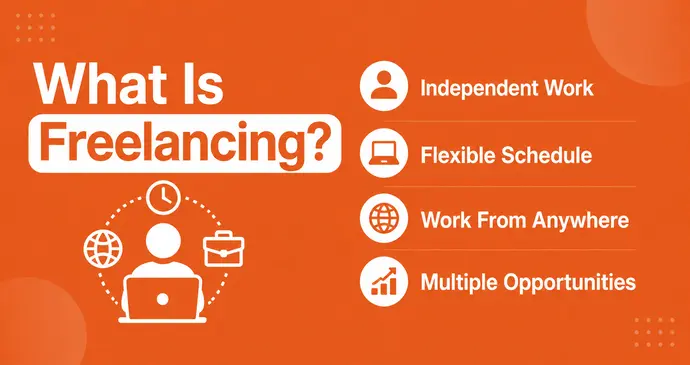
Freelancing means working independently for multiple clients rather than being employed by a single company. As a freelancer, you choose your clients, set your rates, and work on your schedule.
Freelancing spans across hundreds of fields — from writing and graphic design to software development, digital marketing, video editing, and more. The global freelance market is growing fast. According to Upwork’s Freelance Forward report, over 59 million Americans freelanced in 2023, contributing $1.27 trillion to the economy.
How can you Become a Freelancer?
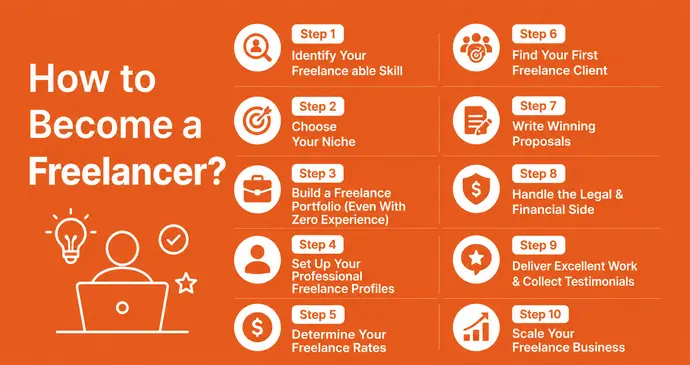
Step 1: Identify Your Freelance able Skill
The first step to becoming a freelancer is figuring out what skill you can sell.
Ask yourself:
- What do I already do well?
- What would people or businesses pay for?
- Can I deliver this skill remotely?
Top Freelance Skills in Demand (2026)
| Category | Skills |
| Tech | Web development, app development, AI/ML, cybersecurity |
| Design | Graphic design, UI/UX, logo design, video editing |
| Writing | Content writing, copywriting, technical writing, SEO |
| Marketing | Social media management, SEO, email marketing, PPC |
| Finance | Bookkeeping, accounting, financial modeling |
| Admin | Virtual assistance, data entry, project management |
Pro Tip: You don’t need to be the best in the world at something. You just need to be good enough to solve a real problem for a real client.
Step 2: Choose Your Niche
“Riches are in niches” — this is especially true in freelancing.
Instead of offering “graphic design,” offer “logo design for SaaS startups”. Instead of “content writing,” offer “SEO blog writing for health & wellness brands”.
A tighter niche means:
- Higher perceived expertise
- Less competition
- Easier to find the right clients
- Ability to charge premium rates
How to pick your niche:
- Combine your skill with an industry you understand
- Research if businesses in that industry spend money on your skill
- Check if there’s demand on platforms like Upwork, LinkedIn, or job boards
Step 3: Build a Freelance Portfolio (Even With Zero Experience)
Your portfolio is your #1 sales tool. Without it, convincing clients to hire you is extremely difficult.
Ways to build a portfolio from scratch:
A. Create Sample Projects
Design a fake logo, write a sample blog post, or build a demo website. Clients care about quality, not whether the project was real.
B. Work for Free (Selectively)
Offer your services to 1–2 nonprofits or small businesses in exchange for a testimonial and the ability to display the work.
C. Freelance Platforms for Beginners
Platforms like Fiverr let you list services even with no reviews. Getting your first 3–5 reviews builds momentum fast.
D. Personal Projects
Start a blog, a YouTube channel, or design your own brand identity. These count as portfolio pieces.
Where to host your portfolio:
- Personal Website (most professional) — use tools like WordPress, Webflow, or Carrd
- Behance (designers)
- GitHub (developers)
- Contently (writers)
- LinkedIn (universal)
Step 4: Set Up Your Professional Freelance Profiles
Once you have portfolio pieces, set up profiles on the right platforms.
Top Freelance Platforms in 2026
| Platform | Best For | Fee Structure |
| Upwork | Tech, writing, design, marketing | 10–20% commission |
| Fiverr | Beginners, quick gigs | 20% commission |
| Toptal | Top 3% professionals | Screened, premium clients |
| Professional networking | Free (Premium optional) | |
| PeoplePerHour | European clients | Commission-based |
| Contra | Zero commission | Free |
| 99designs | Designers | Contest + project-based |
Optimizing Your Upwork/Fiverr Profile:
- Use a professional headshot
- Write a headline with your main keyword (e.g., “SEO Content Writer for SaaS & Tech Brands”)
- Describe the outcome you deliver, not just your skill
- Add portfolio samples immediately
- Set competitive starting rates to get initial reviews
Step 5: Determine Your Freelance Rates
Pricing is where most beginners make mistakes — either charging too little (devaluing yourself) or too much (losing clients).
Common Freelance Pricing Models:
Hourly Rate
Best for: Long-term projects, consulting, when scope is unclear Formula: Desired annual income ÷ billable hours per year Example: ₹15L/year ÷ 1,000 billable hours = ₹1,500/hour
Per-Project Rate
Best for: Defined deliverables (logos, websites, articles) Research: Check what competitors charge on Upwork/Fiverr for the same service
Retainer
Best for: Ongoing monthly work (SEO, social media, bookkeeping) Benefit: Predictable income for both you and the client
Beginner Freelance Rate Guide (India, 2026)
| Skill | Beginner Rate | Experienced Rate |
| Content Writing | ₹1–3/word | ₹5–10/word |
| Graphic Design | ₹500–2,000/project | ₹5,000–25,000/project |
| Web Development | ₹15,000–40,000/site | ₹1L–5L+/site |
| Social Media Mgmt | ₹5,000–10,000/month | ₹25,000–75,000/month |
| SEO Services | ₹8,000–15,000/month | ₹30,000–1L+/month |
Important: Never race to the bottom on pricing. Cheap rates attract difficult clients and drain your energy.
Step 6: Find Your First Freelance Client
This is the hardest step — but once you land your first paying client, the rest gets easier.
Best ways to find freelance clients:
1. Freelance Job Boards
- Upwork, Fiverr, Freelancer.com, Toptal
- LinkedIn Jobs (filter for “Contract” or “Freelance“)
- We Work Remotely, Remote OK
2. Cold Outreach
Identify 10–20 businesses who need your service. Send them a personalized, value-focused email (not a generic pitch).
Cold Email Template:
Subject: Quick idea for [Company Name]’s blog
Hi [Name],
I noticed [Company Name] publishes content on [topic], but I spotted a few gaps
that your competitors are ranking for. I’m a freelance SEO writer who specializes
in [their industry].
I’d love to send you a free content brief as a sample of my work. Would that be helpful?
[Your Name]
3. LinkedIn Outreach
- Optimize your LinkedIn headline and about section
- Post about your expertise weekly (builds authority)
- Connect with decision-makers in your target industry
- DM with a genuine compliment + specific offer
4. Referrals
Ask friends, family, ex-colleagues, or professors to refer you. Tell them exactly what you do and who you help.
5. Facebook & Reddit Groups
Many businesses post in industry-specific Facebook groups or subreddits looking for freelancers.
Step 7: Write Winning Proposals
On platforms like Upwork, your proposal is everything. Most freelancers send generic copy-paste proposals — stand out by being specific.
Winning Proposal Formula:
- Start with their problem, not your skills — Show you read and understood their brief
- Demonstrate relevant experience — Link a specific portfolio piece that matches their need
- Outline your approach — Give them a 3-step plan you’d use for their project
- Call to action — End with a simple question or invitation to discuss
Example Opening (Good):
“I saw you’re looking for a website redesign for your e-commerce store. I noticed your current site isn’t optimized for mobile — which is likely affecting your conversion rate. I recently redesigned [similar store] and they saw a 34% increase in mobile purchases. Here’s how I’d approach yours…”
Example Opening (Bad):
“Hi, I am an experienced web designer with 5 years of experience. I can do this project. Please check my portfolio.”
Step 8: Handle the Legal & Financial Side
Many freelancers skip this — don’t make that mistake.
In India:
- Registration: Register as a sole proprietor or under LLP/Pvt. Ltd for credibility
- GST: Required if annual turnover exceeds ₹20 lakhs (₹10L for some states)
- Invoicing: Always send professional invoices with payment terms (Net 15, Net 30)
- Contracts: Use a simple freelance contract for every project (scope, payment, revision policy)
- Taxes: Set aside 25–30% of income for taxes. Consult a CA.
Use Tools to Manage Finances:
- InvoPilot — for invoicing, tracking payments, and managing clients
- Zoho Books / FreshBooks — accounting
- Notion / Trello — project management
Step 9: Deliver Excellent Work & Collect Testimonials
After you deliver a project:
- Send a client satisfaction check email
- Ask for a 5-star review on the platform you used
- Request a LinkedIn recommendation
- Ask if they know anyone else who might need your services
1 glowing testimonial is worth 10 self-promotional posts.
Step 10: Scale Your Freelance Business
Once you’re consistently getting clients:
- Raise your rates every 3–6 months
- Specialize further to command premium pricing
- Hire subcontractors for work overflow
- Create digital products (templates, courses, ebooks)
- Build a personal brand through content marketing
Common Mistakes to Avoid as a New Freelancer
- Undercharging — sets a bad precedent, attracts bad clients
- No contract — always protect yourself in writing
- Working without upfront payment — at minimum, take 30–50% upfront. Consider interim invoices for long projects.
- Ignoring taxes — don’t get caught off guard at year-end
- Being a generalist — niching down = faster growth
- Waiting until the portfolio is “perfect” — start before you’re ready
Tools Every Freelancer Needs in 2026
| Purpose | Tool |
| Invoicing & Payments | InvoPilot, FreshBooks |
| Contracts | Bonsai, AND.CO |
| Communication | Slack, Zoom |
| Project Management | Trello, Notion, Asana |
| Time Tracking | Toggl, Clockify |
| Design | Canva, Figma |
| Writing | Grammarly, Hemingway Editor |
| Storage | Google Drive, Dropbox |
How Long Does It Take to Become a Freelancer?
| Milestone | Typical Timeline |
| First profile created | Day 1 |
| First proposal sent | Week 1 |
| First paid client | Week 2–8 |
| Consistent income | Month 3–6 |
| Full-time freelancing | Month 6–12 |
Results vary based on your skill, effort, and niche demand. The most important factor is consistency.
Conclusion
Becoming a freelancer is one of the best decisions you can make for your career and lifestyle. The path isn’t without challenges — but with the right skill, the right positioning, and consistent effort, you can build a thriving freelance business.
Here’s your quick recap:
- Identify a marketable skill
- Choose a specific niche
- Build your portfolio
- Set up your professional profiles
- Price your services correctly
- Find clients through multiple channels
- Write winning proposals
- Handle legal & financial setup
- Deliver great work, collect testimonials
- Scale your income
Create Invoices Instantly – Free & Easy!
Generate professional invoices in seconds with our Free Online Invoice Generator.
👉 Try the Invoice Generator Now