
Quick answer: Invoice factoring is when a business sells its unpaid invoices to a third party company called a “factor” in exchange for immediate cash. It is usually 70–95% of the invoice value within 24–48 hours. The factor then collects payment directly from your customer and sends you the rest, minus a fee. It isn’t a loan. You aren’t borrowing money, you’re selling an asset you already own – the money someone already owes you.
If you’ve ever finished a job, sent the invoice, and then spent the next 45 days chasing a client for payment while your own bills kept coming, you already understand why invoice factoring exists. This guide walks through exactly how it works, what it actually costs, which industries use it most, how to qualify, and how to pick a factoring company that won’t bury you in fine print.
What Is Invoice Factoring?
Invoice factoring also known as accounts receivable factoring. It is a financing method where a business sells its outstanding, unpaid invoices to a factoring company at a discount. In return, the business gets most of that cash immediately instead of waiting the usual 30, 60, or 90 days for the customer to pay.
Three parties are involved in every factoring deal:
- You (seller) – the business that delivered goods or services and issued the invoice
- Your customer (debtor) – the company that owes payment on that invoice
- The factor – the finance company that buys invoice and takes on the job of collecting from your customer
The thing that separates factoring from a business loan is ownership. When you take a loan, you’re borrowing against future income and paying it back with interest. When you factor an invoice, you’re selling an asset, the invoice itself for less than its face value. There’s no debt added to your balance sheet, and no monthly repayment schedule to manage.
How Does Invoice Factoring Work Step by Step?
Invoice factoring almost always follows the same 4 step process, whether you’re a trucking company or a staffing agency:
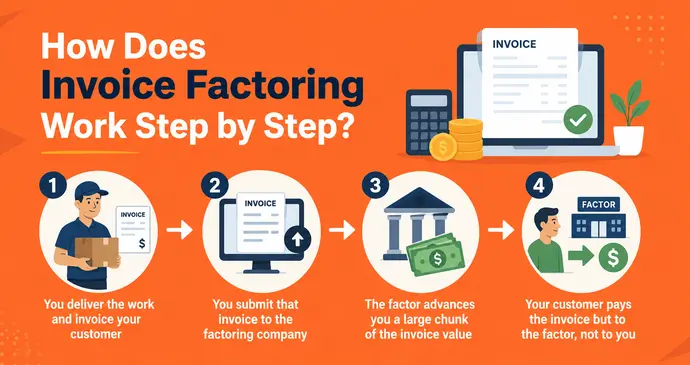
- You deliver the work and invoice your customer – You complete the job or ship the product, then create and send a standard invoice with your normal payment terms (e.g., Net 30).
- You submit that invoice to the factoring company – The factor reviews the invoice and checks the creditworthiness of your customer not just your business, since they’re the one who ultimately has to pay.
- The factor advances you a large chunk of the invoice value – Typically 70 to 95% of the invoice amount lands in your account within 24 to 48 hours.
- Your customer pays the invoice but to the factor, not to you – Once the invoice is paid in full, the factor releases the remaining balance (the “reserve”) to you, minus their fee.
A Real-Life Example
Say a commercial cleaning company, Bright Line Cleaning Co., completes a $20,000 monthly contract for an office park. Their client pays on Net 45 terms, but payroll for the cleaning crew is due every two weeks long before that invoice clears.
- Bright Line factors the $20,000 invoice with an 85% advance rate and a 3% factoring fee.
- Day 1: The factor wires $17,000 (85% advance).
- Day 45: The client pays the full $20,000 to the factor.
- The factor deducts its $600 fee (3% of $20,000) and releases the remaining $2,400 reserve to Bright Line.
- Total received: $19,400 but $17,000 of it arrived 44 days earlier than it otherwise would have.
That timing is the entire point. Bright Line didn’t take on debt; it paid $600 to unlock cash it had already earned, weeks sooner.
Invoice Factoring vs Invoice Financing vs Invoice Discounting
These three terms get used interchangeably online, but they aren’t the same thing. Here’s how they actually differ:
| Invoice Factoring | Invoice Discounting | Invoice Financing (general) | |
|---|---|---|---|
| Who owns the invoice | Sold to the factor | Stays with you | Depends on structure |
| Who collects from the customer | The factoring company | You, as usual | Varies |
| Does the customer know? | Usually yes | Usually no (confidential) | Varies |
| Best for | Businesses that don’t mind outsourcing collections | Businesses that want to keep client relationships in-house | Broad umbrella term covering both |
If you want the fastest cash with the least admin work and don’t mind your customer knowing a third party is involved, factoring is usually the simpler route. If keeping the relationship purely between you and your client matters more, read our full breakdown of invoice discounting and invoice financing to compare. Factoring is also closely related to invoice trading, a newer online marketplace model where multiple investors bid to fund your invoices.
Types of Invoice Factoring
Not all factoring arrangements look the same. Here are the main variations you’ll run into:
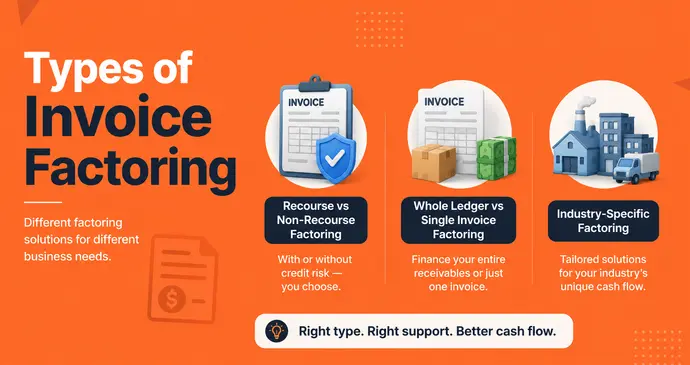
Recourse vs Non-Recourse Factoring
- Recourse factoring – If your customer never pays, you’re responsible for buying the invoice back or replacing it with another one. It’s lower cost because the factor takes on less risk.
- Non-recourse factoring – The factor absorbs the loss if your customer becomes insolvent and can’t pay. It costs more, but it protects you from bad debt.
Whole Ledger vs Single Invoice Factoring
- Whole ledger factoring requires you to factor all (or most) of your invoices with one company on an ongoing basis.
- Single invoice factoring (also called spot factoring) lets you factor one invoice at a time, with no long-term contract. It’s more flexible but usually carries a slightly higher rate since the factor has less predictable volume from you.
Industry-Specific Factoring
Some industries factor invoices so routinely that entire factoring companies specialize in just one sector:
- Construction invoice factoring – Contractors and subcontractors deal with notoriously slow payment cycles (progress billing, retainage, change orders). Factoring bridges the gap between finishing a phase of work and getting paid for it. It’s worth pairing with a solid interim invoicing process so staged payments are documented clearly for the factor.
- Trucking and freight invoice factoring – This is one of the biggest use cases in the industry. Truckers and freight brokers often wait 30–60 days to get paid by shippers and brokers while fuel, maintenance, and driver pay can’t wait. Many freight factoring companies offer fuel card advances or same-day funding specifically because of how tight trucking cash flow can be.
- Staffing and healthcare factoring – Payroll runs weekly, but client payment terms often run 30–60 days, making these industries frequent factoring users too.
How Much Does Invoice Factoring Cost?
This is the part most guides gloss over, so let’s be specific. Invoice factoring pricing has three moving parts:
- The advance rate – the percentage of the invoice you get upfront. Typically 70–95%, with 80–90% being the most common range.
- The factoring fee (discount rate) – the percentage the factor keeps as payment for the service. Typically 1–5% per 30 days, depending on risk.
- The reserve – the remaining balance (5–30% of the invoice) held back until your customer pays, then released to you minus the fee.
How Fees Are Structured
- Flat fee – One fixed percentage regardless of how long the invoice takes to get paid.
- Tiered fee – A base rate for the first 30 days, plus a smaller additional percentage for each extra period the invoice stays unpaid (e.g., 2% for days 1–30, then 0.5% per 15 days after).
What Pushes Your Rate Up or Down
| Factor | Effect on Rate |
|---|---|
| Your customer has strong business credit | Lower rate |
| High monthly invoice volume | Lower rate |
| Invoices concentrated with one customer | Higher rate |
| Longer payment terms (Net 60/90 vs. Net 30) | Higher rate |
| Non-recourse arrangement | Higher rate |
| History with the factoring company | Lower rate over time |
Beyond the headline rate, watch for extra line items some factors add on: origination/setup fees, per-invoice processing fees ($5–$25), wire transfer fees ($25–$75), monthly minimum volume fees, and early termination fees. Always ask for the full fee schedule not just the advertised percentage before signing anything.
How to Qualify for Invoice Factoring
Invoice factoring is easier to qualify for than a traditional bank loan, because approval is based mostly on your customer’s creditworthiness, not yours. That’s good news for newer businesses or ones with limited credit history. Most factoring companies look at:
- Your customer’s credit strength – this matters more than your own personal or business credit score
- B2B invoices, not consumer sales – factoring works on business-to-business invoices, not retail receipts
- Invoices for completed work – the goods must be delivered or the service fully performed, with no contingencies left
- Clean accounts receivable – no existing liens on your invoices from another lender
- Reasonable payment terms – usually Net 30 to Net 90
- A diversified customer base – heavy reliance on one client raises risk for the factor
Most small businesses, freelancers doing B2B work, and even startups with limited operating history can qualify, as long as their clients are creditworthy. This is part of why it’s a popular option among newer freelancers working with established corporate clients.
Choosing an Invoice Factoring Company
Search “invoice factoring companies” and you’ll find dozens of providers, from industry generalists to niche players like Riviera Finance, which has long focused on factoring for trucking, staffing, and manufacturing businesses. Rather than chasing the lowest advertised rate, compare providers on:
- Recourse vs non-recourse options – does the company offer both, or only one?
- Advance rate and full fee schedule – get every fee in writing, not just the headline number
- Contract length and minimums – some require 6–12 month commitments and monthly volume minimums; others (spot/single-invoice factors) don’t
- Funding speed – same-day vs 24 to 48 hour turnaround
- How they treat your customers – some factors handle collections professionally and discreetly; others can strain client relationships with aggressive follow-up
- Industry specialization – a factor that already understands construction retainage or freight broker payment cycles will move faster on your invoices
Since rates and terms change often and vary by provider, always request a current, written quote directly from any company before comparing factoring pricing pages are rarely apples-to-apples.
Pros and Cons of Invoice Factoring
Pros:
- Cash in 24 to 48 hours instead of waiting 30–90 days
- Easier approval than bank loans based on customer credit, not just yours
- No new debt on your balance sheet
- Collections can be outsourced to the factor, freeing up your time
- Scales naturally as your invoice volume grows
Cons:
- More expensive than a low-rate bank line of credit for businesses that qualify for one
- Your customers will usually know a third party is involved
- Recourse factoring still leaves you on the hook if a customer doesn’t pay
- Long-term contracts and volume minimums can lock you in
- Margins get thinner on low-margin businesses if fees stack up
Is Invoice Factoring Worth It for Small Businesses?
For a small business, the real question isn’t “is factoring cheap?” – it’s “does the cash unlocked make more money than the fee costs?” A 3% factoring fee that lets you make payroll on time, take on a bigger contract, or avoid a stockout is often worth far more than 3% in value. Compare that to the cost of missed late payments piling up or a strained small business cash flow position that forces you to turn down work.
That said, factoring makes the most sense when:
- You have long payment terms (Net 30+) with creditworthy B2B customers
- Your business can’t yet qualify for low-cost bank financing
- Cash flow gaps are a recurring, predictable problem (not a one-time emergency)
- You’d rather pay a known fee than chase down accounts receivable yourself
It makes less sense if your margins are already thin, your customers are slow or unreliable payers (which raises your rate significantly), or you only need cash once and could get there faster with a well-structured invoice payment terms policy instead.
Bottom Line
Invoice factoring exists to solve one very specific, very common problem: you’ve already earned the money, but you can’t spend it until your customer decides to pay. For businesses in construction, trucking, staffing, and other industries with long payment cycles, that gap can be the difference between taking on new work and turning it away.
It isn’t free, and it isn’t the right fit for every business but for companies with creditworthy customers and predictable cash flow gaps, it’s often faster and easier to access than a bank loan. Before signing with any factoring company, get every fee in writing, understand your advance rate and reserve structure, and run the real numbers on what the cost buys you.
Know Your Real Factoring Cost Before You Sign
Enter your invoice amount, advance rate and discount rate to instantly see your cash advance, factoring fees, net rebate and true annualized APR.