
Your customer owes you ₱500,000. They will pay it in 60 days. Meanwhile, payroll is due Friday.
This is the gap invoice financing was built to close. It lets you borrow against money you have already earned but haven’t collected yet, so a slow-paying client never has to mean a slow-moving business.
What is Invoice Financing?
Invoice financing is a way to borrow money using your unpaid invoices as collateral. A lender advances you most of the invoice’s value usually 70 to 90% within a day or two. When your customer finally pays, you get the rest, minus a fee.
It is also called accounts receivable financing. The name changes; the mechanic doesn’t. You’re not selling a product to get cash. You’re unlocking cash you already own, just faster than your payment terms allow.
Here’s the part that trips people up: invoice financing is a category, not one single product. It covers a few different structures i.e., factoring, discounting, spot financing, receivables lines of credit. Each with different rules about who collects the payment and who takes the risk if the customer never pays. We’ll break down each one below.
How Does Invoice Financing Work?
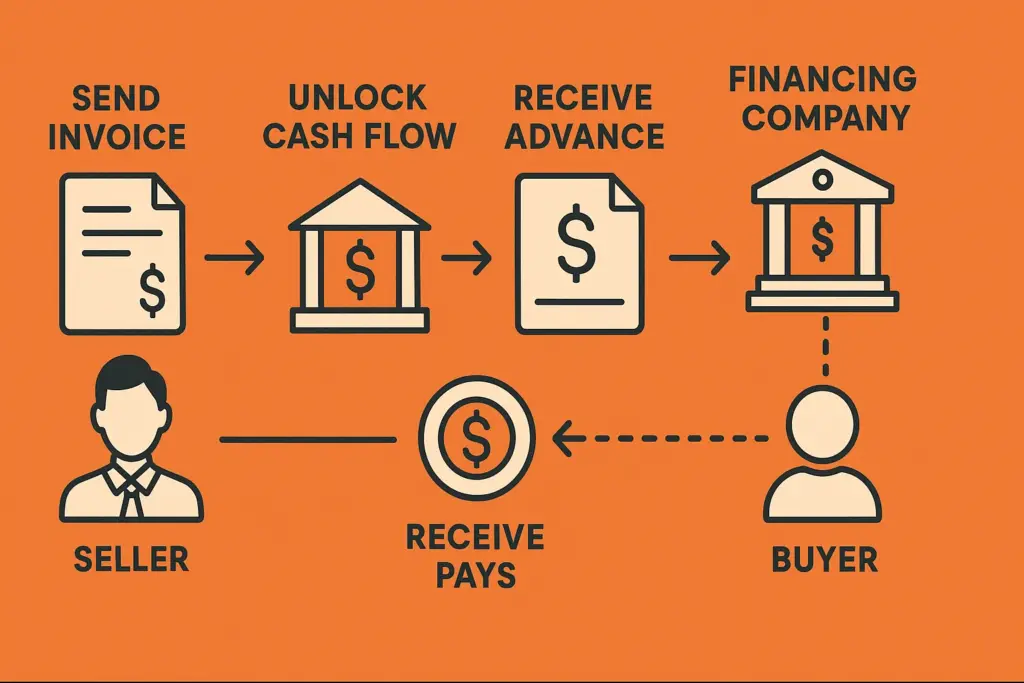
The process is short. Most businesses go from “invoice issued” to “cash in the bank” in under 48 hours. It sits right at the end of your normal invoice processing cycle. Once an invoice is issued and outstanding, financing is simply what turns it into usable cash early. Here’s the flow:
- You deliver the work and send the invoice – A customer owes you money for goods or services already provided.
- You submit that invoice to a financing provider – This can be a bank, a specialty lender, or an online fintech platform.
- The provider checks your customer’s creditworthiness, not just yours. Because the loan is repaid from the invoice, the client’s ability to pay matters more than your own credit score.
- You receive an advance – typically 70 to 90% of the invoice value often within 24 to 48 hours.
- Your customer pays the invoice on its due date, either to you or directly to the financing provider, depending on the arrangement.
- You get the remaining balance, minus the financing fee, once the invoice is settled.
Who’s Involved
Three parties make this work:
- You (the seller) – the business that delivered the goods or services and is waiting to get paid.
- Your customer (the debtor) – the company that owes the money on the invoice.
- The financier – the bank or lender that advances the cash and collects the fee.
A Simple Example
Say you run a printing business and just completed a ₱200,000 order for a retail chain on 45-day terms. You need cash now to buy paper stock for your next job. You submit the invoice to a financing provider, who advances you 85% ( ₱170,000 ) within a day. Thirty days later, your retail client pays the full ₱200,000 to the financier. The financier deducts a 3% fee ( ₱6,000 ) and sends you the remaining ₱24,000. You never took on debt in the traditional sense, you just got paid earlier for work you’d already done.
Invoice Financing vs a Traditional Business Loan
This is where “invoice financing loan” as a search term gets confusing. It isn’t a loan in the conventional sense, even though it functions like one. Here’s the real difference:
| Factor | Invoice Financing | Traditional Business Loan |
|---|---|---|
| What secures it | Your unpaid invoices | Collateral, personal guarantee, or credit history |
| Approval speed | 1 to 3 business days | Weeks to months |
| What matters most | Your customer’s credit | Your business’s credit and financials |
| Repayment | Repaid automatically when the invoice is paid | Fixed monthly installments |
| Best for | Short-term cash flow gaps | Long-term investments (equipment, expansion) |
| Cost structure | Fee per invoice, usually 1–5% per 30 days | Interest rate (APR) over the loan term |
If you have strong, established credit and need money for a long-term purpose, a term loan is usually cheaper. Run the numbers with a business loan EMI calculator to see what fixed monthly repayments would actually cost you. If you need cash fast and your strength is a solid customer base rather than your balance sheet, invoice financing fills that gap.
Types of Invoice Financing
Not all invoice financing looks the same. Picking the wrong type is the most common mistake businesses make. Here’s how to tell them apart.
1. Invoice Factoring
You sell your invoices to a factoring company, which then takes over collecting payment directly from your customer. You get cash fast and one less job to do but your customer will know a third party is involved.
Best for: businesses that would rather outsource collections entirely and don’t mind their customer seeing the arrangement.
2. Invoice Discounting
You borrow against your invoices but keep collecting payments yourself. Your customer never finds out a lender is involved.
Best for: businesses that want to protect the customer relationship and keep the financing arrangement private.
3. Spot Factoring
You finance a single invoice, once, with no ongoing contract. It costs a bit more per transaction, but there’s zero long-term commitment.
Best for: a one-off cash crunch, or testing whether invoice financing works for your business before signing a longer contract.
4. Receivables-Based Line of Credit
Instead of financing one invoice at a time, the lender gives you a revolving credit line sized to a percentage of your total outstanding receivables (commonly 80–85%). As invoices get paid, your available credit refreshes.
Best for: businesses with a steady, recurring stream of invoices who want flexible, reusable access to cash rather than a one-time advance.
Recourse vs Non-Recourse: Who Absorbs the Risk?
This detail decides who’s stuck holding the bag if your customer simply doesn’t pay.
- Recourse financing: You’re still responsible for the debt if your customer defaults. Cheaper, but riskier for you.
- Non-recourse financing: The financier absorbs the loss if the customer doesn’t pay (fraud and disputes are usually still excluded). Safer for you, but the fees are higher because the lender is taking on more risk.
The Invoice Financing Process, Step by Step
Beyond the basic mechanics, here’s what actually happens when you apply:
- Choose a provider – Compare banks, specialty lenders, and fintech platforms on speed, fees, and contract flexibility not just the headline advance rate.
- Submit your application and documents – Expect to provide an accounts receivable aging report, recent bank statements, and details on the customers you invoice.
- The provider evaluates your customer’s credit, not just yours – A well-known, reliably-paying client will get you a better rate than a customer with a shaky payment history.
- You sign the agreement – Read the fee structure carefully. Some contracts charge extra for early repayment or minimum volume commitments.
- You submit invoices as they’re issued (or your whole receivables ledger, for a credit line).
- You receive the advance, usually the same day or next business day.
- The invoice gets settled, the advance is matched against it through invoice reconciliation, and the provider releases your remaining balance, minus fees.
Invoice Financing for Manufacturing
Manufacturing is one of the industries where invoice financing does the most work, for a simple reason: the cash gap in manufacturing is unusually wide. You pay for raw materials up front, cover labor and overhead during production, and then wait 30, 60, or 90 days for a buyer to pay after delivery. That gap can stall your next production run before the last one is even paid for.
Where it helps most in a manufacturing business:
- Bridging the raw-material-to-payment gap – Buy the next batch of materials without waiting on the last invoice.
- Taking on larger orders with confidence – A manufacturer that can’t front the cost of materials often has to turn down big contracts. Invoice financing against your existing receivables removes that ceiling.
- Managing seasonal demand – Manufacturers with seasonal spikes (holiday goods, agricultural equipment, back-to-school products) can use financing to ramp up production ahead of peak demand, before the season’s revenue comes in.
- Handling long buyer payment cycles – Many manufacturers sell to large retailers or distributors who set their own extended terms (net-60, net-90). Financing evens out that mismatch.
A mid-sized furniture manufacturer, for example, might land a ₱3 million order from a retail chain on 60-day terms. Without financing, that single order could tie up all their working capital. By financing the invoice for an 85% advance, they can pay their timber and hardware suppliers on time, keep the workshop staffed, and still take on smaller orders in the meantime.
Invoice Financing in the Philippines
Cash flow is not a side issue for Philippine businesses — it’s the main issue. SMEs make up roughly 99.5% of all registered businesses in the country and employ about 63% of the workforce, yet a huge share of them run into cash flow problems simply because clients pay late. Bank loans don’t move fast enough to fix this: a typical bank business loan in the Philippines takes 45 to 75 days to process, and banks often require at least one to three years of operating history plus hard collateral SMEs don’t have.
Invoice financing sidesteps both problems. It’s built around receivables instead of collateral, and approval typically takes days, not months.
How It Works Locally
The mechanics mirror the global model, with a few Philippine-specific details:
- Advance rates usually run 70–90% of invoice value, released within 1–3 business days for established, recurring clients.
- Credit limits scale with your revenue and invoice size. SMEs can qualify for facilities up to ₱20 million depending on the provider and your receivables volume.
- Repayment terms are typically synced to your invoice due dates, usually 30 to 60 days.
- Eligibility generally requires business registration, an operating track record, and invoices from creditworthy business customers, not personal collateral.
Who Offers It
The Philippine market has grown well beyond bank-only options. You’ll find:
- Banks offering traditional invoice financing lines, usually best suited to businesses with longer operating histories and existing banking relationships.
- Licensed non-bank financing companies (regulated by the SEC) that specialize in fast SME receivables funding, often turning around approval in 5–7 days.
- Fintech platforms that digitize the entire process — some advance funds in as little as 30 minutes for qualifying invoices, using online applications instead of paper-heavy bank processes.
A regulatory shift has also helped: the Personal Property Security Act (PPSA) formally recognized receivables and other movable assets as valid collateral, opening the door for more lenders to build products specifically around Philippine SME invoices rather than requiring land or equipment as security.
Is It a Fit for Your Philippine Business?
Invoice financing tends to make the most sense if you:
- Regularly invoice other businesses on 30- to 90-day terms
- Have creditworthy, established clients who pay reliably (even if slowly)
- Need cash faster than a 45–75 day bank loan cycle allows
- Don’t have hard collateral like property or equipment to offer a bank
What to Look for in an Invoice Financing Platform or Solution
If you’re comparing providers, don’t stop at the advance percentage. The real differences show up in the fine print:
- Speed of funding – same-day vs multi-day disbursement can matter more than a slightly better rate.
- Fee transparency – look for a flat, clearly stated fee per invoice rather than layered charges (application fees, service fees, early-termination fees) that only appear later.
- Recourse terms – know upfront whether you’re on the hook if your customer doesn’t pay.
- Contract flexibility – some platforms lock you into monthly minimums or long contracts; others let you finance invoices one at a time with no commitment.
- Integration with your invoicing – the best modern platforms plug directly into how you already invoice, so you’re not re-entering data or juggling separate portals.
- Customer experience – if you choose factoring, check how the provider communicates with your customers. A heavy-handed collections process can damage relationships you’ve spent years building.
Advantages and Disadvantages of Invoice Financing
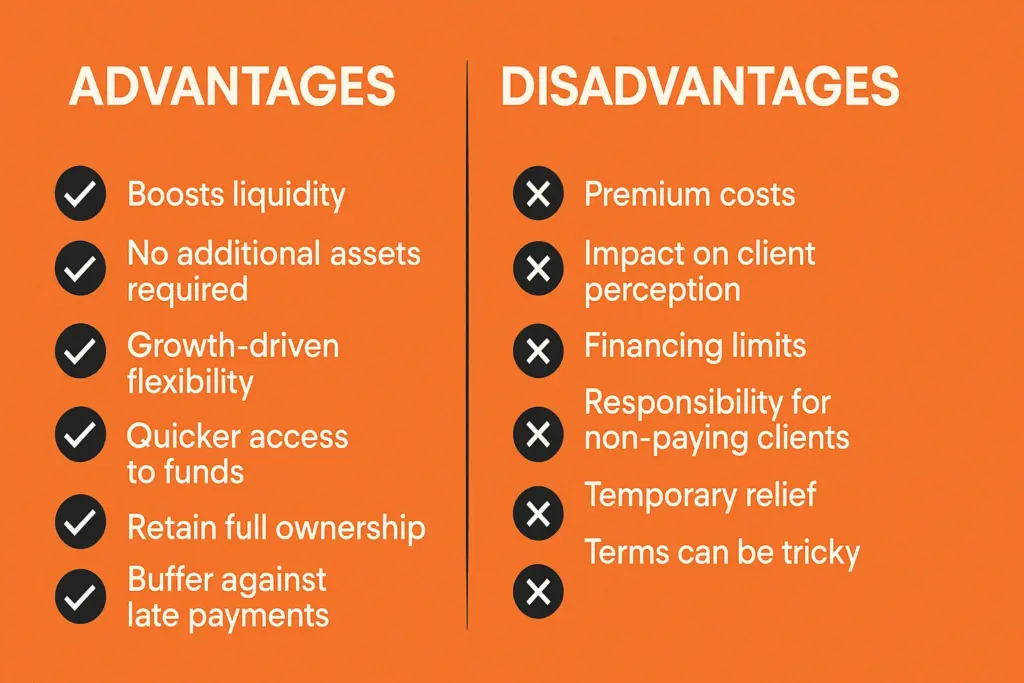
Advantages
- Fast access to cash – often within 24 to 48 hours, versus weeks for a bank loan.
- No collateral beyond your invoices – no need to pledge property or equipment.
- Scales with your sales – the more you invoice, the more funding you can access.
- No equity given up – you keep full ownership and control of your company.
- Approval based on your customer, not just you – useful for newer businesses with limited credit history but reliable clients.
Disadvantages
- Higher cost than traditional loans – fees typically run 1–5% per 30 days, which adds up on longer payment terms.
- Customer awareness (with factoring) – your client may notice a third party is now collecting payment.
- Funding tied to invoice value – you can’t access more than your receivables support.
- Recourse risk – under recourse agreements, you’re still liable if the customer never pays.
- A short-term fix, not a long-term strategy – it solves a cash flow gap; it doesn’t fix an underlying profitability problem.
Invoice Financing vs Invoice Factoring
People use these terms interchangeably, but they’re not identical. Here’s the real distinction:
| Invoice Financing | Invoice Factoring | |
|---|---|---|
| Who collects payment | You do | The factoring company does |
| Customer awareness | Often invisible to your customer | Customer knows and pays the factor directly |
| Control over relationships | You keep full control | Factor manages the customer interaction |
| Best for | Businesses that want privacy and control | Businesses that want to outsource collections entirely |
| Typical cost | Interest-style fee on the amount borrowed | Discount taken off the invoice’s face value |
If keeping your customer relationship entirely in your hands matters, financing (specifically discounting) is the better fit. If you’d rather hand off collections and free up your team’s time, factoring does that job.
Real-World Examples
A catering business, mid-event-season: After booking a ₱1 million corporate event on 30-day terms, a catering company lands a second, urgent booking days later and needs cash for supplies and staff immediately. Financing 80% of the pending invoice puts ₱800,000 in their account within a day. The 30-day fee runs 4%. Once the corporate client pays in full, the caterer repays the advance and keeps the rest — no loans, no credit checks, no missed opportunity.
A steel fabricator recovering from a rough year: After a bankruptcy filing, a steel fabrication company can’t get a bank to even take a meeting, but they have solid receivables from ongoing contracts. Factoring those invoices gives them the working capital to pay vendors and staff while they rebuild — without adding new debt to a balance sheet that’s already strained.
A small manufacturer scaling into a major contract: A rooftop-equipment startup lands orders from two large telecom clients but can’t self-fund production at that scale. Financing the invoices from those clients lets them manufacture at volume, and the business eventually grows past ₱1 billion in revenue — funded by their own receivables, not by giving up equity.
Is Invoice Financing Right for Your Business?
Ask yourself three questions:
- Do you invoice other businesses, not individual consumers?
Invoice financing is built for B2B receivables — it generally doesn’t apply to consumer sales.
- Are your customers reliable, even if slow?
Financiers care more about your customer’s ability to pay than your own credit history.
- Is this a short-term cash flow problem, not a profitability problem?
If your business is fundamentally cash-flow positive but timing is the issue, financing bridges the gap well. If revenue itself doesn’t cover costs, financing will only delay a deeper problem.
If you answered yes to all three, invoice financing is worth a serious look. If not, a traditional line of credit or a longer-term loan may serve you better.
For freelancers and small business owners, it also helps to know your real annual run-rate — whether you’re on track for $50k a year, $75k a year, or $80k a year – so you can judge whether financing fees are worth it against your actual income goals.
The Bottom Line
Invoice financing doesn’t create new money. It moves money you’ve already earned closer to the moment you actually need it. Used well, it smooths out the gap between delivering the work and getting paid for it, so a client’s 60-day payment terms never have to become your business’s 60-day problem.
The right structure is factoring, discounting, spot financing, or a receivables line of credit. It depends on how much control you want to keep over customer relationships and how much you’re willing to pay for that control. Compare providers on speed, fee transparency, and recourse terms, not just the advance percentage, and it can become one of the most reliable tools in your cash flow toolkit.
Create Invoices Instantly – Free & Easy!
Generate professional invoices in seconds with our Free Online Invoice Generator.
👉 Try the Invoice Generator Now