
⚡ Quick Answer: Invoice vs Receipt — Key Difference
An invoice is a payment request sent before money changes hands. A receipt is a payment confirmation sent after money is received. A bill is the same as an invoice — just viewed from the buyer’s perspective.
- Invoice: Requests payment — issued before or upon completing work
- Receipt: Confirms payment — issued after the buyer pays
- Bill: What the buyer calls the invoice they receive
- All three are different stages in the same payment lifecycle
- Invoices carry legal weight as unpaid financial claims; receipts serve as proof of payment
If you’ve ever sent a client a document asking for payment and wondered whether to call it an invoice or a receipt — you’re not alone. These two terms are frequently confused, and using the wrong one can cause accounting errors, tax filing problems, and payment delays.
This guide explains the exact difference between an invoice and a receipt, how both compare to a bill, and when each document is used — with real-world examples for freelancers, small businesses, and service providers. Whether you’re looking for the simple answer or a deep dive into compliance and best practices, you’ll find everything here.
What Is an Invoice?
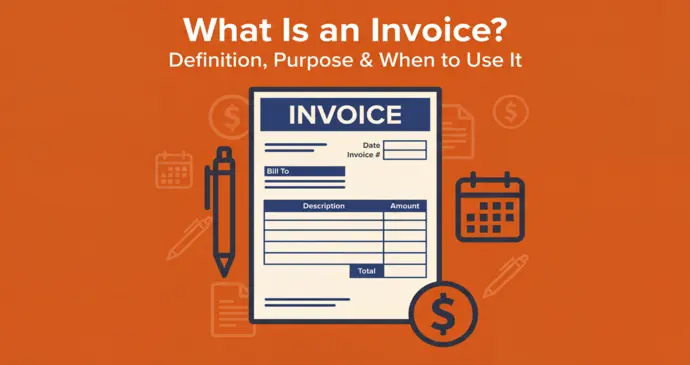
An invoice is a formal, itemized document issued by a seller (or service provider) to a buyer, requesting payment for goods delivered or services rendered. It is a pre-payment document — it comes before money changes hands.
An invoice typically contains:
- Seller’s name, address, and contact details
- Buyer’s name and billing address
- Unique invoice number (for bookkeeping and reference)
- Invoice date (when it was issued)
- Payment due date (when payment is expected)
- Itemized list of products or services with quantities and unit prices
- Subtotal, applicable taxes, and grand total
- Payment terms and accepted payment methods
Legally, an invoice is a financial claim. It records the obligation of the buyer to pay. If unpaid, it can be used as evidence in a dispute or debt recovery process. For a complete walkthrough on how to create one, see our guide on how to write an invoice.
Invoice vs Bill — They’re the Same Document
An invoice and a bill describe the same document from different perspectives. The seller sends an invoice; the buyer receives a bill. In accounting, they are treated identically — both record the same financial obligation.
What Is a Receipt?
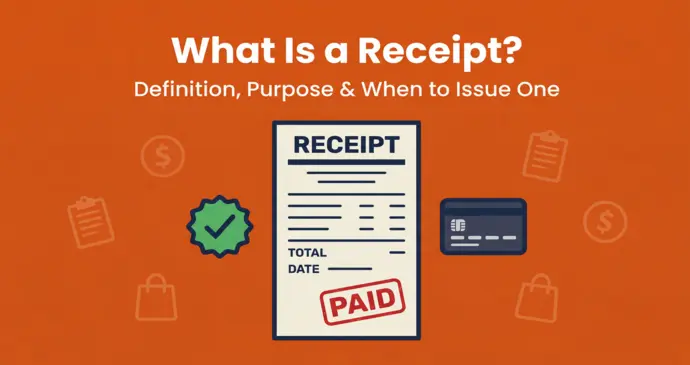
A receipt is a document issued after payment has been made. It serves as official proof that a transaction was completed and that the buyer fulfilled their payment obligation. Receipts are post-payment documents — they confirm what already happened.
A standard receipt includes:
- Seller’s name and contact information
- Date of payment (when money was received)
- Receipt number or transaction reference
- Description of goods or services paid for
- Amount paid (including taxes)
- Payment method used (cash, card, transfer, etc.)
- “Paid” or “Payment Received” status
Receipts are critical for expense tracking, tax deductions, warranty claims, and audits. A buyer without a receipt cannot easily prove they paid for something — which matters enormously in disputes, returns, or insurance claims.
Freelancer Tip: Always Issue a Receipt After Payment
Many freelancers only send invoices and skip receipts. Sending a “Payment Received” confirmation email (or a formal receipt) after every payment builds trust, confirms amounts, and gives both parties a clean audit trail — especially useful at tax time.
Invoice vs Receipt: The Complete Difference
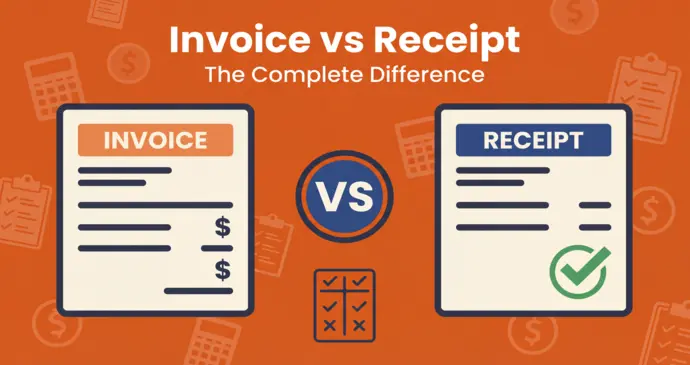
Here is the most comprehensive comparison of invoices and receipts available — covering every dimension that matters for freelancers, small businesses, and accountants:
| Criteria | 📄 Invoice (Orange) | 🧾 Receipt (Green) |
|---|---|---|
| Purpose | Requests payment from buyer | Confirms payment was received |
| When issued | Before payment is made | After payment is made |
| Issued by | Seller / service provider | Seller / service provider |
| Received by | Buyer / client | Buyer / client |
| Payment status | Payment is pending | Payment is completed |
| Contains due date? | Yes — payment due date required | No — not applicable (already paid) |
| Contains invoice number? | Yes — mandatory for bookkeeping | Contains receipt/transaction number |
| Payment method shown? | Accepted methods listed | Method actually used is recorded |
| Legal role | Evidence of outstanding obligation | Proof of completed payment |
| Tax document? | Yes — used for tax reporting / input tax credit | Yes — used for expense claims and deductions |
| Itemized breakdown? | Always — full line-item detail required | Often — depends on context (retail may simplify) |
| Used for audits? | Yes — verifies sales revenue | Yes — verifies business expenses |
| Can be disputed? | Yes — buyer can query before paying | Less common — payment already made |
| Common format | PDF file, sent by email or post | Printed slip, PDF, or email confirmation |
| Typical industries | B2B services, freelancing, consulting | Retail, e-commerce, in-person services |
Invoice vs Receipt vs Bill: All Three Explained
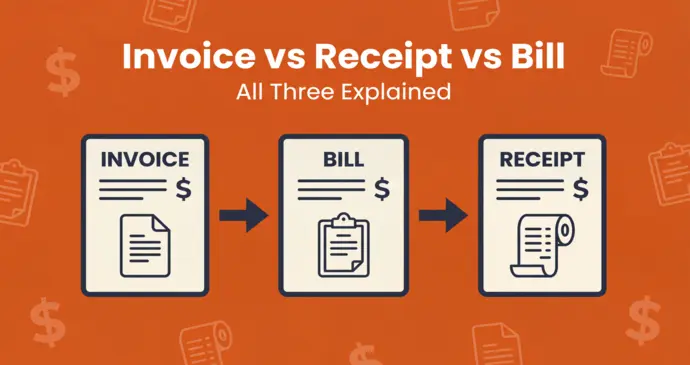
The confusion between invoice, receipt, and bill is one of the most common in business finance. Here’s the simplest way to understand all three — and where each fits in a typical transaction lifecycle:
Payment Request
Sent by the seller to the buyer. Details what is owed, line by line. Created before payment.
Same as Invoice
The buyer’s name for the invoice they receive. The document is identical — only the perspective differs.
Payment Proof
Issued by the seller after money is received. Confirms the transaction is complete.
The Transaction Lifecycle: When Each Document Appears
Think of it as a journey from agreement to completion. Each document marks a different stage:
Invoice vs Receipt vs Bill — Comparison Table
| Feature | 📄 Invoice | 📋 Bill | 🧾 Receipt |
|---|---|---|---|
| Who creates it | Seller | Same as invoice | Seller |
| Who uses it | Seller tracks income | Buyer tracks owed amounts | Buyer proves payment |
| Timing | Before payment | Before payment | After payment |
| Shows payment status | Pending / unpaid | Pending / unpaid | Paid / completed |
| Has due date | ✅ Yes | ✅ Yes | ❌ No |
| Has “amount paid” | ❌ No | ❌ No | ✅ Yes |
| Common in B2B | ✅ Very common | ✅ Very common | ✅ Post-payment |
| Common in retail / B2C | Less common | Sometimes | ✅ Standard |
| Tax purposes | Tax invoice, input credit | Payable tracking | Expense deductions |
Can an Invoice Become a Receipt?
Yes — many businesses issue a single “invoice/receipt” document. Once an invoice is marked PAID with the payment date and method recorded, it functions as a receipt. This is common in professional services, freelancing, and small business invoicing software.
What They Look Like: Invoice vs Receipt Side-by-Side
Seeing the actual documents makes the difference instantly clear. Notice the key visual cues: invoices show a due date and PENDING status; receipts show a payment date and PAID status.
Sample Invoice
| Description | Qty | Rate | Total |
|---|---|---|---|
| Brand Identity Design | 1 | $1,400.00 | $1,400.00 |
| Social Media Kit (10 templates) | 1 | $600.00 | $600.00 |
Payment via bank transfer or PayPal · Late fee: 1.5%/month after due date
Sample Receipt (Same Transaction — After Payment)
| Description | Qty | Rate | Total |
|---|---|---|---|
| Brand Identity Design | 1 | $1,400.00 | $1,400.00 |
| Social Media Kit (10 templates) | 1 | $600.00 | $600.00 |
Thank you for your payment! Keep this receipt for your records.
When to Use an Invoice vs a Receipt — Real-World Scenarios
Knowing the theory is one thing. Here are 8 real-world scenarios that show exactly which document to use and when:
Freelance Web Developer
Completes a client website build. Sends a document listing all work done, requesting $3,500 with Net 14 terms.
→ Use: INVOICECoffee Shop Customer
Buys a latte and croissant. Pays immediately at the counter. Cashier issues a printed slip confirming $8.50.
→ Use: RECEIPTGraphic Designer — Monthly Retainer
Sends a recurring monthly document to a client for ongoing design services at the start of each month.
→ Use: INVOICEB2B Software Company
Client pays annual software license. Company sends a payment confirmation with transaction ID, amount, and date.
→ Use: RECEIPTPlumber After a Home Job
Finishes a repair and gives the homeowner a document on the spot. Homeowner pays cash immediately.
→ Use: RECEIPT (or Invoice/Receipt combo)Photographer — Wedding Shoot
Requires 50% upfront deposit. Sends a document for the deposit amount, then another for the balance after delivery.
→ Use: INVOICE (two: deposit + final)E-Commerce Order Confirmation
Customer places an online order and pays immediately. Store sends an order confirmation email with amounts paid.
→ Use: RECEIPTConsultant Filing Taxes
Tax authority asks for proof of a client expense. The accountant needs documentation of payment — not just the request for it.
→ Use: RECEIPT (invoice alone is insufficient)Tax and Legal Differences: Invoice vs Receipt
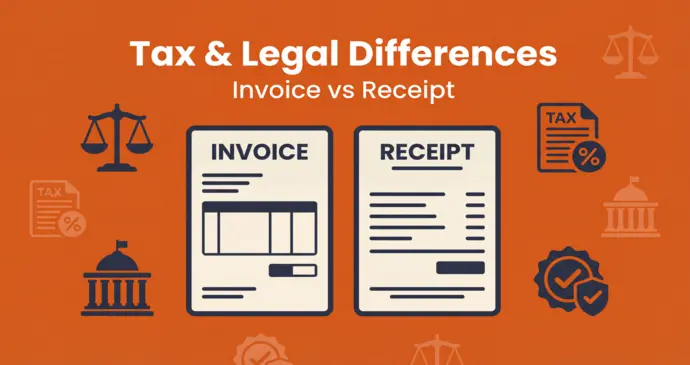
For accounting and compliance, invoices and receipts serve different — but complementary — functions. Understanding which document does what will save you during audits and tax filings. Invoice statistics show that unclear documentation is one of the top reasons businesses face delayed payments and failed expense claims.
Invoice: Tax Role
- Records taxable income: Every invoice you issue becomes part of your revenue record for income tax purposes.
- VAT / GST invoices: In most countries, if you are VAT or GST registered, your invoice must show the tax registration number, tax rate, and taxable amount separately. This is called a tax invoice.
- Input tax credit: Businesses can claim back GST/VAT paid on purchases — but only if they hold a valid tax invoice from the supplier. A receipt alone is usually not sufficient for input tax credit claims.
- Proof of sale: Invoices are the primary documents auditors check to verify reported income.
Receipt: Tax Role
- Expense documentation: Businesses need receipts to claim business expense deductions. The IRS, HMRC, ATO, and most tax authorities require receipts — not just invoices — as proof of payment.
- Confirms cash flow: A receipt proves money actually moved, not just that it was requested.
- VAT reclaim: For personal tax claims, receipts showing VAT charged are needed for reclaims.
- Audit protection: In a tax audit, a receipt is stronger evidence than an invoice because it confirms actual payment occurred.
Important: An Invoice Is NOT Proof of Payment
This is the most common misconception. An invoice only proves that payment was requested. If your accountant or tax authority asks for proof that you paid a supplier, you need the receipt — or a bank statement showing the transfer. Never confuse the two in a tax or legal context.
Invoice vs Receipt for Freelancers and Self-Employed
For freelancers, understanding the invoice-receipt relationship is especially important because you typically handle your own billing with no accounts department to back you up. Here’s how to manage both documents professionally.
Always Send an Invoice First
After completing a project (or at agreed billing milestones), send a professional invoice with a clear due date. This creates a formal, traceable payment request and sets a firm expectation for when payment is due.
Issue a Receipt After Every Payment
Once a client pays, send a payment confirmation — either a formal receipt document or a simple email stating “Payment received for Invoice #INV-042, $2,200. Thank you.” This closes the loop and prevents future “did you receive it?” disputes.
Mark Your Invoice as PAID
Many freelancers simply stamp or mark their original invoice PAID with the payment date and method, then resend it as the receipt. This dual-purpose document satisfies both functions and keeps your records tidy.
Store Both Documents Together
For each client engagement, store the invoice and its corresponding receipt in the same folder. This makes annual tax filing significantly faster and protects you if a client ever claims non-receipt of a payment.
Use Matching Reference Numbers
Link your receipt back to the original invoice with a reference number (e.g., Receipt REC-042 references Invoice INV-042). This matching makes reconciliation instant and audit trails clean.
Common Confusions: Invoice vs Receipt vs Other Documents
Beyond the core comparison, several adjacent documents are frequently mixed up. Here’s a quick-reference guide to the full family of financial documents:
| Document | Timing | Purpose | Payment Status |
|---|---|---|---|
| Quote / Estimate | Before work begins | Proposes cost of future work | No obligation yet |
| Purchase Order (PO) | Before work begins | Buyer formally orders goods/services | Commitment to pay |
| Pro Forma Invoice | Before work is complete | Preliminary invoice for customs or deposits | Not yet due |
| Invoice | After work / delivery | Formal payment request | Unpaid / pending |
| Bill | After work / delivery | Same as invoice (buyer’s perspective) | Unpaid / pending |
| Statement | Periodic (monthly) | Summary of all outstanding invoices | Multiple, mixed |
| Receipt | After payment | Confirms payment completed | Paid |
| Credit Note | After invoice issued | Reduces or cancels invoice amount | Adjusts outstanding |
Pro Tip: Use Invoice Numbers That Link to Receipts
A simple numbering system like INV-001 → REC-001 links every invoice to its receipt. When you need to prove a payment during a tax audit or client dispute, you can instantly pull both documents and show the complete transaction history. Understanding invoice payment terms also helps reduce the gap between invoice and receipt.
Digital Invoices vs Digital Receipts in 2026
As businesses move online, the distinction between digital invoices and digital receipts becomes even more important. Most countries now accept — and in some cases require — electronic invoicing. For businesses struggling with slow-paying clients, it’s also worth understanding invoice financing as a way to unlock cash tied up in unpaid invoices. Here’s what you need to know about digital documents:
- Email PDF invoices are legally valid in most jurisdictions when they contain all required fields (seller info, invoice number, dates, line items, tax detail).
- Email receipts (order confirmation emails from Amazon, Stripe, PayPal, etc.) are accepted as valid receipts by most tax authorities for expense claims.
- E-invoicing mandates: Countries including Italy, India (GST e-invoicing), Saudi Arabia, France, and Brazil now mandate electronic invoicing for B2B transactions above certain thresholds.
- PDF vs editable formats: Always send invoices and receipts as PDFs — never as Word or Excel files. PDFs are tamper-evident and universally accepted by accountants and auditors.
- Cloud storage: Store all invoices and receipts in a cloud-based system for at least 5–7 years (varies by country) to meet statutory record-keeping requirements.