
Every shipment that involves money needs paperwork that explains what was sent, to whom, and for how much. This guide breaks down the shipping invoice in plain words, shows two real examples, and gives you a working tool to build one in minutes.
QUICK ANSWER: A shipping invoice is the bill that travels with (or ahead of) a shipment. It lists the seller, the buyer, every item being shipped, its price, and the shipping charges, so the receiver knows exactly what they are being charged for and so customs, insurers, or couriers have a paper trail if anything goes wrong. If you sell and ship physical goods locally or across a border, you need one for every order.
What Is a Shipping Invoice?
A shipping invoice is a document that a seller hands over physically attached to the box, emailed, or both the moment goods leave the warehouse. Think of it as a receipt with a travel itinerary stapled to it. On one side it does the job of a normal invoice: it says who bought what, at what price, and how they should pay. On the other side, it does something a regular sales invoice doesn’t: it records the physical journey of the goods, including the carrier, the tracking or waybill number, the mode of transport, and any freight or handling charges added on top.
You’ll hear it called a few different things depending on the industry: a shipment invoice, a freight invoice, or simply the shipping bill of the order (though, as we’ll clear up below, a shipping bill is technically a different document). Whatever the label, the job is the same, prove what was sent, to whom, and for how much.
A small business owner shipping ten candles a week and an exporter shipping a container of auto parts both need one. The difference is only in how detailed it has to be. A local courier shipment might need five lines of information. An export shipment crossing a border needs HS codes, country of origin, and the agreed Incoterm, because customs officers use the invoice to calculate duty and confirm the shipment matches what was declared.
Shipping Invoice vs Shipping Bill vs Packing List
These three get mixed up constantly, and search engines aren’t much help because a lot of pages use the terms loosely. Here’s the actual distinction, in one table.
| Document | Who creates it | What it’s for | Has prices? |
|---|---|---|---|
| Shipping invoice | The seller / shipper | Bills the buyer and records shipment details | Yes |
| Shipping bill | The exporter, filed with customs | Legal permission to export goods out of the country | Yes, for duty calculation |
| Packing list | The seller / warehouse | Describes how goods are packed, box count, weight, dimensions | No |
In short: a shipping invoice moves money and information, a shipping bill moves goods legally across a border, and a packing list moves nothing. It just describes the box. A single international shipment often travels with all three attached to the outside of the crate or in the courier’s document pouch. Domestic shipments almost never need a shipping bill, since that’s a customs-specific document.
Why a Shipping Invoice Matters
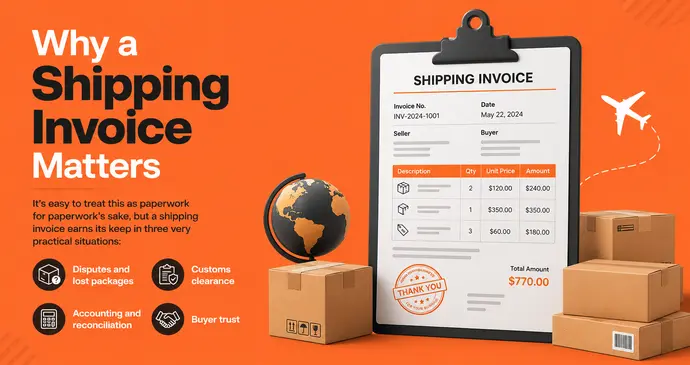
It’s easy to treat this as paperwork for paperwork’s sake, but a shipping invoice earns its keep in three very practical situations:
- Disputes and lost packages – If a courier loses a shipment, the invoice is your proof of value for a claim. Without it, insurers and carriers have nothing to compensate against.
- Customs clearance – For anything crossing a border, customs uses the declared value on the invoice to calculate import duty and taxes. A missing or vague invoice can hold a shipment at port for days.
- Accounting and reconciliation – It’s the record your books rely on to match what shipped against what was invoiced and what was paid, useful the moment a customer says “I never got this.”
- Buyer trust – A clean, itemised invoice tells the buyer exactly what they paid for, which cuts down on “why was I charged this much for shipping” emails.
The Shipping Invoice Format, Field by Field
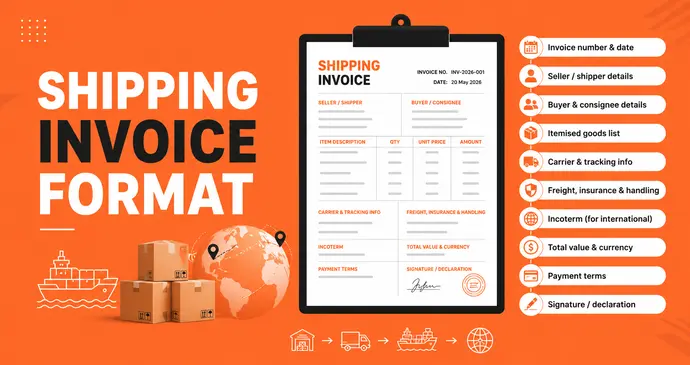
There’s no single legally fixed shipping invoice format. It flexes based on whether the shipment is domestic or international but a complete one always covers four blocks of information: who’s involved, what’s being sent, how it’s travelling, and what it costs. Here’s what to include:
- Invoice number & date – unique per shipment, used for tracking and accounting
- Seller / shipper details – name, address, tax ID or GSTIN
- Buyer & consignee details – the payer and the receiver, if different
- Itemised goods list – description, quantity, unit price, HS code for exports
- Carrier & tracking info – courier name, tracking or waybill number, mode of transport
- Freight, insurance & handling – shown separately from the goods value
- Incoterm (for international) – FOB, CIF, EXW, etc., defining who pays for what leg of the journey
- Total value & currency – the number customs and accounting both rely on
- Payment terms – prepaid, COD, net 30, bank details
- Signature / declaration – required for most export shipments
Notice that freight and goods value are always kept as separate line items, never bundled into one number. That separation matters because customs calculates duty differently on goods value versus shipping cost, and because it lets the buyer see exactly what portion of the bill is shipping.
Free Shipping Invoice Generator
Rather than build this from a blank spreadsheet, fill in the fields below. It auto-calculates your subtotal, freight, tax, and grand total as you type, and switches between a domestic layout and an international / export layout. The two templates covered later on this page. Nothing you type leaves your browser.
Pick a template, fill in the shipment, and download a print-ready PDF. Free, no signup, no watermark.
SHIPPING INVOICE
From: To:
Carrier: Tracking:
Subtotal:
Freight:
Tax:
TOTAL:
Two Real-Life Shipping Invoice Examples
Numbers make this easier to picture than a bare field list. Here are two shipments — one domestic, one export worked out in full.
Example 1: Domestic Courier Shipment
SHP-2026-0417 Jaipur – Mumbai
Meera’s Handmade Soaps, a small business in Jaipur, ships a ₹2,400 order of gift-boxed soaps to a customer in Mumbai through a regional courier. The invoice that goes inside the parcel looks like this:
| Item | Qty | Unit Price | Amount |
|---|---|---|---|
| Lavender Gift Box (6 bars) | 2 | ₹900.00 | ₹1,800.00 |
| Charcoal Bar (single) | 4 | ₹150.00 | ₹600.00 |
| Shipping (Delivery, 1.2 kg) | — | — | ₹80.00 |
| Total Due (Prepaid) | ₹2,480.00 |
Notice the shipping charge is listed as its own line, not folded into the product price, that’s what lets the customer see exactly what they paid for delivery, and it’s what lets Meera reconcile courier charges against what she billed at the end of the month.
Example 2: International Export Shipment
EXP-2026-0092 Pune, India – Hamburg, Germany
Zenith Auto Components exports a batch of precision-machined gearbox parts to a buyer in Germany. Because this crosses a border, the invoice needs HS codes, country of origin, and an Incoterm — here, FOB Nhava Sheva, meaning the buyer takes over cost and risk once the goods are loaded onto the vessel.
| Item | HS Code | Qty | Unit Price | Amount |
|---|---|---|---|---|
| Machined Gearbox Housing | 8483.30 | 120 | $42.00 | $5,040.00 |
| Steel Drive Shaft | 8483.10 | 120 | $18.50 | $2,220.00 |
| Freight (FOB to Hamburg) | — | — | — | $610.00 |
| Insurance | — | — | — | $95.00 |
| Total Invoice Value | $7,965.00 |
German customs uses this total, along with the HS codes, to calculate import duty on arrival. If any of these fields were missing — say, the HS code or country of origin — the shipment could be held for clarification, which is the single most common reason export shipments get delayed at port.
Two Free Shipping Invoice Templates
Every shipment falls into roughly one of two buckets, so instead of one generic template, InvoPilot gives you two matched to the fields you’ll actually need. Both are built into the generator above, and both are available as ready-to-edit Word files.
Domestic Shipping Invoice
Built for courier, road, and rail shipments within one country — ecommerce orders, local B2B deliveries, retail dispatch.
- Ship-from / ship-to, no customs fields
- Carrier, tracking number, package count
- Prepaid or COD payment mode
International / Export Shipping Invoice
Built for cross-border freight — includes everything a customs officer needs to clear the shipment.
- HS codes, country of origin, Incoterm
- Port of loading / discharge, B/L or AWB number
- Declaration line for signature
How to Create a Shipping Invoice, Step by Step
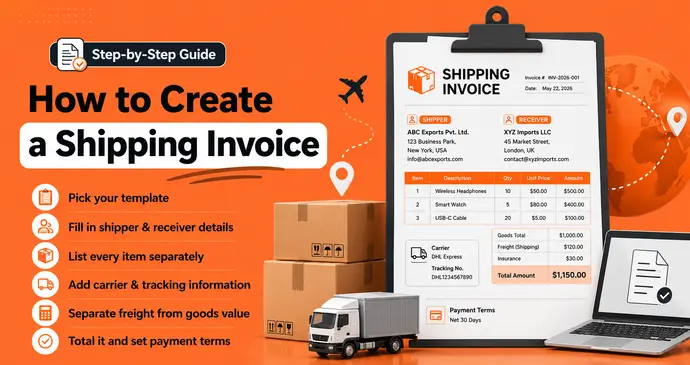
- Pick your template. Domestic for in-country deliveries, international for anything crossing a border.
- Fill in shipper and receiver details. Full name, address, and — for exports — tax ID or IEC.
- List every item separately. Never lump multiple SKUs into one line; customs and accounting both need the breakdown.
- Add carrier and tracking information. This is what turns a plain bill into a shipping invoice.
- Separate freight from goods value. Keep shipping, insurance, and tax as their own lines.
- Total it and set payment terms. Prepaid, COD, or net terms, plus bank details if relevant.
- Download and attach. Print a copy for the package and email a copy to the buyer.
You can do all seven steps directly in the generator above, or if you need extra fields like a logo, multiple tax rates, or saved client details, the full InvoPilot Invoice Generator handles that too.
Common Mistakes to Avoid
- Bundling shipping into the product price – Always show freight as its own line, it’s needed for both duty calculation and buyer trust.
- Skipping the tracking number – Without it, the invoice can’t be matched back to the actual shipment if something goes wrong.
- Leaving out HS codes on exports – This is the 1 reason customs holds an international shipment for clarification.
- Vague item descriptions – “Parts” or “Misc goods” invites a customs inspection; specific descriptions move faster.
- No declared Incoterm – Without one, buyer and seller can end up disputing who pays for insurance or the last-mile delivery.
- Reusing invoice numbers – Every shipment needs a unique number, or your books and the buyer’s records will never match cleanly.
Curious what a role handling this typically pays? Check our free Salary Calculator.
Conclusion
A shipping invoice isn’t complicated once you know what it actually needs to do: prove who sent what, to whom, for how much, and how it’s travelling. Get those four things right – seller and buyer details, an itemised list, carrier and tracking info, and a clear total with freight shown separately and the invoice will hold up whether it’s used for a buyer’s records, a courier claim, or customs clearance.
The template you reach for depends entirely on the shipment. A local courier delivery only needs the domestic layout, while anything crossing a border needs the extra fields in the international /export layout – HS codes, country of origin, and an Incoterm so customs can clear it without delays. Rather than rebuilding this in a spreadsheet every time, the generator on this page keeps both formats one click apart and totals everything automatically as you type.