
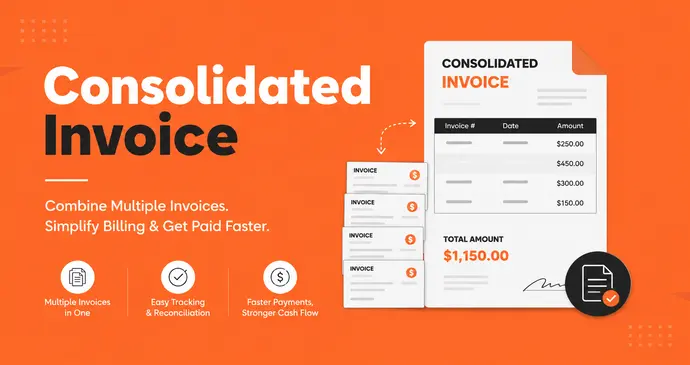
Quick answer: A consolidated invoice is one single bill that combines charges from many separate orders, deliveries, or subscriptions into a single document. Instead of paying 10 small bills every month, a client pays 1 invoice that lists every charge as a line item. This is called consolidated invoicing, and businesses use it to save time, cut costs, and make accounting simple.
If you run a business that sends multiple orders to the same client, or you receive many small bills from 1 vendor, this guide explains everything in simple words. We use real examples so you can picture exactly how it works.
What Is a Consolidated Invoice?
Think of a coffee shop owner named Riya. She orders milk from the same supplier every single day. If the supplier billed her daily, she would get 30 invoices a month. That is 30 emails to open, 30 payments to track, and 30 chances for a mistake.
Instead, the supplier waits until the end of the month, adds up every delivery, and sends Riya one document. That single document is a consolidated invoice. It shows each daily delivery as a separate line, but Riya only needs to make one payment.
So the consolidated meaning here is simple: many small charges brought together under one roof, billed at once.
Consolidated Invoicing vs a Normal Invoice
People often ask what makes this different from a regular invoice. A normal invoice covers one transaction. You buy something once, you get a bill for that one purchase.
A consolidated invoice covers many transactions across a set period, usually a week or a month. Here is the difference laid out simply:
| Normal Invoice | Consolidated Invoice |
|---|---|
| Covers one order or sale | Covers many orders or sales |
| Sent right after each transaction | Sent at the end of a billing cycle |
| One line item, one payment | Multiple line items, one payment |
| Common for retail and one time sales | Common for subscriptions, recurring supply, and bulk buyers |
If you want to understand the basics of a standard bill first, our guide on creating professional invoices covers the fundamentals in an easy format. You can also read our breakdown of an itemized invoice to see how line by line billing works, since consolidated invoices rely heavily on clear itemization.
How Consolidated Invoicing Actually Works
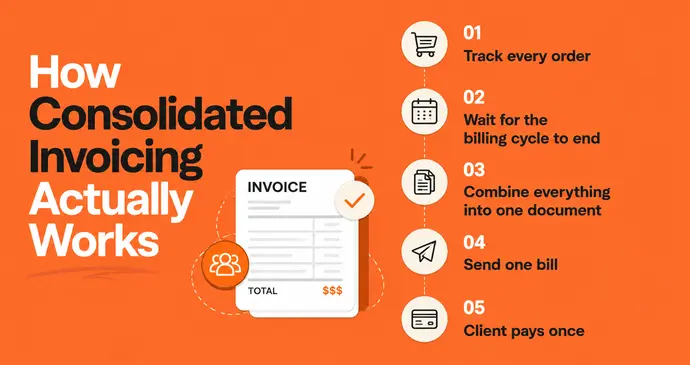
Let us walk through the process step by step using a real world example.
Imagine a company called BrightBox that sells office supplies to a large corporate client. Instead of billing every single order the moment it ships, BrightBox follows this flow:
- Track every order. Every time the client places an order during the month, BrightBox logs it in their system instead of billing it right away.
- Wait for the billing cycle to end. At the end of the month, the system pulls up all the orders placed by that client.
- Combine everything into one document. All charges get grouped into a single invoice, with each order shown as its own line so nothing gets hidden.
- Send one bill. The client receives a single, easy to read invoice with a total amount due.
- Client pays once. Instead of 15 separate payments, the client makes one payment for the whole month.
This is exactly why growing companies love this method. Fewer bills mean fewer bank transfers, fewer approval steps, and far less paperwork for the accounts team.
If you want to try this yourself, you can build a clean, professional bill using our free invoice generator, which lets you list multiple items on one document with automatic totals, no spreadsheet needed.
Why Businesses Choose Invoice Consolidation
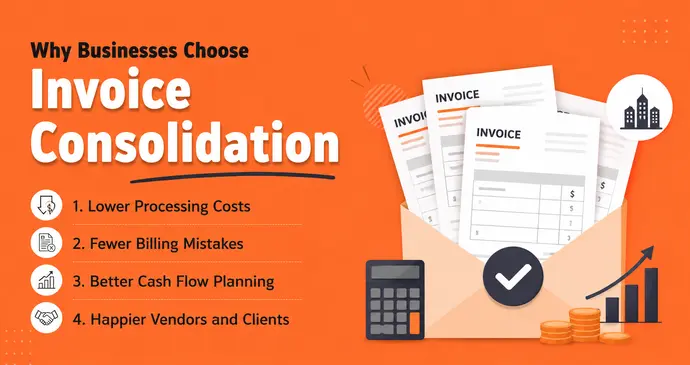
1. Lower Processing Costs
Every invoice a company processes costs money. Someone has to open it, check it, approve it, and pay it. When you combine ten invoices into one, you cut that admin work by ten times. Banks may also charge a fee per transaction, so fewer payments mean lower fees.
2. Fewer Billing Mistakes
When a finance team handles fifty tiny invoices, mistakes creep in. Someone might pay the same bill twice or miss one completely. A single combined document with a clear total is far easier to check and approve.
3. Better Cash Flow Planning
When you know exactly one bill is coming on the same date each month, you can plan your cash flow with confidence. There is no guessing when the next surprise charge will land in your inbox.
4. Happier Vendors and Clients
Nobody enjoys opening a flooded inbox full of small bills. A single, well organized statement builds trust and keeps the relationship smooth. It also makes invoice reconciliation much simpler at month end, since everything sits in one place instead of scattered across many documents.
When to Submit a Consolidated Invoice
Businesses usually consolidate invoicing in these situations:
- Recurring supply chains: A vendor who delivers goods daily or weekly, like our coffee shop example above.
- SaaS and subscription billing: A company using five different software tools from the same provider gets one combined bill instead of five separate charges.
- Retail and point of sale transactions: Many tax authorities allow small, low value sales made throughout the day to be grouped and billed once, instead of issuing a bill for every single sale.
- Procurement across multiple vendors: Large buyers often ask a platform to combine bills from many suppliers into a single payment cycle, which makes budgeting far easier.
- Multi location businesses: A company with several branches ordering from one supplier may prefer one master invoice covering every branch.
Consolidated Invoice in GST
In countries with a Goods and Services Tax system, tax rules allow suppliers to combine multiple small value sales made to unregistered buyers into a single consolidated tax invoice, as long as certain conditions on value and timing are met. This keeps daily retail sales simple without forcing a shop to print a fresh tax invoice for every tiny sale.
If your business deals with GST and needs to check tax amounts quickly, our GST calculator helps you work out the exact tax on any consolidated bill before you send it. It also pairs well with our guide on the tax invoice, which explains what a compliant tax document must include, and our VAT invoice guide if your country follows a VAT system instead.
What Goes Into a Consolidated Invoice Format
A good consolidated invoice format should always include:
- Business name, address, and tax ID
- Client name and billing address
- Invoice number and the billing period it covers, for example 1 June to 30 June
- A line item for every order or transaction, with date, description, quantity, and amount
- Subtotal, applicable tax, any discounts, and the final total due
- Payment terms and due date
- Bank or payment details
This is essentially the same as a normal invoice, just with more line items grouped under one billing period. If you want a downloadable, ready made layout, browse our invoice templates and simply add extra rows for each transaction.
Consolidated Invoice PDF and Format Tips
When creating a consolidated invoice as a PDF, keep these tips in mind:
- Group line items by date so the client can scan through easily
- Use subtotals for each week if the billing period is long
- Highlight the final total clearly so there is no confusion
- Keep the document to one or two pages if possible, since a cluttered PDF defeats the purpose of consolidation
You can create this instantly with our invoice tool, download it as a polished PDF, and send it directly to your client without any signup.
Consolidated Bill Meaning in Everyday Life
Outside of business, you may have already used a version of this idea without realizing it. Think about your monthly electricity bill. If you had to pay for every single hour of electricity you used, you would drown in tiny charges. Instead, the electricity company adds up your entire month of usage and sends one consolidated bill. That is the exact same logic businesses use for invoicing, just applied to sales instead of electricity units.
Ready to Create Your Own Consolidated Invoice?
You do not need complex accounting software to start consolidating your bills. With InvoPilot, you can list every order as a separate line, let the tool calculate your subtotal, tax, and grand total automatically, and download a clean PDF in minutes. Try our free invoice generator today, or explore our bill generator if you prefer a simpler itemized layout for retail or service billing.