
Late payments are not just a cash flow nuisance — they are a systemic threat to business survival. This page aggregates the most authoritative 2025–2026 data on overdue invoices, the real cost to businesses, country-by-country patterns, and what the research says about getting paid faster.
The data on this page is drawn from peer-reviewed surveys, government reports, and research published by organisations including Intuit QuickBooks, Bluevine, Atradius, the Federation of Small Businesses (FSB), GoCardless, Coface, and the UK Office of the Small Business Commissioner. Where studies differ, we note both figures and the relevant methodology. All data points are dated; older statistics are included only where no more recent equivalent exists.
Late Payment Statistics (2025–2026)
These are the top-line numbers that define the global late payment problem today.
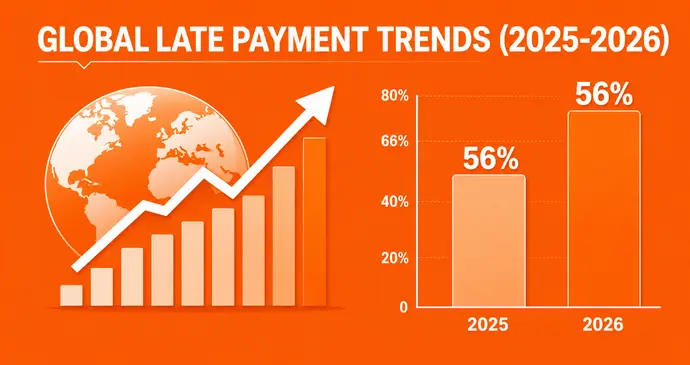
- 56% of US small businesses report being owed money from unpaid invoices at any given time. { Intuit QuickBooks Small Business Late Payments Report, 2025 (n=2,487) }
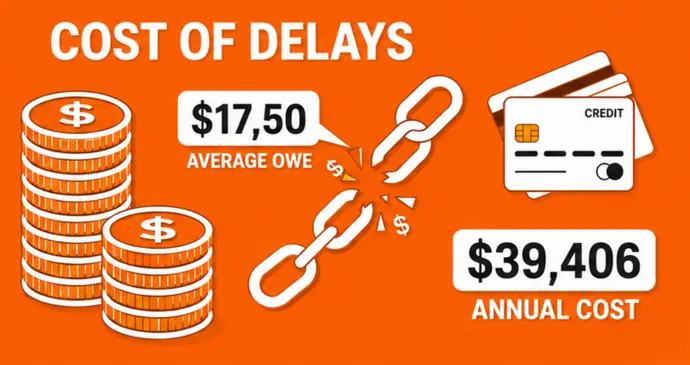
- $17,500 average amount owed in unpaid invoices per affected US small business. { Intuit QuickBooks, 2025 }
- 59% of US small businesses experience late payments at least occasionally. { Bluevine Payment Gap Report, Feb 2026 (n=1,052) }
- 47% of US businesses have invoices overdue by more than 30 days. { QuickBooks / Kaplan Group, 2025 }
- 75% of companies globally experience late B2B payments, impacting cash flow. { Upflow, cited Kaplan Group 2025 }
- 25% of EU company bankruptcies are directly caused by late payments from customers. { Council of the European Union }
Key Insight – Late payments have crossed from periodic inconvenience to structural threat. More than half of all US and UK small businesses are managing outstanding invoices right now — not as an edge case, but as a persistent operating condition. One of the most effective first steps is making sure your invoice payment terms are explicit, enforceable, and set before work begins.
- 1 in 10 invoices across all surveyed US businesses is more than 30 days overdue on average. { Intuit QuickBooks, 2025 }
- 64% of US small businesses have at least one invoice that is 90 or more days overdue. { Kaplan Group, 2025 }
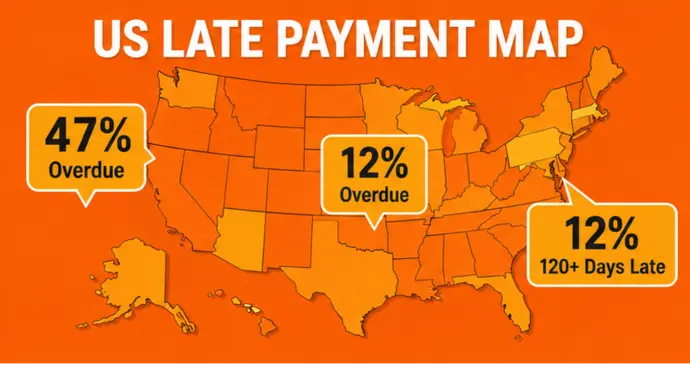
- 12% of small businesses have invoices that are 120 or more days past due. { Kaplan Group, 2025 }
- $39,406 is the average annual cost of late payments per US company, including administrative time, financing costs, and written-off bad debt. { Kaplan Group, 2025 }
- 10% of US companies suffer over $100,000 per year in expenses related to managing late payments. { Kaplan Group, 2025 }
- 73% of SMBs globally are negatively impacted by late payments in a material way. { Kaplan Group, 2025 }
United States Late Payment Statistics
Data from US-specific surveys, including QuickBooks (n=2,487), Bluevine (n=1,052) and Atradius 2025.
- 56% of US small businesses currently have outstanding unpaid invoices, with each affected business owed an average of $17,500. { Intuit QuickBooks Small Business Late Payments Report, 2025 }
- 47% of US small businesses report that some invoices are overdue by more than 30 days; on average, around 1 in 10 of their invoices falls into this extended overdue category. { QuickBooks, 2025 }
- 43% of credit-based B2B sales in the US are overdue, primarily due to customer cash flow pressures. { Atradius Payment Practices Barometer, North America 2025 }
- 5% of long-overdue US B2B invoices are written off as bad debt, underlining the credit risk of extended payment terms. { Atradius, North America 2025 }
- 53% of US firms expect insolvency risk to increase in the near term, reflecting wide uncertainty about the working capital environment. { Atradius, North America 2025 }
- 35% of US companies report a worsening trend in B2B payment behaviour, with an equal share seeing no change and the remainder seeing improvement. { Atradius, North America 2025 }
- Payment terms average 43 days from invoicing in North America, yet many invoices exceed this significantly. { Kaplan Group / Atradius, 2025 } — see our full guide to invoice payment terms and conditions for how to set shorter, enforceable terms.
- 55% of all B2B invoiced sales in the US are overdue, making late payment the norm rather than the exception in B2B commerce. { Kaplan Group, 2025 }
- 86% of US businesses report that up to 30% of their monthly invoiced sales are overdue at any given time. { Kaplan Group, 2025 }
- 26% of US business decision-makers have stopped working with a buyer or supplier specifically because of payment delays. { American Express, cited in Kaplan Group 2025 }
- 51.9% of the value of US B2B payments that remain unpaid at 90 days past due is ultimately lost by SMEs. { Industry aggregate data, 2025 }
- 29% of US small business owners have delayed paying themselves because customers failed to pay invoices on time. { Bluevine Payment Gap Report, February 2026 }
- 17% of US small businesses — roughly 1 in 6 — have missed or nearly missed payroll for employees due to payment gaps created by late-paying customers. { Bluevine, 2026 }
- 28% of US small business owners report having more than $5,000 currently tied up in unpaid invoices. { Bluevine Payment Gap Report, 2026 }
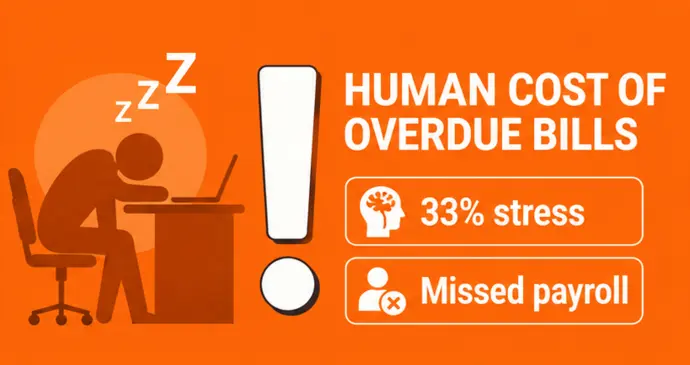
- 34% of small business owners say they experience increased stress or anxiety while waiting for overdue invoices to clear. { Bluevine, 2026 }
- 31% maintain a dedicated cash reserve for late payment scenarios, while 32% keep no reserve at all — a striking split showing uneven business preparedness. { Bluevine, 2026 }
- 18% of US small business owners say their biggest challenge is time spent chasing overdue payments rather than running their businesses. { Bluevine, 2026 }
- US businesses with 90-day payment terms use credit cards for 32% of monthly expenses on average, versus 27% for those with shorter terms — a direct cash-flow substitution effect. { QuickBooks, 2025 } — for broader context on credit reliance driven by payment gaps, see our credit card statistics report.
Data highlight — Bluevine 2026 – The February 2026 Bluevine Payment Gap Report surveyed 1,052 US small business owners between 2–5 February 2026 (margin of error ±3%, 95% confidence). It found that late payments aren’t just an accounting headache — for many small firms, especially those earning under $100,000 annually, a single delayed invoice can threaten operational stability.
United Kingdom Late Payment Statistics
The UK has some of the most comprehensive late payment data globally, including government-commissioned research and sector-specific surveys.
- 62% of UK small businesses report grappling with unpaid invoices, each owed an average of £21,400 in late payments. { Intuit QuickBooks UK Small Business Late Payments Report, 2025 (n=1,063) }
- 54% of UK B2B invoices are currently overdue, affecting businesses across virtually all sectors. { Atradius Payment Practices Barometer UK, 2025 }
- 51% of UK B2B invoices are overdue in a second Atradius measurement, with bad debts accounting for 7% of all B2B invoices. { Atradius UK 2025 }
- 90% of UK businesses experienced late payments in the past year — significantly higher than France (85%), Germany (81%) and Poland (60%). { Coface UK Payment Survey, 2025 }
- The average payment delay in the UK stands at 32 days beyond agreed terms, consistent across company sizes but most damaging to the smallest firms. { Coface, 2025 }
- 44% of UK businesses say they are experiencing late payments more frequently than 12 months ago. { Coface, 2025 }
- 70% of UK small businesses experienced late payments in Q1 2025 alone. { Federation of Small Businesses (FSB), 2025 }
- 45% of UK SMBs are experiencing more late payments than 12 months ago; 50% are concerned the number will rise further over the next 12 months. { GoCardless / FSB Late Payments Report, 2025 (n=2,298) }
- 24% of UK SMBs receive payments that are up to 60 days late — nearly a quarter of all small businesses dealing with very extended overdue periods. { GoCardless / FSB, 2025 }
- 52% of UK SMBs say they forfeit late payment charges up to 10 times a year to avoid the time and cost involved in chasing them. { GoCardless / FSB, 2025 }
- 38 businesses close every day in the UK due to overdue invoices, equivalent to approximately 14,000 SME closures per year. { Companies House data / Office of the Small Business Commissioner, 2025 }
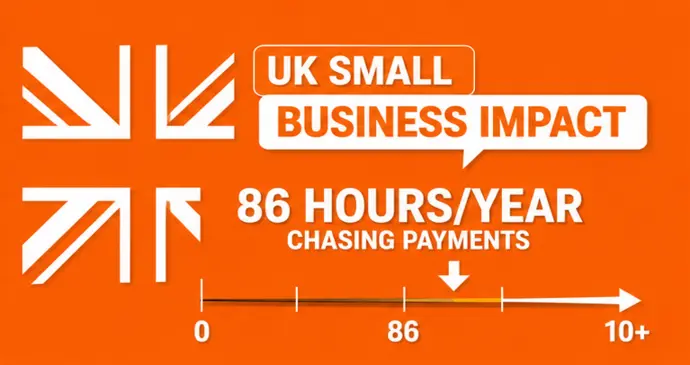
- 86 hours per year is how long UK businesses spend on average chasing late payments, at a cost of up to £5,200 per year in lost time and resources. { Office of the Small Business Commissioner (OSBC), July 2025 }
- 63% of UK firms spend time chasing overdue payments on a regular basis. { FSB, 2025 }
- £70.4 billion is the estimated total value of overdue invoices owed to UK SMEs. { Startups.co.uk, citing industry data, 2025 }
- 25.2% of all invoices issued by UK large businesses are not paid on time, per official government disclosure requirements. { UK Department for Business and Trade Payment and Cash Flow Review Report }
- UK businesses with the most overdue invoices are more than 3 times as likely to report increased reliance on credit cards compared to those with few late payments. { QuickBooks UK, 2025 }
- 37% of UK companies expect late payments to decrease in 2026, but optimism is uneven — micro and small firms are far less confident than larger organisations. { Coface, 2025 }
UK Policy Watch — 2026 – In March 2026, the UK government announced its toughest crackdown on late payments in over 25 years, including a hard 60-day maximum payment cap, mandatory CEO accountability, and new annual report disclosure requirements. The Small Business Commissioner recovered three times more overdue invoices in 2025 than in 2024.
India Late Payment Statistics
India records the highest overdue invoice rate of any major economy tracked by Atradius, reflecting structural liquidity challenges across the corporate sector.
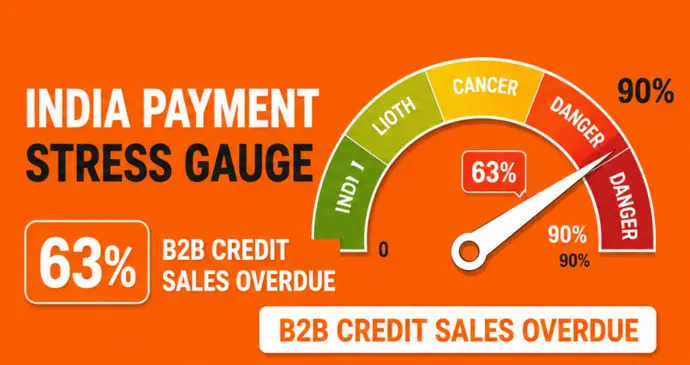
Key headline — India – India’s B2B payment environment is the most stressed globally. With 63% of B2B credit sales overdue and bad debts rising to 7%, the country faces acute cash flow pressure across virtually every major industry sector. Businesses in India looking to ease immediate cash pressure can explore invoice discounting platforms as a working capital tool.
- 63% of all credit-based B2B sales in India are overdue — the highest rate of any economy in the Atradius global survey. { Atradius Payment Practices Barometer India, 2025 }
- Bad debts have risen to 7% of B2B invoices in India, causing direct revenue losses and eroding margins across industries. { Atradius India, 2025 }
- Nearly 3 in 5 Indian firms (59%) report deteriorating customer payment behaviour, with customers now taking more than a month beyond the due date to settle debts on average. { Atradius India, 2025 }
- The primary causes of late payment in India are customer liquidity constraints and supply chain disruptions, both of which are expected to persist. { Atradius India, 2025 }
- 72% of Indian companies expect B2B customer insolvencies to rise in the coming months, reflecting deep concern about the credit risk landscape. { Atradius India, 2025 }
- In India’s textile and clothing sector, overdue invoices account for 56% of B2B transactions, with bad debts reaching as high as 10%. { Atradius India, 2025 }
- In India’s agri-food sector, overdue payments affect more than 60% of invoices, with customers taking more than a month beyond due dates to settle. { Atradius India, 2025 }
- India’s chemicals industry sees payment terms averaging close to 60 days from invoicing, with most companies relaxing terms to stay competitive despite rising payment risk. { Atradius India, 2025 }
- India saw a 17% increase in late payments year-over-year, one of the highest growth rates in payment delays globally. { Industry aggregate, 2025 }
Global B2B Late Payment Statistics
Cross-border and regional data from Atradius, covering Western Europe, Central and Eastern Europe, Asia, and North America.
- 47% of B2B invoices in Western Europe are overdue, driven by financial stress across the economy. { Atradius, Western Europe 2025 }
- 53% of B2B sales on credit in Central & Eastern Europe are overdue — the second highest regional rate. { Atradius, CEE 2025 }
- 44% of B2B credit sales across Asia are overdue on average. { Atradius, Asia 2025 }
- 6% of B2B invoices in Western Europe are written off as bad debt — a significant revenue hit for suppliers. { Atradius, Western Europe 2025 }
- Global insolvencies rose 19% in 2024, driven by high input costs, elevated interest rates and withdrawal of pandemic support, with a further 5% forecast rise in 2025. { Atradius global research, 2025 }
- In Canada, 44% of B2B invoices are overdue, slightly better than the prior year but with 50% of companies anticipating a worsening insolvency landscape ahead. {Atradius North America, 2025 }
- In Spain, late payments affect more than two-thirds of B2B invoices, with bad debts averaging 7% — and 63% of Spanish companies report no improvement versus the prior year. { Atradius Spain, 2025 }
- Bad debts in CEE stand at 8% of all B2B invoices — higher than any other global region — with the Czech Republic reporting the most severe impact. { Atradius CEE, 2025 }
- In Singapore, overdue invoices affect 35% of B2B sales, with bad debts rising to 6% and customer liquidity issues driving 54% of delays. { Atradius Singapore, 2025 }
- Canada sees 70% of invoices paid late — one of the highest rates among developed economies outside the UK. { Industry aggregate, 2025 }
- In Asia, bad debts average around 5% of B2B invoices, though Hong Kong has seen a sharp increase, placing serious pressure on cash flow management. { Atradius Asia, 2025 }
- In Latin America, approximately 51% of businesses experience late payments, comparable to Asia but well below the UK’s 90% incidence rate. { Coface regional data, 2025 }
Cash Flow & Business Survival Impact
The downstream consequences of unpaid invoices stretch far beyond a delayed bank transfer. Optimising your invoice-to-cash process — from how you raise an invoice to how you follow up on it — is the most direct lever businesses have on their own cash position.
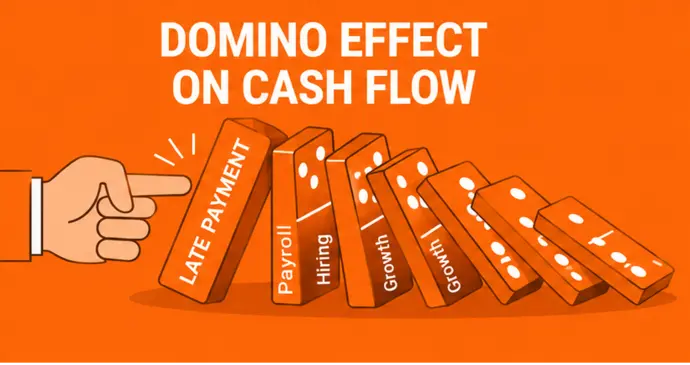
- Small businesses with a high volume of overdue invoices are more than 1.4x more likely to encounter cash flow problems than those with few late payments. { QuickBooks, 2025 }
- 60% of small businesses with 90-day payment terms report cash flow problems, compared to far lower rates for those with immediate terms. { QuickBooks, 2025 }
- Businesses carrying the highest volume of overdue invoices allocate an average of 34% of expenses to credit cards, versus 24% for those with fewer delays. { QuickBooks UK, 2025 }
- Businesses with many overdue invoices are 3x more likely to cite financing as their primary obstacle (19% vs 6%). { QuickBooks UK, 2025 } — when unpaid invoices are creating a capital gap, invoice financing is one route to unlock cash tied up in receivables.
- UK small businesses most burdened by late payments are nearly 6x more likely to have had a credit card application denied in the past half year. { QuickBooks UK, 2025 }
- Over half of companies globally must delay or cancel investment, expansion or hiring plans due to late payments. { Kaplan Group, 2025 }
- Companies experiencing significant payment delays are 1.3x more likely to face challenges hiring skilled workers; for those with longer payment terms, that rises to 1.6x. { QuickBooks, 2025 }
- 38% of US small businesses fail in their first year, largely due to financial challenges — with late payment-driven cash flow crises a leading factor. { Forbes, cited in Clockify 2025 }
- 39% of US small businesses have less than one month’s worth of cash on hand for operating expenses, leaving them acutely vulnerable to any delay. { Bluevine, 2025 }
- Small businesses with shorter payment terms projected 11% average revenue growth, more than double the 5% projected by those with longer terms. { QuickBooks UK, 2025 }
- UK businesses most affected by late payments are 1.4x more likely to report difficulties in both hiring and retaining skilled workers. { QuickBooks UK, 2025 }
- 76% of businesses say they must address late invoice payments before they can meaningfully focus on growth activities. { Kaplan Group, 2025 }
Industry Breakdown: Which Sectors Pay Latest?
Late payment patterns vary significantly by sector. These are the worst-performing industries globally.
Sector Watch – Construction is the worst-performing sector for late payments globally and in virtually every national market studied. Security/compliance, manufacturing, and transport are close behind.
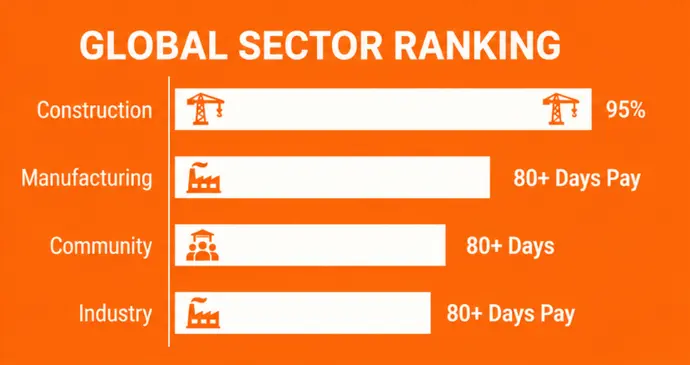
- In the UK, construction has the highest late payment incidence at 95% of businesses affected, with average delays of 38.2 days beyond terms — the longest of any sector. { Coface UK, 2025 }
- UK automotive and transport businesses experience late payments at a rate of 93%, the second highest sector rate in the country. { Coface UK, 2025 }
- Business services in the UK averages 38.1 days of payment delay — tied with construction as the longest average delay by sector. { Coface UK, 2025 }
- In the US, security and compliance sectors have 60% of overdue invoices 90 or more days late — the highest long-overdue concentration of any industry. { Kaplan Group, 2025 }
- In the UK, manufacturing takes an average of 80+ days to pay suppliers, making it the slowest-paying sector overall. { Apollo Finance / UK sector data, 2025 }
- Transportation and storage in the UK averages around 62 days to pay suppliers. { Apollo Finance, 2025 }
- Administrative and support services in the UK average around 57 days for supplier payments. { Apollo Finance, 2025 }
- Over half of manufacturing suppliers in the US report experiencing late payments, averaging nearly 2 months. { Kaplan Group, 2025 }
- In India’s pharma sector, 65% of B2B sales are made on credit with payment terms averaging 45 days, yet overdue invoices account for 42% of B2B sales. { Atradius India, 2025 }
- The UK publishing, communications and media sector has the shortest average delay (21 days) yet still sees 50% of companies report significant cash flow impact from late payments. { Coface UK, 2025 }
The Human Cost of Late Payments
Behind the financial statistics are real people — business owners losing sleep, delaying their own pay, and sacrificing growth for survival.
- 60.3% of US small business owners delayed paying themselves in 2025 to keep their businesses running. { Bluevine Small Business Growth & Trends Report, 2025 }
- Of those who delayed paying themselves: 27.9% did so 1–3 times in the year, 18% did so 4–8 times, and 7.2% did so 12 or more times — every single month. { Bluevine, 2025 }
- 34% of US small business owners report increased stress or anxiety specifically while waiting for overdue invoices to clear. { Bluevine, 2026 }
- The UK’s Small Business Commissioner notes that late payments lead to “sleepless nights, deteriorating wellbeing and possible mental health problems,” as well as relationship difficulties. { OSBC, 2025 }
- UK SMBs spend an estimated 14 hours per week handling overdue invoices — nearly 3 hours every working day. { Industry aggregate, 2025 } — much of that time goes into manual invoice processing tasks that can be streamlined or eliminated with the right workflow.
- In the UK, 5% of SMBs spend over 10 hours per week dealing specifically with past-due invoices; an additional 9% spend 5–10 hours per week. { QuickBooks UK research, cited in Clockify 2025 }
- Just 1 hour per working day spent chasing payments translates to 260 hours per year — more than 6 full working weeks. { Clockify analysis, 2025 }
- The FSB has found that late payments contribute to up to 50,000 UK business closures per year — described by the FSB as a cycle where “every day becomes a fight to stay afloat.” { FSB, 2025 }
Country Comparison: Late Payment Rates (2025)
How overdue invoice rates compare across major economies, based on Atradius Payment Practices Barometer 2025 and Coface data.
| Country / Region | % B2B Invoices Overdue | Bad Debt Rate | Avg. Payment Delay | Primary Source |
| India | 63% | 7% | 30+ days past due | Atradius 2025 |
| United Kingdom | 54% | 7% | 32 days past terms | Atradius / Coface 2025 |
| Central & Eastern Europe | 53% | 8% | — | Atradius 2025 |
| Canada | 44% | 6% | — | Atradius 2025 |
| Asia (average) | 44% | 5% | — | Atradius 2025 |
| United States | 43% | 5% | ~7 days past terms | Atradius 2025 |
| Western Europe | 47% | 6% | 31–60 days avg. terms | Atradius 2025 |
| Latin America | ~51% | — | — | Coface 2025 |
| Singapore | 35% | 6% | — | Atradius 2025 |
Note: Figures represent percentage of B2B credit sales that are overdue, as measured by Atradius Payment Practices Barometer surveys conducted across H1 2025. Country-level figures may differ from regional averages due to survey methodology.
What the Data Says Reduces Late Payments
Research points clearly to a set of behaviours and technologies that correlate with faster payment. These are not opinions — they are statistically validated findings.
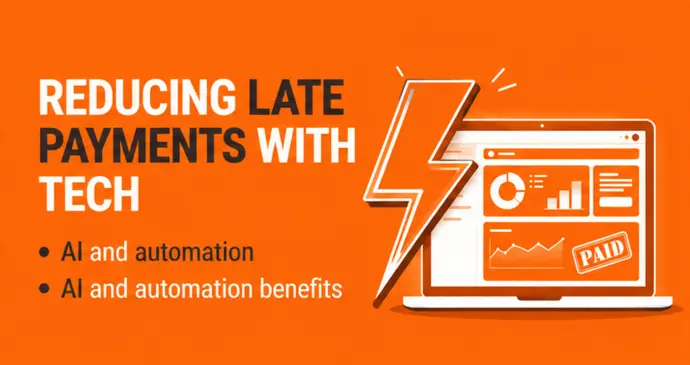
- Businesses with fewer overdue invoices had 4%–28% higher rates of digital tool adoption than those most burdened by unpaid bills, suggesting that technology is the single clearest differentiator. { QuickBooks / Mountain-Ear analysis, 2025 }
- Automating invoicing can improve accounts payable processing by 60%–75%, dramatically reducing the time between invoice issuance and payment. { Industry research, 2025 }
- Businesses with immediate payment terms experience substantially lower rates of cash flow problems than those using 30- or 90-day terms — confirming that shorter terms reduce risk. { QuickBooks, 2025 } — use our free invoice generator to build clear payment terms directly onto every invoice you send.
- In Australia, 33% of businesses cited late invoicing by themselves as a cause of payment delays — suggesting many businesses could dramatically reduce late payments simply by invoicing faster. { Atradius Australia, 2025 } — our guide on how to send an invoice covers the fastest way to get invoices out the door.
- Sending payment reminders is the most common and effective first-line strategy, used by 48% of UK respondents to tackle overdue payments. { Hiscox, cited in Startups.co.uk 2026 } — making sure your invoice itself is professional and unambiguous is the prerequisite; read our guide to creating professional invoices.
- The AI invoice processing market is growing from $2.8 billion in 2025 to a projected $47.1 billion by 2034, reflecting rapid enterprise adoption. { Kaplan Group, 2025 }
- 75% of AP departments expect to adopt AI invoice processing within the next year, though only 44% currently rely on AI for any part of the process. { State of ePayables 2025 Report } — for context on the broader shift to digital, see our paper vs electronic invoice breakdown and complete guide to e-invoicing.
- Real-time payments in the US saw a 69% year-over-year increase in 2025, indicating strong directional momentum toward faster settlement infrastructure. { Kaplan Group, 2025 }
- 91% of businesses believe that easy, secure payment processing is critical for driving business growth — reinforcing that payment experience is a strategic, not tactical, concern. { Kaplan Group, 2025 }
- Only 17% of businesses have fully automated their payment processes despite widespread recognition of the benefits, representing a significant untapped efficiency opportunity. { American Express, cited in Kaplan Group 2025 }
Stop chasing late payments — InvoPilot’s free invoice generator helps you create professional invoices with clear payment terms in minutes. Pair it with our invoice templates and billing software so you can focus on growing your business, not chasing money.
Frequently Asked Questions
What percentage of invoices are paid late?
The proportion varies significantly by region. In the US, 43% of credit-based B2B invoices are overdue (Atradius 2025), and 56% of small businesses overall have unpaid invoices outstanding (QuickBooks 2025). In the UK, between 51% and 54% of B2B invoices are overdue (Atradius 2025), and 90% of businesses experienced at least one late payment in the past year (Coface 2025). In India, 63% of B2B credit sales are overdue — the highest rate globally. Across Western Europe, 47% of B2B invoices are overdue.
How much are small businesses owed in late payments?
US small businesses with unpaid invoices are owed an average of $17,500 each (QuickBooks 2025, n=2,487). In the UK, the figure is £21,400 per affected business (QuickBooks UK, 2025, n=1,063). More than 28% of US small business owners have over $5,000 currently tied up in unpaid invoices (Bluevine 2026). The total outstanding debt owed to UK SMEs is estimated at £70.4 billion.
What is the average number of days invoices are paid late?
In the UK, the average payment delay is 32 days beyond agreed terms (Coface, 2025), consistent across company sizes. In the US, standard B2B payment terms average 43 days from invoicing, but many invoices exceed this. The worst sectors — UK construction and business services — average 38+ days beyond terms. In India, customers typically take more than a month beyond the invoice due date to pay.
How many businesses close because of late payments?
In the UK, 38 businesses close every day due to late payments (OSBC, 2025), equating to approximately 14,000 SME closures per year. In the EU, 25% of corporate bankruptcies are directly attributable to late payments by customers. In the US, 38% of small businesses fail within their first year, with cash flow problems — often driven by late payments — a leading cause.
Which industries have the worst late payment rates?
Construction is consistently the worst-performing sector globally. In the UK, 95% of construction businesses experience late payments, with an average delay of 38.2 days beyond terms. Automotive and transport (93%), manufacturing (80+ day average payment times), and administrative and support services (57 days) are also among the worst. In the US, security/compliance sectors have 60% of overdue invoices at 90+ days past due.
What is the total cost of late payments to businesses?
The average annual cost of late payments per US company is $39,406, including administrative time, financing costs, and bad debt write-offs (Kaplan Group, 2025). 10% of US companies face over $100,000 per year in late payment costs. UK businesses spend up to £5,200 per year in staff time chasing payments, at an average of 86 hours annually (OSBC, 2025). In Australia, small businesses lose $6,000–$30,000 annually to late payments.
Do late payments affect hiring?
Yes. Businesses experiencing significant payment delays are 1.3 times more likely to face challenges hiring skilled workers (QuickBooks 2025). For those with 90-day payment terms, that rises to 1.6 times. 28% of business owners report pausing recruitment because of overdue payments (NerdWallet). In the UK, small businesses most burdened by late invoices are 1.4x more likely to report difficulty in both hiring and retaining staff.
What are the main causes of late payments?
Across all markets studied, the top causes of late payment are: (1) customer cash flow pressure or liquidity constraints, (2) inefficiencies in the customer’s internal payment processes, (3) supply chain disruptions, and (4) invoice disputes. In Singapore, customer liquidity issues (54%) and invoice disputes (53%) are the top two causes (Atradius 2025). Importantly, in Australia, 33% of businesses cited their own late invoicing as a contributing cause — suggesting a significant self-inflicted component in many markets.
Sources & Methodology
All statistics on this page are drawn from primary research published by recognised institutions. We link to source reports where publicly accessible.
- Intuit QuickBooks Small Business Late Payments Report 2025 — January 2025 wave of the QuickBooks Small Business Insights survey; n=2,487 US small businesses (0–100 employees). US and UK versions published separately.
- Bluevine Payment Gap Report, February 2026 — Survey of 1,052 US small business owners conducted by Centiment, 2–5 February 2026. Margin of error ±3% at 95% confidence.
- Bluevine Small Business Growth & Trends Report 2025 — Survey of 1,067 US small business owners plus proprietary data from 210,000+ Bluevine business checking accounts.
- Atradius Payment Practices Barometer 2025 — Annual global survey conducted across 31 countries with nearly 6,500 companies. Regional editions: US, UK, North America, Western Europe, CEE, Asia, India, Spain, Singapore.
- GoCardless / Federation of Small Businesses (FSB) Late Payments Report 2025 — Survey of 2,298 UK small business owners and professionals, October–December 2024.
- Coface UK Payment Survey 2025 — Survey of UK businesses across company sizes and sectors; findings published October 2025.
- Office of the Small Business Commissioner (OSBC) Research, July 2025 — UK government-backed research into time cost and business closure rates.
- The Kaplan Group — B2B Payment Delay Statistics 2025 — Aggregated research compiling data from Atradius, American Express, Upflow and Federal Reserve sources.
- UK Government — Time to Pay Up, March 2026 — Policy announcement by UK DBET on late payment crackdown including legislative changes.
- Clockify — Late Invoice Statistics 2025 — Aggregated secondary research from QuickBooks, Atradius and other primary sources.