
If your business charges customers on a subscription, rental, or usage basis, you’ve almost certainly encountered prorated billing — even if you didn’t call it that. A customer joins halfway through the month. Another upgrades their plan mid-cycle. A tenant moves in on the 14th. In every case, you need to charge them only for what they actually used — not the full period.
That’s exactly what prorated billing does. And with the subscription economy growing rapidly, understanding how to calculate, communicate, and automate prorated charges has become a core billing competency for modern businesses.
This guide breaks down everything — from the pro rata definition and calculation formulas to real-world examples, implementation tips, and how tools like InvoPilot can automate the entire process for you.
Quick Answer: What is Prorated Billing?
Prorated billing (also called pro rata billing) is a method of charging customers only for the portion of a billing period they actually used a service. Instead of billing the full monthly or annual amount, you divide the total cost by the number of days in the period, then multiply by the days of actual use.
Formula: Prorated Amount = (Full Price ÷ Days in Period) × Days Used
What Is Prorated Billing?
Prorated billing is a proportional billing method that adjusts what a customer pays based on their actual usage during a billing cycle. The term comes from the Latin “pro rata”, meaning “in proportion.”
Unlike standard flat-rate billing — which charges a fixed amount regardless of when a customer joins, cancels, or upgrades — prorated billing ensures every invoice reflects actual value delivered. To understand what a proper invoice should include, see our guide on how to write an invoice for products or services.
Prorated Billing vs. Standard Billing
| Feature | Standard Billing | Prorated Billing |
| Charge basis | Fixed rate per period | Proportional to usage |
| Mid-cycle changes | Full period charged | Only days used charged |
| Customer perception | May feel unfair | Fair and transparent |
| Calculation complexity | Simple | Requires formula |
| Revenue predictability | High | Slightly variable |
| Customer retention | Risk of churn | Typically higher |
Why Prorated Billing Matters for Your Business
Prorated billing is more than a billing preference — for many businesses, it’s a competitive differentiator and a legal requirement. Here’s why it matters:
- Competitive Advantage: Customers increasingly expect usage-based fairness
- Customer Trust: Transparent billing builds loyalty and reduces churn
- Revenue Recognition Compliance (ASC 606): FASB requires revenue to be recognized when — and only when — service is delivered
- Subscription Flexibility: Makes it easy for customers to upgrade, downgrade, or start mid-cycle without penalty
- Dispute Reduction: Clear, proportional invoices mean fewer billing disagreements
Understanding invoice payment terms and conditions is equally important — they work hand-in-hand with prorated billing to set clear expectations with customers.
How to Calculate Prorated Billing: Step-by-Step Formula
The prorated billing formula is straightforward once you know the variables. Here’s the universal method:
Prorated Amount = (Full Billing Amount ÷ Days in Period) × Days of Actual Use
Step-by-Step Calculation Process
- Identify your billing period (e.g., 30-day month, 365-day year)
- Determine the full cost for that period (e.g., $60/month)
- Calculate the daily rate: Full Cost ÷ Days in Period = Daily Rate ($60 ÷ 30 = $2/day)
- Count the actual days of service used (e.g., customer used service for 18 days)
- Multiply: Daily Rate × Days Used = Prorated Amount ($2 × 18 = $36)
- Apply any credits or adjustments for upgrades/downgrades
- Issue the prorated invoice with clear breakdown — use InvoPilot’s free invoice generator to get it right every time
Pro Tip from InvoPilot: Always use calendar-accurate day counts, not averages (e.g., February has 28/29 days, not 30). Automated billing tools handle this automatically.
6 Real-World Prorated Billing Examples
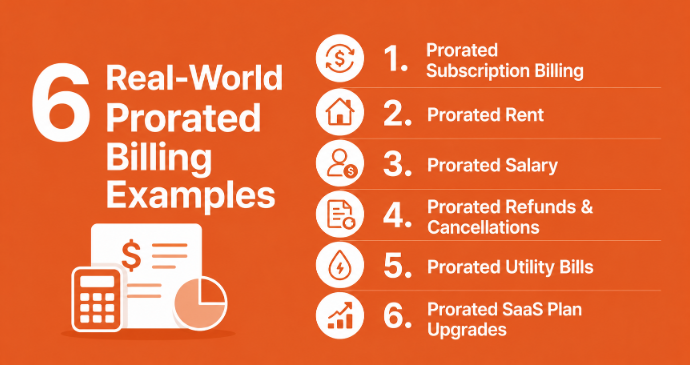
Proration appears across dozens of industries. Here are the most common scenarios with formulas and worked examples:
1. Prorated Subscription Billing
When to use: Customer signs up mid-month, cancels early, or changes plans.
Formula: (Monthly Fee ÷ Days in Month) × Days Used
Example: A project management tool costs $90/month. A customer subscribes on the 11th of a 30-day month. They used the service for 20 days. Prorated charge = ($90 ÷ 30) × 20 = $60
When issuing this kind of invoice, make sure it’s itemized clearly. Learn why itemized invoices matter and how to create them.
2. Prorated Rent
When to use: Tenant moves in or out mid-month.
Formula: (Monthly Rent ÷ Days in Month) × Days Occupied
Example: Rent is $1,500/month. Tenant moves in on the 8th of a 31-day month and occupies for 24 days. Prorated rent = ($1,500 ÷ 31) × 24 = $1,161.29
3. Prorated Salary
When to use: Employee starts or leaves mid-pay period.
Formula: (Annual Salary ÷ Working Days in Year) × Days Worked
Example: Annual salary is $60,000 (250 working days). Employee works 12 days in their first partial month. Prorated pay = ($60,000 ÷ 250) × 12 = $2,880
For HR teams, understanding the difference between gross pay vs. net pay is essential when calculating prorated salary correctly. You can also use InvoPilot’s free payslip generator to produce accurate, professional payslips for partial-period employees.
4. Prorated Refunds & Cancellations
When to use: Customer prepaid and cancels before the period ends.
Formula: (Total Amount Paid ÷ Total Units) × Remaining Units
Example: Customer paid $120 for an annual plan. Cancels after 8 months. Refund = ($120 ÷ 12) × 4 = $40
This scenario often intersects with invoice reconciliation — making sure your books match the credits and refunds issued.
5. Prorated Utility Bills
When to use: Customer moves in/out or service starts/stops mid-billing cycle.
Formula: (Monthly Bill ÷ Days in Month) × Days of Service
Example: Monthly electricity bill averages $90. Customer moves out after 18 days of a 30-day month. Final bill = ($90 ÷ 30) × 18 = $54
6. Prorated SaaS Plan Upgrades
When to use: Customer upgrades/downgrades mid-billing cycle.
Formula: Credit unused days on old plan + Charge remaining days at new plan rate
Example: Customer on $30/month plan upgrades to $60/month on day 16 of a 30-day month. Credit = ($30 ÷ 30) × 14 = $14. New charge = ($60 ÷ 30) × 14 = $28. Net additional charge = $28 − $14 = $14
Which Businesses Need Prorated Billing?
Prorated billing is particularly valuable — and sometimes legally required — for these business types:
| Business Type | Why Proration Matters | Common Trigger |
| SaaS / Software | Plan changes, mid-cycle signups | Upgrade/downgrade/cancel |
| Subscription Boxes | Customer joins mid-cycle | New subscription start |
| Telecom / ISP | Plan changes, service interruptions | Mid-cycle plan switch |
| Property Management | Partial month occupancy | Move-in/move-out dates |
| Utilities (Electric, Gas, Water) | Meter readings on non-standard dates | Service start/stop |
| HR / Payroll | Partial pay periods | Hire/termination date |
| Financial Products | Loan or interest calculations | Partial interest periods |
| Healthcare | Daily billing or partial stays | Admission/discharge dates |
For businesses dealing with vendors across these sectors, a solid vendor invoice management process ensures that incoming prorated bills are tracked, validated, and reconciled properly.
Prorated Billing and ASC 606 Compliance
The Financial Accounting Standards Board (FASB) requires businesses to follow ASC 606 — Revenue from Contracts with Customers. Under these guidelines, revenue must be recognized only when control of a service is transferred to the customer.
For subscription businesses, this directly necessitates proration. You cannot recognize full monthly revenue on a customer’s first day if they subscribed mid-cycle. Prorated billing ensures your invoices and revenue recognition are aligned, which is critical for:
- SaaS companies with recurring revenue models
- Telecom providers with variable service periods
- Real estate and leasing companies
- Healthcare providers billing per service/day
- Any subscription service with mid-cycle changes
⚠️ Compliance Note: Non-compliance with ASC 606 can result in audit issues and restatements. If your business is growing or investor-backed, prorated revenue recognition is not optional.
Benefits and Drawbacks of Prorated Billing
Benefits for Businesses
- Higher customer satisfaction and trust
- Reduced billing disputes and chargebacks
- Improved customer lifetime value (CLV)
- ASC 606 revenue recognition compliance
- Competitive advantage through billing transparency
- Easier upsell/downgrade pathways for customers
Benefits for Customers
- Pay only for what they use — no overpaying
- Flexibility to start, change, or cancel without financial penalty
- Clear, understandable invoices
Clear invoicing also directly impacts your bottom line. See our research on late invoice payment statistics — businesses with transparent billing get paid faster.
Potential Drawbacks (Primarily for Businesses)
- More complex billing calculations — especially for multiple plan tiers
- Requires robust billing infrastructure or software
- Slightly less predictable monthly revenue
- Customer confusion if proration is not clearly communicated
How to Implement Prorated Billing: 6 Best Practices
- Define your proration policy clearly — what triggers it, how it’s calculated, and when it applies
- Use automated billing software to eliminate calculation errors and save time
- Communicate prorated charges proactively — include breakdowns in every invoice. Not sure how? Read our guide on how to send an invoice
- Test all scenarios before going live (new signups, upgrades, downgrades, cancellations, annual plans)
- Train your customer support team so they can explain proration easily and resolve disputes
- Review and audit your proration rules quarterly as your pricing evolves — pair this with a solid invoice-to-cash process to keep cash flow healthy
Alternatives to Prorated Billing
If prorated billing isn’t right for your business model, consider these alternatives:
- Flat-Rate Billing: Charge the same amount regardless of join date. Simple, but may cause customer frustration.
- Rolling Billing Cycles: Each customer’s billing cycle starts on their signup date. Eliminates proration but complicates accounting.
- Credit System: Give customers account credits for unused time, redeemable on future invoices.
- Usage-Based Billing: Bill purely on consumption (API calls, GB stored, etc.). Completely eliminates proration but requires metering infrastructure.
- Discounts for Full Cycles: Incentivize customers to commit to full billing periods with discounts.
Automate Prorated Billing with InvoPilot
Manual prorated calculations are error-prone and time-consuming — especially as your customer base grows. InvoPilot is built for exactly this challenge: smart invoicing that handles proration automatically, so you can focus on running your business instead of spreadsheet math.
What InvoPilot Does for Prorated Billing
- Automatic daily rate calculation based on your billing period and calendar
- Mid-cycle plan change tracking with instant prorated invoice generation
- Credit and refund management for cancellations
- ASC 606-compliant revenue recognition reporting
- Custom invoice templates that show clear proration breakdowns for customers
- Integration with your existing CRM, ERP, and payment gateways
- Real-time billing dashboards so you always know what’s owed
Ready to automate your prorated billing? InvoPilot handles all the math — you just set the rules. Start your free trial at invopilot.com.
Conclusion: Make Prorated Billing a Competitive Advantage
Prorated billing is no longer a “nice to have” — it’s a fundamental expectation in the subscription economy. Customers expect to pay for what they use. Regulators and accounting standards require proportional revenue recognition. And businesses that get it right enjoy higher retention, fewer disputes, and a stronger reputation for fairness.
Whether you’re managing 50 subscriptions or 50,000, the principles are the same: calculate proportionally, communicate clearly, and automate wherever possible. Pair your prorated billing strategy with smart tools for sales invoicing, electronic invoicing, and a clear understanding of net income to build a billing operation that scales.
InvoPilot was designed to make this effortless — from your first prorated invoice to enterprise-scale billing automation.