
Quick Summary: Over 1.57 billion people freelance worldwide. The US freelance economy generated $1.5 trillion in 2024. 85% of freelancers face late payments. India’s gig workforce will nearly triple to 23.5 million by 2029–30. AI-enabled freelancers earn 40% more per hour. Read on for every major stat — fully sourced.
Freelancing is no longer a side hustle or a temporary bridge between “real jobs.” It is the real job — for hundreds of millions of people across every continent.
Whether you’re a freelancer trying to benchmark your rates, a business owner deciding whether to hire contractors, a researcher looking for citation-ready data, or just curious about where the world of independent work is headed — this is the definitive guide.
We’ve compiled over 100 freelance statistics from the most authoritative sources available: Upwork’s Freelance Forward, MBO Partners’ State of Independence 2025, NITI Aayog’s gig economy reports, Remote’s State of Freelance Work 2025, Bonsai invoice analysis, Statista, McKinsey, and more.
Let’s dig in.
Key Freelance Statistics at a Glance (2026)
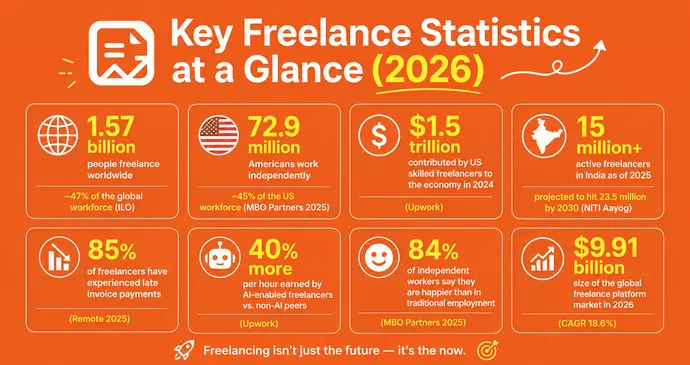
Before diving deep, here are the headline numbers that define freelancing in 2026:
- 🌍 1.57 billion people freelance worldwide — ~47% of the global workforce (ILO)
- 🇺🇸 72.9 million Americans work independently — ~45% of the US workforce (MBO Partners 2025)
- 💰 $1.5 trillion contributed by US skilled freelancers to the economy in 2024 (Upwork)
- 🇮🇳 15 million+ active freelancers in India as of 2025, projected to hit 23.5 million by 2030 (NITI Aayog)
- 📉 85% of freelancers have experienced late invoice payments (Remote 2025)
- 🤖 40% more per hour earned by AI-enabled freelancers vs. non-AI peers (Upwork)
- 😊 84% of independent workers say they are happier than in traditional employment (MBO Partners 2025)
- 📈 $9.91 billion — size of the global freelance platform market in 2026 (CAGR 18.6%)
Global Freelance Market Size Statistics
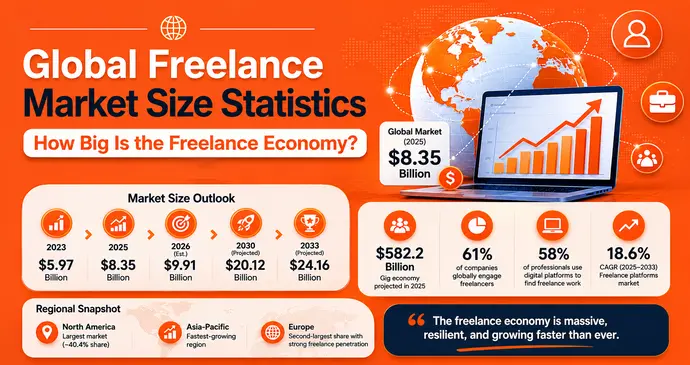
How Big Is the Freelance Economy?
The global freelance economy is one of the fastest-growing sectors in the world. Measuring its exact size depends on methodology — platforms alone, total freelancer earnings, or the entire gig economy — but all data points in one direction: massive and accelerating.
Platform Market Size:
| Year | Market Size | Source |
|---|---|---|
| 2023 | $5.97 billion | Global Growth Insights |
| 2025 | $8.35 billion | Business Research Company |
| 2026 | $9.91 billion (est.) | Business Research Company |
| 2030 | $20.12 billion (projected) | Business Research Company |
| 2033 | $24.16 billion (projected) | Grand View Research |
- The global freelance platforms market was valued at $8.35 billion in 2025, growing to an estimated $9.91 billion in 2026 at an 18.6% CAGR. (Business Research Company)
- By 2030, the freelance platforms market is projected to reach $20.12 billion, representing a 19.4% compound annual growth rate. (Business Research Company)
- By 2033, the market could reach $24.16 billion at an 18.6% CAGR. (Grand View Research)
- The broader gig economy — including delivery, transportation, and all professional services — is projected at $582.2 billion by 2025. (Business Research Insights)
- When including total freelancer earnings across all work types, the global freelance economy is estimated at approximately $500 billion to $1.5 trillion depending on scope. (Various sources)
Regional Breakdown:
- North America is the largest region in the freelance platforms market, commanding ~40.4% of global share.
- Asia-Pacific is the fastest-growing region, with a CAGR outpacing all others.
- Europe holds the second-largest share, with significant freelance penetration in the UK, Germany, and France.
- About 61% of companies globally now engage freelancers. (Global Growth Insights)
- 58% of professionals rely on digital platforms to find freelance work. (Global Growth Insights)
Key Insight: The freelance economy isn’t slowing down. Even as traditional markets fluctuate, demand for skilled independent talent continues its structural upward trend — driven by companies’ need for agility, specialized skills, and cost efficiency.
US Freelancer Statistics
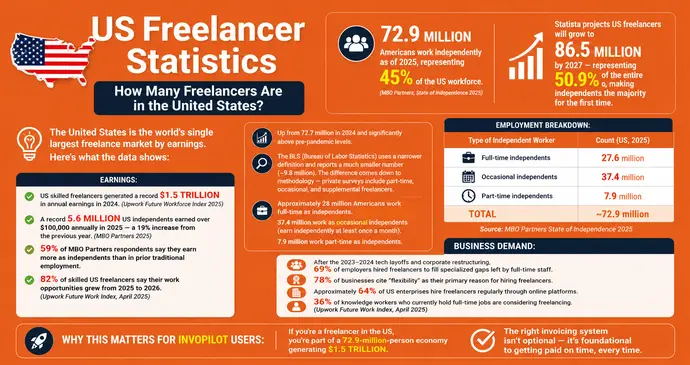
How Many Freelancers Are in the United States?
The United States is the world’s single largest freelance market by earnings. Here’s what the data shows:
Workforce Size:
- 72.9 million Americans work independently as of 2025, representing approximately 45% of the US workforce. (MBO Partners, State of Independence 2025)
- This is up from 72.7 million in 2024 and significantly above pre-pandemic levels.
- Statista projects US freelancers will grow to 86.5 million by 2027 — representing 50.9% of the entire US workforce, making independents the majority for the first time.
- The BLS (Bureau of Labor Statistics) uses a narrower definition (primary occupation in unincorporated businesses) and reports a much smaller number (~9.8 million). The difference comes down to methodology — private surveys include part-time, occasional, and supplemental freelancers.
- Approximately 28 million Americans work full-time as independents. (MBO Partners 2025)
- 37.4 million work as occasional independents (earn independently at least once a month).
- 7.9 million work part-time as independents.
Employment Breakdown:
| Type of Independent Worker | Count (US, 2025) |
|---|---|
| Full-time independents | 27.6 million |
| Occasional independents | 37.4 million |
| Part-time independents | 7.9 million |
| Total | ~72.9 million |
Source: MBO Partners State of Independence 2025
Earnings:
- US skilled freelancers generated a record $1.5 trillion in annual earnings in 2024. (Upwork Future Workforce Index 2025)
- A record 5.6 million US independents earned over $100,000 annually in 2025 — a 19% increase from the previous year. (MBO Partners 2025)
- 59% of MBO Partners respondents say they earn more as independents than in prior traditional employment.
- 82% of skilled US freelancers say their work opportunities grew from 2025 to 2026. (Upwork Future Work Index, April 2025)
Business Demand:
- After the 2023–2024 tech layoffs and corporate restructuring, 69% of employers hired freelancers to fill specialized gaps left by full-time staff. (Various employer surveys)
- 78% of businesses cite “flexibility” as their primary reason for hiring freelancers.
- Approximately 64% of US enterprises hire freelancers regularly through online platforms. (Global Growth Insights)
- 36% of knowledge workers who currently hold full-time jobs are considering freelancing. (Upwork Future Work Index, April 2025)
Why This Matters for InvoPilot Users: If you’re a freelancer in the US, you’re part of a 72.9-million-person economy generating $1.5 trillion. The right invoicing system isn’t optional — it’s foundational to getting paid on time, every time.
India Freelance Statistics
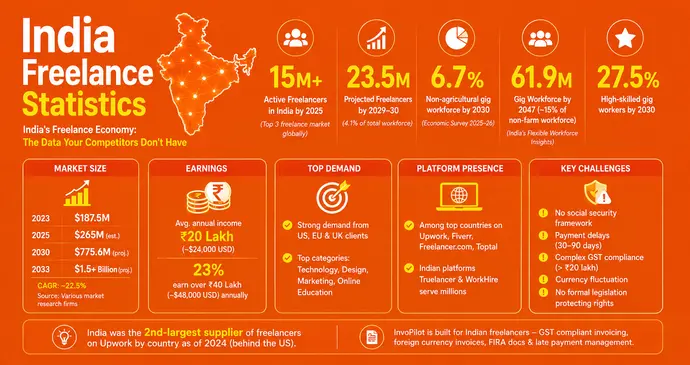
India’s Freelance Economy: The Data Your Competitors Don’t Have
India is one of the world’s largest and fastest-growing freelance markets — yet it remains dramatically underrepresented in most global statistics compilations. Here we fix that.
Workforce Size:
- NITI Aayog estimated 7.7 million gig workers in India in 2020–21. (NITI Aayog Report, 2022)
- By 2025, India had an estimated 15 million+ active freelancers, making it one of the top three freelance markets globally. (Multiple estimates)
- NITI Aayog projects this will grow to 23.5 million (2.35 crore) by 2029–30, representing 4.1% of the entire Indian workforce.
- India’s Economic Survey 2025–26 projects that non-agricultural gig work could reach 6.7% of the nation’s workforce by 2030.
- India’s broader gig workforce could reach 61.9 million by 2047, near 15% of the non-farm workforce. (India’s Flexible Workforce Insights)
- The share of high-skilled gig workers is expected to reach 27.5% by 2030.
Market Size:
| Year | India Freelance Platform Market |
|---|---|
| 2023 | $187.5 million |
| 2025 | $265 million (est.) |
| 2030 | $775.6 million (projected) |
| 2033 | $1.5+ billion (projected) |
*CAGR: ~22.5% – Source: Various market research firms*
India Gig Workforce Breakdown (2020–21, NITI Aayog):
- Sales and retail trade: 26.6 lakh (2.66 million) gig workers
- Transportation: Large segment
- Manufacturing and logistics: Growing
- High-skill digital services (IT, design, content, marketing): Rapidly expanding
Earnings:
- Indian freelancers see average annual incomes around ₹20 lakh (~$24,000 USD) for established professionals.
- 23% of Indian freelancers earn over ₹40 lakh (~$48,000 USD) annually. (Karbon Business, 2025)
- Demand for Indian freelance talent is strongest from US, EU, and UK clients.
- Top income-generating categories: Technology, design, marketing, and online education.
Platform Presence:
- India ranks among the top countries on platforms like Upwork, Fiverr, Freelancer.com, and Toptal by talent count.
- Indian platform Truelancer and WorkHire also serve millions of domestic freelancers.
- Platform commissions range from 5–20% depending on the platform — a significant income leak for Indian freelancers.
Challenges Unique to Indian Freelancers:
- No social security framework — no health insurance, retirement benefits, or paid leave.
- Payment delays of 30–90 days are commonly reported by Indian freelancers.
- Complex GST compliance — freelancers earning above ₹20 lakh must register for GST.
- Currency fluctuation — those earning in USD/EUR face INR volatility.
- No formal legislation protecting freelancer rights — India’s Parliament Committee called for tighter protections in March 2026, but formal legislation remains pending.
Key India-Specific Data (NITI Aayog):
- Workers engaged primarily in platform-centric gig work are growing fastest in metro cities.
- The COVID-19 pandemic was a major catalyst — job losses accelerated adoption of freelancing platforms.
- India was the 2nd-largest supplier of freelancers on Upwork by country as of 2024, behind only the US.
InvoPilot Relevance: Indian freelancers face unique invoicing challenges — GST compliance, foreign currency invoicing, FIRA documentation, and late payments from international clients. InvoPilot is built to handle these specific pain points.
Freelancer Earnings & Pay Statistics
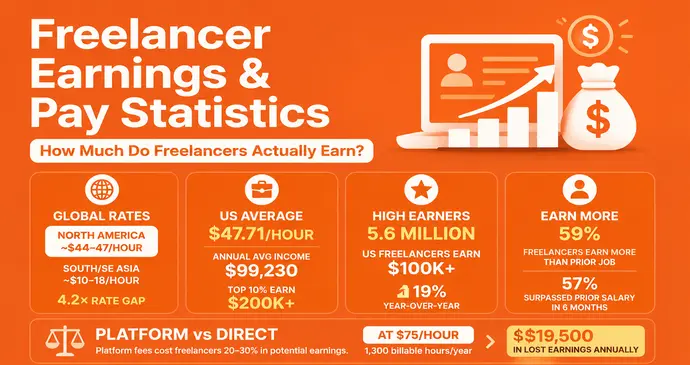
How Much Do Freelancers Actually Earn?
Freelancer earnings vary enormously by geography, skill, experience, and whether the freelancer works through platforms or direct client relationships. Here’s the full picture:
US Earnings:
- US freelancers average approximately $47 an hour for skilled work. (Upwork)
- Annual average US freelancer income: approximately $99,230 (ZipRecruiter data)
- Top 10% of US freelancers earn over $200,000 annually.
- 25th percentile: ~ $24 an hour | 75th percentile: ~ $62 an hour
- Full-time freelancers’ median income meets or exceeds comparable full-time employee peers, especially in tech, design, and consulting. (Upwork)
Global Earnings by Region:
| Region | Average Hourly Rate |
|---|---|
| North America | ~$44–47/hour |
| Western Europe | ~$38.50/hour |
| Eastern Europe | ~$18–25/hour |
| Latin America | ~$15–22/hour |
| South/Southeast Asia | ~$10–18/hour |
| India | ~$12–20/hour |
Source: Upwork, Jobbers.io 2026 Rate Index
Note: North American rates average 4.2× South/Southeast Asian rates for the same services — a gap that has actually widened from 3.8× in 2020.
Earnings by Skill Category:
| Skill | Hourly Rate Range | Median |
|---|---|---|
| LLM Development | $150–$250/hour | $180 |
| AI Strategy Consulting | $80–$300/hour | $150 |
| ML Engineering | $60–$200/hour | $120 |
| Cybersecurity | $80–$180/hour | $120 |
| UX/UI Design | $45–$150/hour | $75 |
| Full-Stack Development | $60–$120/hour | $85 |
| Digital Marketing Strategy | $50–$150/hour | $85 |
| Video Editing / Motion | $40–$120/hour | $65 |
| Graphic Design | $30–$80/hour | $45 |
| Content Writing / Copywriting | $25–$75/hour | $35 |
| SEO Consulting | $40–$100/hour | $65 |
| Social Media Management | $25–$80/hour | $40 |
| Data Entry (declining) | $10–$20/hour | $14 |
Source: Jobbers.io Rate Index 2026, PayScale, index.dev
High Earners:
- A record 5.6 million US independents crossed $100,000 annually in 2025 — the highest figure MBO Partners has ever recorded.
- This represents a 19% year-over-year increase.
- The top earners in AI/ML fields command $150–$600/hour for specialized work.
Earnings vs. Traditional Employment:
- 59% of MBO Partners independents say they earn more as freelancers than at their last traditional job.
- Of those earning more, 57% surpassed their prior salary within just 6 months of going independent.
- 45% of freelancers overall report higher earnings than in traditional employment.
Platform vs. Direct:
- Freelancers working through platforms typically charge 20–30% less than those with direct client relationships — underscoring the value of building a personal client network.
- At a $75/hour rate, the difference between 20% platform commission and 0% commission amounts to $19,500 in lost earnings annually (based on 1,300 billable hours/year).
Freelance Payment Problem Statistics
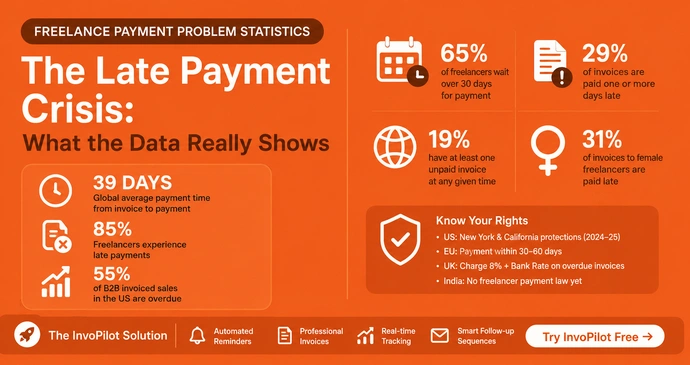
The Late Payment Crisis: What the Data Really Shows
Late and missing payments are freelancing’s single biggest operational challenge. The statistics are alarming — and every freelancer and client relationship manager needs to understand them.
The Scale of the Problem:
- 85% of freelancers worldwide have experienced late payments at least some of the time. (Remote, State of Freelance Work 2025)
- 21% of freelancers are paid late — or not paid at all — more than half the time. (Remote 2025)
- 29% of all freelance invoices are paid one or more days late. (Bonsai, analysis of 100,000+ invoices)
- 65% of freelancers wait over 30 days for payment globally. (Jobbers.io 2026 research across 22,847 transactions)
- 33% of freelancers wait over 60 days for payment.
- 19% of freelancers have at least one unpaid invoice at any given time.
- The global average payment time for freelancers is 39 days from invoice submission to funds received. (Jobbers.io 2026)
By Geography:
| Country/Region | Median Payment Time |
|---|---|
| Singapore | 11–12 days |
| Netherlands | 12 days |
| Germany | 14 days |
| United States | ~21 days |
| United Kingdom | ~24 days |
| India | 30–90 days (reported) |
| Spain | 52–56 days |
| Italy | 56+ days |
| Greece | 56+ days |
Source: Jobbers.io 2026 Payment Research
Gender Disparity:
- Female freelancers see late payments on 31% of invoices.
- Male freelancers see late payments on 24% of invoices.
- A 7-percentage-point gap — female freelancers face a structurally worse payment environment. (Bonsai 2024)
The Business Cost:
- 14% of small businesses spend 5+ hours weekly chasing overdue payments. (Remote 2026)
- At $75/hour, 5 hours/week = $19,500/year in lost revenue potential from payment chasing alone.
- 5 weeks/year (260 hours) wasted chasing payments for businesses that spend 5+ hours/week.
- 55% of all B2B invoiced sales in the US are overdue. (Kaplan Group 2025)
- 25% of all EU business bankruptcies are caused, at least in part, by late invoice payments. (European Commission 2024)
- 50,000 UK small businesses close annually due to untimely customer payments. (FSB / Clockify 2025)
- 47% of EU businesses reported problems due to outstanding invoices in 2024 — the highest in 5 years. (European Commission 2024)
India-Specific:
- Many Indian freelancers report waiting 30 to 90 days for client payments, particularly from domestic clients.
- Cross-border payment delays are compounded by SWIFT processing times and foreign inward remittance documentation requirements.
Platform Payment Delays:
Platforms add their own layer of payment delays:
- 14–30 day escrow holds
- 7–14 day dispute windows (even when no dispute exists)
- 3–7 day payment processing
- 1–10 day withdrawal times
- Total potential platform-added delay: up to 60+ days from work completion to funds in hand
Legal Protections (Key Laws):
- New York Freelance Isn’t Free Act (August 2024): Requires written contracts for services ≥ $800; non-compliant clients face double damages (a $5,000 unpaid invoice = $10,000 judgment).
- California Freelance Worker Protection Act (January 2025): Written contracts required for services ≥ $250; freelancers can file complaints with California Labor Commissioner.
- EU Late Payment Directive: Requires business-to-business payment within 30–60 days; statutory interest allowed.
- UK Late Payment of Commercial Debts Act: Statutory right to charge 8% + Bank of England base rate on overdue invoices.
- India: No equivalent freelancer payment protection legislation yet — Parliament Committee recommended protections in March 2026, pending formal enactment.
The InvoPilot Solution: InvoPilot is designed specifically for freelancers battling late payments. With automated payment reminders, professional branded invoices, real-time tracking, and smart follow-up sequences, InvoPilot users spend less time chasing payments and more time doing billable work. Try InvoPilot free →
Freelance Demographics Statistics
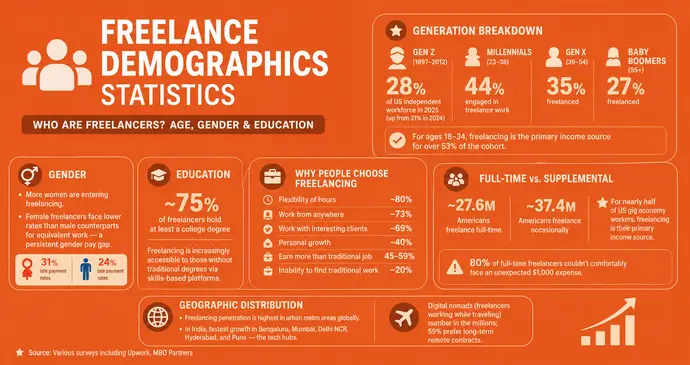
Who Are Freelancers? Age, Gender & Education
Generation Breakdown:
- Gen Z (born 1997–2012) makes up 28% of the US independent workforce in 2025, up from 21% in 2024. (MBO Partners 2025)
- 52% of Gen Z took on freelance work in 2023; by 2024, 53% of Gen Z freelancers do so full-time.
- 44% of Millennials (ages 23–38) engaged in freelance work.
- 35% of Gen X freelanced.
- 27% of Baby Boomers freelanced.
- For ages 18–34, freelancing is the primary income source for over 53% of the cohort.
Gender:
- More women are entering freelancing: Female freelancers have grown consistently since COVID-19.
- However, female freelancers still face lower rates than male counterparts for equivalent work — a persistent gender pay gap in the gig economy.
- Female freelancers experience 31% late payment rates vs. 24% for male freelancers. (Bonsai 2024)
Education:
- ~75% of freelancers hold at least a college degree — the independent workforce is highly educated.
- However, freelancing is increasingly accessible to those without traditional degrees via skills-based platforms.
Why People Choose Freelancing:
| Reason | % of Freelancers |
|---|---|
| Flexibility of hours | ~80% |
| Work from anywhere | ~73% |
| Work with interesting clients | ~69% |
| Personal growth | ~40% |
| Earn more than traditional job | ~45–59% |
| Inability to find traditional work | ~20% |
Source: Various surveys including Upwork, MBO Partners
Full-Time vs. Supplemental:
- ~27.6 million Americans freelance full-time.
- ~37.4 million Americans freelance occasionally (supplemental income).
- For nearly half of US gig economy workers, freelancing is their primary income source.
- 80% of full-time freelancers couldn’t comfortably face an unexpected $1,000 expense — underscoring the income volatility challenge.
Geographic Distribution:
- Freelancing penetration is highest in urban metro areas globally.
- In India, freelancing growth is fastest in Bengaluru, Mumbai, Delhi NCR, Hyderabad, and Pune — the tech hubs.
- Digital nomads (freelancers working while traveling) number in the millions; 59% of freelancers prefer long-term remote contracts.
Freelancer Happiness & Satisfaction Statistics
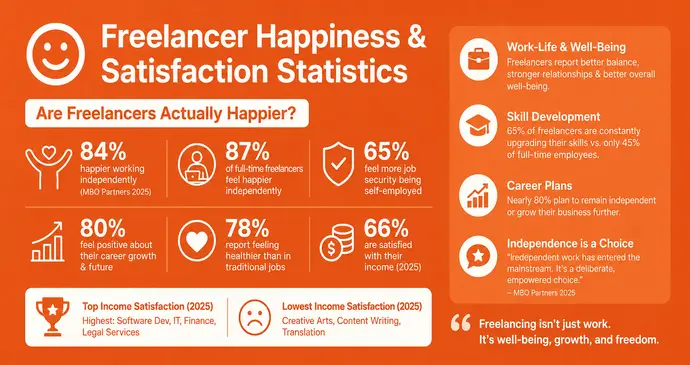
Are Freelancers Actually Happier?
The data is clear: freelancers report consistently higher satisfaction, happiness, and well-being than traditional employees — even when accounting for income volatility.
Happiness & Satisfaction:
- 84% of MBO Partners independents report being happier working independently than in traditional employment. (MBO Partners 2025)
- 87% of full-time freelancers feel happier working independently vs. traditional jobs. (Various surveys)
- 97% of independent contractors felt happier than traditional workers in McKinsey research.
- 80% of freelancers feel positive about their career growth and future. (Upwork)
- 66% of freelancers are satisfied with their income (2025 survey of 3,571 freelancers). (Freelancermap 2025)
- 75% of workers with a side hustle are highly satisfied with their freelance work, vs. only 47% satisfaction in their primary full-time job.
Work-Life & Well-Being:
- 78% of freelancers report feeling healthier than when in traditional employment.
- 71% of freelancers believe freelancing provides a better way to support their families.
- 64% of freelancers believe freelancing allows them to have stronger personal relationships.
- 65% of full-time freelancers feel more job security being self-employed vs. nearly 47% of traditional employees who worry about their job security.
- 64% of full-time freelancers say no amount of money could make them return to a traditional 9-to-5.
- Freelancers work an average of 43 hours per week — comparable to traditional employment but with far greater autonomy.
Income Satisfaction by Industry (2025):
- Highest income satisfaction: Software development, IT, finance, and legal services
- Lowest income satisfaction: Creative arts, content writing, translation (sectors facing AI-driven rate compression)
Skill Development:
- 65% of freelancers are constantly upgrading their skills, vs. only 45% of full-time employees. (Founderjar)
- Freelancers report faster skill acquisition due to exposure to diverse clients, industries, and projects.
Career Plans:
- Nearly 80% of MBO Partners independents plan to remain independent or grow their business further.
- Independence is increasingly a deliberate career choice, not a fallback.
MBO Partners 2025 on Independence: “Independent work has entered the mainstream. It’s no longer an alternative; it is a deliberate, empowered choice. What began as a niche has become a movement.”
AI & Technology’s Impact on Freelancing Statistics
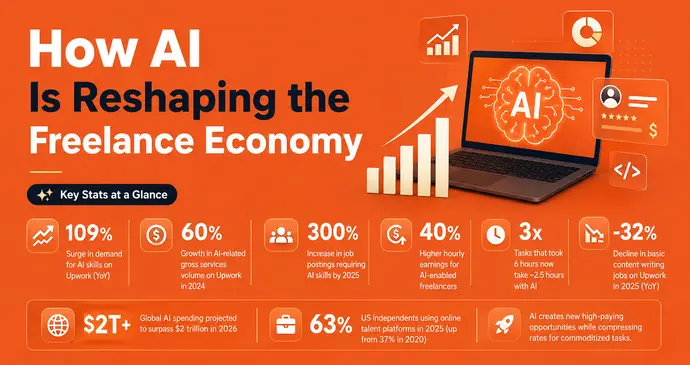
How AI Is Reshaping the Freelance Economy
Artificial intelligence is transforming freelancing faster than any previous technological shift. The data tells a nuanced story — AI creates new high-paying opportunities while compressing rates for commoditized tasks.
AI Demand:
- Demand for AI skills on Upwork has surged over 109% year-over-year. (Upwork 2026 Report)
- AI-related gross services volume on Upwork grew 60% year-on-year in 2024.
- Job postings requiring AI skills grew 300% year-on-year by 2025.
- Demand for AI Integration Specialists scores 94/100 on the Jobbers.io Skills Demand Index.
- LLM development, computer vision, MLOps, and NLP are the fastest-growing sub-categories.
AI Earnings Premium:
- AI-enabled freelancers earn approximately 40% more per hour than peers not using AI tools. (Upwork, global survey of 4,360+ freelancers)
- 84% of skilled freelancers are excited by the prospect of AI tools reshaping their work. (Upwork Future Work Index 2025)
- Freelancers using AI workflows report tasks previously taking 6 hours now take ~2.5 hours — effectively tripling profit per hour when rates stay constant.
Top AI Freelance Rates (2026):
| AI Specialty | Hourly Rate Range |
|---|---|
| AI Strategy Consulting | $80–$300/hour |
| LLM Fine-tuning & Deployment | $150–$250/hour |
| Computer Vision Engineering | $120–$200/hour |
| MLOps & Model Deployment | $100–$180/hour |
| Healthcare AI | $100–$250/hour |
| Financial Services AI | $120–$300/hour |
| AI Application Development | $55–$180/hour |
Source: Jobbers.io AI/ML Rate Analysis 2026, Upwork
AI’s Impact on Lower-Skilled Work:
- Basic content writing jobs on Upwork declined 32% year-over-year in 2025.
- Transcription rates declined 35% (inflation-adjusted) from 2020–2026.
- Data entry rates declined 28% over the same period.
- Basic translation (common language pairs) down 10%.
- Basic graphic design down 12%.
AI Infrastructure:
- Global AI spending is projected to surpass $2 trillion in 2026, growing toward $3.3 trillion by 2029. (Gartner, cited in Vention State of AI 2026)
- Enterprise AI spending is growing 30%+ annually — directly driving demand for AI-capable freelancers.
- 63% of US independent professional service providers use online talent platforms in 2025, up from 37% in 2020. (MBO Partners 2025)
Freelance Platform Statistics
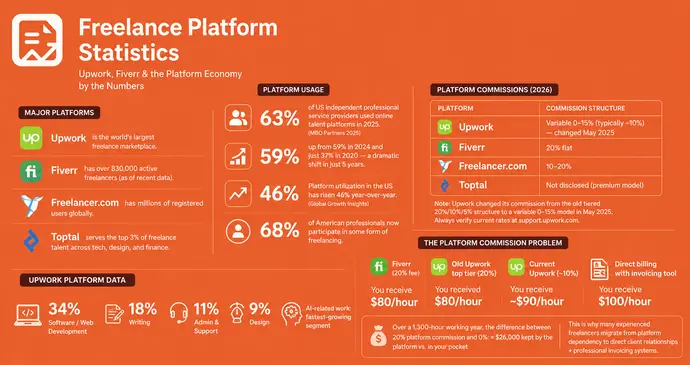
Upwork, Fiverr & the Platform Economy by the Numbers
Major Platforms:
- Upwork is the world’s largest freelance marketplace.
- Fiverr has over 830,000 active freelancers (as of recent data).
- Freelancer.com has millions of registered users globally.
- Toptal serves the top 3% of freelance talent across tech, design, and finance.
Platform Usage:
- 63% of US independent professional service providers used online talent platforms in 2025. (MBO Partners 2025)
- This is up from 59% in 2024 and just 37% in 2020 — a dramatic shift in just 5 years.
- Platform utilization in the US has risen 46% year-over-year. (Global Growth Insights)
- 68% of American professionals now participate in some form of freelancing.
Platform Commissions (2026):
| Platform | Commission Structure |
|---|---|
| Upwork | Variable 0–15% (typically ~10%) — changed May 2025 |
| Fiverr | 20% flat |
| Freelancer.com | 10–20% |
| Toptal | Not disclosed (premium model) |
Note: Upwork changed its commission from the old tiered 20%/10%/5% structure to a variable 0–15% model in May 2025. Always verify current rates at support.upwork.com.
Upwork Platform Data:
- Software/web development: 34% of Upwork platform activity
- Writing: 18%
- Admin and support: 11%
- Design: 9%
- AI-related work: fastest-growing segment
The Platform Commission Problem:
On a $100/hour rate:
- Fiverr (20% fee): You receive $80/hour
- Old Upwork top tier (20%): You received $80/hour
- Current Upwork (~10%): You receive ~$90/hour
- Direct billing with invoicing tool: You receive $100/hour
Over a 1,300-hour working year, the difference between 20% platform commission and 0%: = $26,000 kept by the platform vs. in your pocket
This is why many experienced freelancers migrate from platform dependency to direct client relationships + professional invoicing systems.
Top Freelance Skills & Demand Statistics
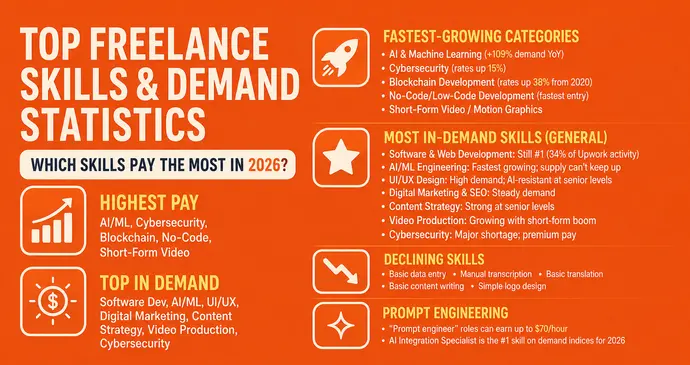
Which Freelance Skills Pay the Most in 2026?
Fastest-Growing Categories:
- AI & Machine Learning (+109% demand YoY on Upwork)
- Cybersecurity (critical shortage, rates up 15%)
- Blockchain Development (rates up 38% from 2020)
- No-Code/Low-Code Development (fastest entry point for new freelancers)
- Short-Form Video / Motion Graphics (driven by social media platform growth)
Most In-Demand Skills (General):
- Software & Web Development: Still #1 on most platforms, 34% of Upwork activity
- AI/ML Engineering: Fastest growing; supply cannot meet demand
- UI/UX Design: Consistently high demand; visual work AI-resistant at senior levels
- Digital Marketing & SEO: Steady demand; heavily impacted by AI tools at junior levels
- Content Strategy: Senior, strategic content work remains strong; commodity writing declining
- Video Production: Growing with short-form content explosion
- Cybersecurity: Major talent shortage; governments and enterprises paying premium
Declining Skills:
- Basic data entry
- Manual transcription
- Basic translation (common language pairs)
- Basic content writing (commodity level)
- Simple logo design (commodity level)
Prompt Engineering:
- “Prompt engineer” roles can command up to $70/hour on specialized platforms.
- AI Integration Specialist is the single highest-scoring skill on demand indices for 2026.
Future of Freelancing: Predictions & Trends for 2026–2030
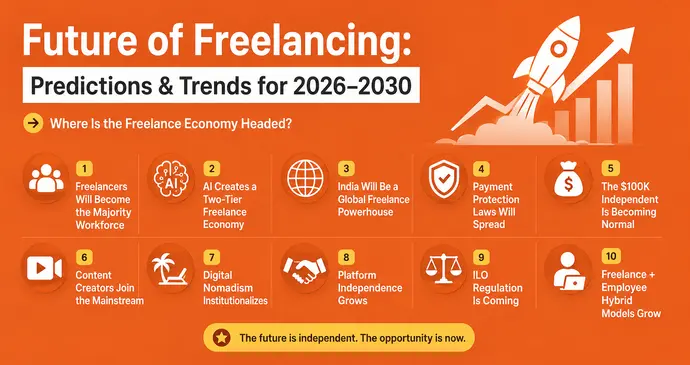
Where Is the Freelance Economy Headed?
Based on all available data, here are the major trends shaping the next 3–5 years of freelancing:
1. Freelancers Will Become the Majority Workforce in the US Statista’s projection: 86.5 million US freelancers by 2027 = 50.9% of the workforce. The tipping point is near.
2. AI Creates a Two-Tier Freelance Economy Freelancers who embrace AI tools will earn significantly more (+40% per hour). Those offering undifferentiated, AI-replaceable services will face increasing commoditization and rate compression. The middle ground is shrinking.
3. India Will Be a Global Freelance Powerhouse With 23.5 million freelancers projected by 2029–30, India’s gig workforce will be among the world’s largest. Government attention (Parliamentary committees, Economic Survey acknowledgment) signals the sector will gain regulatory frameworks and potentially protections.
4. Payment Protection Laws Will Spread Following New York (2024) and California (2025), more states and countries are expected to enact freelancer payment protection legislation. Structured invoicing and documented payment terms will become legally necessary.
5. The $100K Independent Is Becoming Normal 5.6 million US independents earned $100K+ in 2025 — a 19% YoY increase. As freelancers gain AI leverage and develop premium niches, six-figure independent income will become increasingly attainable.
6. Content Creators Join the Mainstream The number of independent content creators jumped 13% in 2025 to 10.1 million — the largest single-year increase recorded. (MBO Partners 2025)
7. Digital Nomadism Institutionalizes 59% of freelancers prefer long-term remote contracts. 60% of freelancers work remotely vs. 32% of non-freelance professionals. Dedicated digital nomad visa programs are expanding globally.
8. Platform Independence Grows As freelancers mature and build client relationships, dependency on high-commission platforms decreases. Direct invoicing, direct contracts, and personal brand building become the preferred long-term strategy — driving demand for tools like InvoPilot.
9. ILO Regulation Is Coming In 2025, the International Labour Organization (ILO) began formal standard-setting discussions on platform work — potentially leading to international binding conventions on fair pay, working conditions, and social protections for gig workers.
10. Freelance + Employee Hybrid Models Grow More workers will maintain both a part-time traditional job and freelance income simultaneously — blurring the distinction further. Occasional independents (37.4 million in the US) already do this.
FAQs
How many freelancers are there in the world in 2026?
There are an estimated 1.57 billion freelancers worldwide in 2026, representing roughly 46–47% of the global workforce according to ILO self-employment data. However, this broad figure includes subsistence farmers and informal traders in developing economies. The World Bank’s narrower estimate for workers routinely using online platforms is 154–435 million.
How many freelancers are there in the United States?
72.9 million Americans work independently as of 2025 (MBO Partners State of Independence 2025), representing approximately 45% of the US labor force. Statista projects this will grow to 86.5 million by 2027 — surpassing 50% of the US workforce for the first time.
How much do freelancers earn per hour?
US freelancers average approximately $47.71/hour for skilled work (Upwork). Globally, rates range from $10–18/hour in South/Southeast Asia to $44–47/hour in North America. AI/ML specialists command $80–$300/hour. A record 5.6 million US independents crossed $100,000 annually in 2025 (MBO Partners).
What percentage of freelancers experience late payments?
85% of freelancers experience late invoice payments at least some of the time (Remote 2025). 21% are paid late or not at all more than half the time. 29% of all freelance invoices are paid one or more days late (Bonsai, 100K+ invoice analysis). The global average payment time is 39 days from invoice submission to receipt.
How big is the freelance market in India?
India had an estimated 15 million+ active freelancers in 2025. NITI Aayog projects growth to 23.5 million by 2029–30 (4.1% of total workforce). The India freelance platform market is expected to grow from $265 million in 2025 to over $1.5 billion by 2033 at a ~22.5% CAGR. India is the 2nd-largest supplier of talent on Upwork globally.
Are freelancers happier than traditional employees?
Yes — consistently. 84% of MBO Partners independents report greater happiness (2025). 80% of Upwork freelancers feel positive about career growth. 65% of full-time freelancers feel more job security than traditional employees. 59% earn more as freelancers than in prior traditional employment.
What is the most in-demand freelance skill in 2026?
AI and Machine Learning is the fastest-growing skill by demand — with a 109% surge in demand on Upwork and an AI Integration Specialist demand score of 94/100. AI-enabled freelancers earn approximately 40% more per hour than peers not using AI. LLM development specialists command $150–$250/hour.
What percentage of Gen Z freelances?
52% of Gen Z (ages 18–26) took on freelance work in 2023. By 2024, 53% of Gen Z freelancers do so full-time. Gen Z now makes up 28% of the entire US independent workforce (2025), up from 21% in 2024, per MBO Partners.
Do freelancers need invoicing software?
Given that 85% of freelancers face late payments and 14% of small businesses waste 5+ hours weekly chasing overdue invoices, professional invoicing software is not optional — it’s essential. Tools like InvoPilot automate payment reminders, track invoice status, generate GST-compliant invoices, and reduce payment delays, allowing freelancers to focus on billable work rather than admin.
What are the biggest challenges freelancers face?
According to aggregated survey data, the top challenges are:
- Late or non-payment (85% experience this)
- Income instability and unpredictable cash flow
- Finding consistent clients
- Managing taxes and compliance (especially GST in India)
- No access to employee benefits (health insurance, retirement, paid leave)
- Isolation and lack of community
- Scope creep and difficult client relationships
Sources & Methodology
All statistics in this article are sourced from reputable primary and secondary research. We cite original sources wherever possible and note when data has been compiled from aggregated estimates.
Primary Sources Used:
| Source | Report / Data |
|---|---|
| Upwork | Freelance Forward 2023, Future Work Index April 2025, Freelancing Stats 2026 |
| MBO Partners | State of Independence 2025 (15th Annual Report) |
| NITI Aayog | India Gig Worker Report 2022 |
| India Economic Survey | 2025–26 Edition |
| Remote | State of Freelance Work 2025 |
| Bonsai | Invoice Analysis (100,000+ freelancers, 3 years) |
| Statista | Freelancer count projections, market size data |
| Grand View Research | Freelance Platforms Market Report |
| Business Research Company | Global Freelance Platforms Market 2026 |
| Global Growth Insights | Freelance Platforms Market Feb 2026 |
| Jobbers.io | Payment Delay Report 2026, Rate Index 2026, Skills Demand Index 2026 |
| Kaplan Collection Agency | B2B Payment Delays Report 2025 |
| European Commission | Late Payments Report 2024 |
| McKinsey Global Institute | Future of Work / Independent Workers |
| Freelancermap | Freelance Income Satisfaction Survey 2025 (3,571 respondents) |
| ILO | Self-employment global labor data |
| World Bank | Online gig worker estimates |
Data Notes:
- Freelancer counts vary significantly by methodology. We present multiple estimates with source context.
- Earnings data represents averages/medians and should not be taken as guarantees of individual income.
- Market size figures vary by research firm scope — platform-only vs. total freelance economy definitions differ.
- India data relies heavily on NITI Aayog (2022 report) — official government estimates lag real-time growth.
- All figures are as of the dates cited; the freelance economy changes rapidly.
Update Schedule: This article is reviewed and updated quarterly. Last updated: May 2026.
About InvoPilot
InvoPilot is a professional invoicing tool built for freelancers, consultants, and independent professionals. We know the pain of late payments, chasing clients, and managing invoice admin — because 85% of freelancers live it every day.
InvoPilot helps you:
- Create professional invoices in minutes (including GST-compliant formats for India)
- Automate payment reminders — no more awkward follow-up emails
- Track invoice status in real time — know exactly what’s paid and what’s overdue
- Accept payments faster — with integrated payment options
- Look professional to clients with branded invoice templates
[Start Free with InvoPilot — No Credit Card Required →]