
What Is a Recurring Invoice?
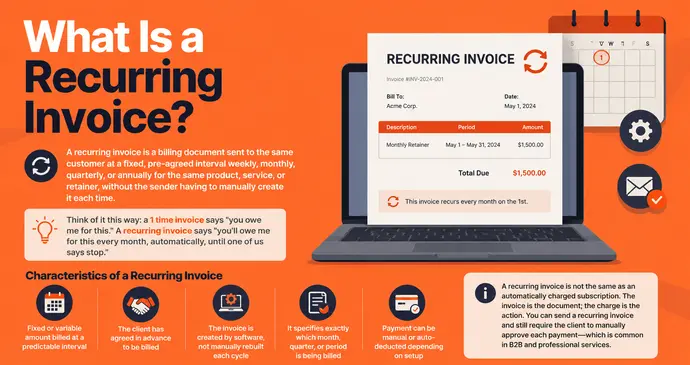
A recurring invoice is a billing document sent to the same customer at a fixed, pre-agreed interval weekly, monthly, quarterly, or annually for the same product, service, or retainer, without the sender having to manually create it each time.
Think of it this way: a 1 time invoice says “you owe me for this.” A recurring invoice says “you’ll owe me for this every month, automatically, until one of us says stop.”
That distinction sounds simple. But most businesses treat recurring invoices like regular invoices they happen to send repeatedly. That misunderstanding is the source of late payments, compliance headaches, and silent revenue leaks.
The right way to think about a recurring invoice is as a billing contract made visible. It documents a standing financial agreement. Every time it lands in a client’s inbox, it renews trust or erodes it, if the invoice is confusing, inaccurate, or poorly structured.
Characteristics of a Recurring Invoice
- Fixed or variable amount billed at a predictable interval
- The client has agreed in advance to be billed
- The invoice is created by software, not manually rebuilt each cycle
- It specifies exactly which month, quarter, or period is being billed
- Payment can be manual or auto-deducted depending on setup
A recurring invoice is not the same as an automatically charged subscription. The invoice is the document; the charge is the action. You can send a recurring invoice and still require the client to manually approve each payment which is common in B2B and professional services.
Recurring Invoice vs Recurring Billing
These 2 terms are used interchangeably across the internet including by major software companies. They are not the same thing.
| Recurring Invoice | Recurring Billing | |
|---|---|---|
| What it is | A document sent to a client on a schedule | A payment charged to a client on a schedule |
| Client action required? | Sometimes (manual payment) | No (auto-deduction) |
| Common in | B2B services, consulting, retainers | SaaS, subscriptions, memberships |
| Paper trail | Yes — invoice is sent | May or may not generate an invoice |
| Client sees amount before paying? | Yes | Not always |
The practical difference: A law firm sends a recurring invoice to its client every month. The client reviews it, confirms the hours and charges look right, and then pays. That is recurring invoicing. A streaming service automatically charges your card every month without sending you a traditional invoice. That is recurring billing.
Both approaches are valid but they serve different relationships and industries. Many B2B businesses use recurring invoices with auto pay enabled, giving clients the invoice visibility they expect while still automating the payment collection.
Understanding this difference helps you choose the right workflow and avoid disputes where clients feel charged without documentation.
Who Uses Recurring Invoices?
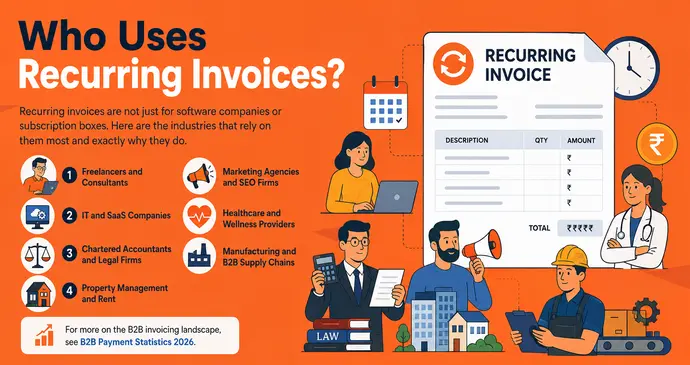
Recurring invoices are not just for software companies or subscription boxes. Here are the industries that rely on them most and exactly why they do.
1. Freelancers and Consultants
Freelancers on monthly retainers send recurring invoices to document hours or a fixed monthly fee. A copywriter on a ₹50,000/month retainer should not be rebuilding that invoice from scratch every four weeks. A recurring invoice automates the document while leaving space to update notes or itemize work done.
Related: How to Write an Invoice: Step-by-Step Guide for Freelancers & Businesses
2. IT and SaaS Companies
Software businesses often combine recurring billing on the back end with recurring invoices sent to finance departments — especially in enterprise B2B, where procurement teams require a paper invoice for every charge regardless of automation.
3. Chartered Accountants and Legal Firms
Professional service firms bill clients monthly for ongoing advisory, compliance, or litigation support. A recurring invoice protects both parties: it establishes what was agreed and creates an auditable record. Read more on tax invoice requirements to understand compliance needs here.
4. Property Management and Rent
Recurring invoices for rent, maintenance fees, or property management services are standard in real estate. Monthly billing with a fixed amount and clear property reference is a textbook recurring invoice use case. For property businesses managing rental units, keeping details such as apartments in Delhi organized alongside recurring rent invoices can also make billing and record-keeping easier.
5. Marketing Agencies and SEO Firms
Agencies run on retainers. Monthly recurring invoices for strategy, content, paid media management, or SEO services are the backbone of agency cash flow. A poorly structured recurring invoice is one of the top reasons agencies experience payment disputes.
6. Healthcare and Wellness Providers
Clinics, gyms, physiotherapists, and wellness centres use recurring invoices for membership, subscription packages, or ongoing treatment plans. These often need to comply with specific tax rules (GST-exempt services vs taxable services).
7. Manufacturing and B2B Supply Chains
Suppliers delivering raw materials, packaging, or services on a scheduled cadence (weekly delivery, monthly service contract) use recurring invoices to streamline procurement on both ends.
For more on the B2B invoicing landscape, see B2B Payment Statistics 2026.
Anatomy of a Perfect Recurring Invoice
Most guides list generic invoice fields. This section focuses specifically on what a recurring invoice needs that a one-time invoice does not.
Required on Every Recurring Invoice
1. Invoice Number with Cycle Indicator
Use a numbering format that indicates the cycle, such as INV-2026-07-001 (year-month-sequence) or INV-CLIENT-0034. This prevents numbering confusion when you have multiple active recurring clients and makes reconciliation easier.
2. Billing Period
This is the single biggest omission on recurring invoices. Your invoice date tells the client when you sent it. The billing period tells them what they’re being billed for. Always include:
“Billing period: 1 June 2026 – 30 June 2026”
Without this, clients raise disputes. Finance teams can’t match invoices to their records. Payments are delayed.
3. Service Description That Doesn’t Say “Monthly Services”
Vague line items are a compliance and trust problem. Instead of “Professional services – ₹30,000,” write “Monthly SEO retainer – keyword research, on-page optimization, and monthly report – June 2026 – ₹30,000.” Specificity eliminates disputes before they start.
4. Payment Terms and Due Date
Net 15, Net 30, or due on receipt — whatever the agreement, it must be on every invoice. For recurring invoices, the due date should be consistent (e.g., always the 10th of the month) to train client payment behavior.
Learn how specific payment terms affect how fast you actually get paid: Invoice Payment Terms That Actually Get You Paid Faster
5. Cumulative Invoice Reference
For long-term clients, consider adding a running total: “This is invoice #12 of 24 in your annual agreement.” This reduces cancellation disputes and gives the relationship a natural endpoint that both parties track.
6. GST/Tax Details
For Indian businesses, every recurring tax invoice must comply with GST rules. This includes GSTIN of both parties, HSN/SAC code, and correct CGST/SGST/IGST breakdown. We cover this in detail in the GST section below.
7. Clear Payment Instructions
Bank details, UPI ID, or payment link — every recurring invoice should include the exact payment method. Even if the client has paid you 11 times before, always include it. People lose emails, switch finance teams, and forget.
You can generate a professional recurring invoice with all these fields using InvoPilot’s free Invoice Generator.
How to Set Up a Recurring Invoice?
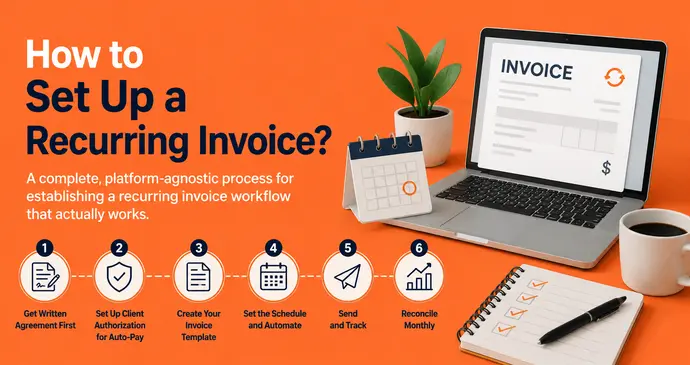
Here is a complete, platform-agnostic process for establishing a recurring invoice workflow that actually works.
Step 1: Get Written Agreement First
Before sending a single recurring invoice, document the agreement. This does not need to be a formal contract even an email confirmation works but it must state:
- The service or product being billed
- The amount (or how it will be calculated)
- The billing frequency and start date
- Any agreed end date or cancellation terms
- Whether payments will be auto-charged or manually approved
Skipping this step causes the majority of recurring invoice disputes.
Step 2: Set Up Client Authorization for Auto-Pay
If you plan to auto-charge the client’s card or bank account, you must obtain explicit written authorization. This is a legal requirement in most jurisdictions, not just good practice. The authorization should clearly state what amounts will be charged, when, and how the client can cancel.
Step 3: Create Your Invoice Template
Build a master template that includes all the recurring fields. Lock in: your business details, client details, line items, GST/tax setup, payment terms, and bank details. You will use this template to auto-generate each cycle’s invoice.
Step 4: Set the Schedule and Automate
Choose your billing cycle where many businesses make the wrong call. See the next section for how to decide.
If you are using invoicing software, create the recurring invoice schedule in the platform. If you are managing invoices manually, set a calendar reminder 2–3 days before the invoice is due so you have time to review and send.
Step 5: Send and Track
Send the invoice at a consistent time – same day of every month. Track whether it has been opened, whether payment has been received, and when payment is due. If payment is not received 3 days before the due date, trigger a gentle reminder.
Step 6: Reconcile Monthly
Every month, reconcile your sent recurring invoices against payments received. This is a non-negotiable accounting practice. Missing this step is how businesses discover 60 days later that a client has not paid for three cycles.
For a deeper look at this process, read What is Invoice Reconciliation and How to Reconcile Invoices?
Recurring Invoice Frequency: Which Schedule Should You Choose?
The billing frequency you choose affects your cash flow, client relationship, and administrative overhead. Here’s how to think about it:
Monthly Billing — The Default
Monthly recurring invoices are the most common because they match how most businesses manage their own finances. Monthly billing balances cash flow predictability with manageable invoice volume.
Best for: Retainers, SaaS subscriptions, property management, consulting, marketing agencies.
Weekly Billing
Weekly recurring invoices make sense when the work is delivered weekly (weekly cleaning services, weekly content delivery, weekly reporting). However, weekly billing increases invoice volume and can create payment fatigue, some clients start deprioritizing frequent small invoices.
Best for: Staffing, labour-hire, weekly deliverables.
Quarterly Billing
Quarterly invoices reduce administrative overhead and are appreciated by finance teams that prefer fewer but larger transactions. They work best when the service value is clear and the relationship is well-established.
Best for: Annual subscriptions billed quarterly, professional memberships, insurance-adjacent services.
Annual Billing
Annual recurring invoices are ideal when you want to lock in revenue upfront and reduce churn. Offering a discount for annual pre-payment is a common and effective strategy.
Best for: Software platforms, annual maintenance contracts, membership organisations.
The Cash Flow Angle
Here’s what most guides won’t tell you: your billing frequency directly affects your working capital. If you have ₹5 lakh in monthly recurring revenue but all invoices are due on the 30th, you have 25+ days each month where that money is technically receivable but not in your account.
Staggering your billing dates (some clients billed on the 1st, others on the 15th) smooths out cash flow. This is a small operational tweak with a significant financial impact.
For deeper analysis of cash flow management, see 70 Small Business Cash Flow Statistics Every Owner Must Know in 2026.
Recurring Tax Invoice and GST Compliance
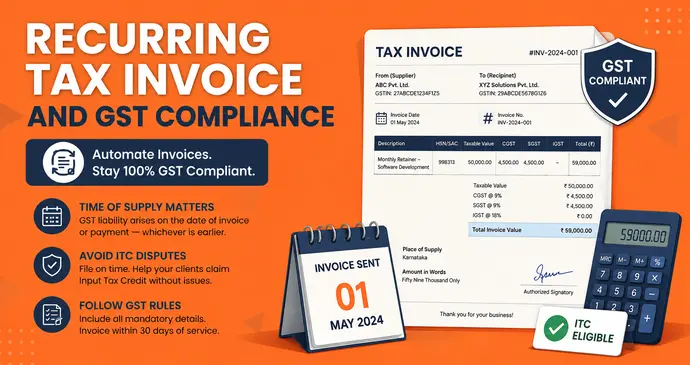
This is the section most competing guides skip entirely. For Indian businesses, recurring invoices carry specific GST compliance obligations that, if ignored, can result in audit risk and input tax credit (ITC) disputes for your clients.
What Is a Recurring Tax Invoice?
A recurring tax invoice is a recurring invoice that also qualifies as a valid tax invoice under GST (or VAT, depending on jurisdiction). Not every recurring invoice is automatically a valid tax invoice — it must meet specific legal requirements.
Under GST in India, a valid tax invoice must include:
- GSTIN of supplier mandatory for all registered businesses
- GSTIN of recipient mandatory for B2B supplies
- Invoice date and invoice number sequential numbering is required
- HSN/SAC code for goods (HSN) and services (SAC)
- Taxable value the pre-tax amount
- GST breakdown CGST, SGST for intra-state; IGST for inter-state
- Place of supply determines whether CGST/SGST or IGST applies
- Signature or digital signature of the supplier
GST Problem with Recurring Invoices
Here is the issue that trips up businesses using recurring invoices under GST:
Time of supply determines your GST liability not when you receive payment.
Under Section 13(2) of the CGST Act, the time of supply for services is the earlier of:
- The date of invoice
- The date of receipt of payment
This means if you send your recurring invoice on the 1st of the month, your GST liability arises on the 1st — even if your client pays on the 28th. If you forget to file that liability in your GSTR-1 for the month, you are non-compliant.
For businesses on a quarterly GSTR filing scheme, this creates a gap between when you raise an invoice and when your client can claim their ITC which can cause disputes.
Practical rule: Send your recurring tax invoice within 30 days of the end of the service period (for services). For goods, invoice within the time of removal or delivery.
GST Exemption and Mixed Supply Scenarios
Not all services in a recurring invoice attract GST equally. If your retainer includes both taxable services (e.g., software development — 18% GST) and exempt services (e.g., certain healthcare or educational services), you need to itemize them separately on the invoice. Combining them under a single line item creates a mixed supply risk where the higher GST rate may apply to the entire amount.
Use InvoPilot’s free GST Calculator to verify your tax breakdown before sending.
VAT on Recurring Invoices (International)
For businesses operating in VAT jurisdictions (UK, EU, UAE, etc.), recurring invoices need the VAT number, VAT rate, and VAT amount clearly stated. In many EU jurisdictions, if you supply services repeatedly to the same business customer, you may need to issue a “continuous supply of services” invoice with specific time-of-supply rules. More on this: What Is a VAT Invoice? Every Business Owner Must Know.
Avoid These 7 Recurring Invoice Mistakes
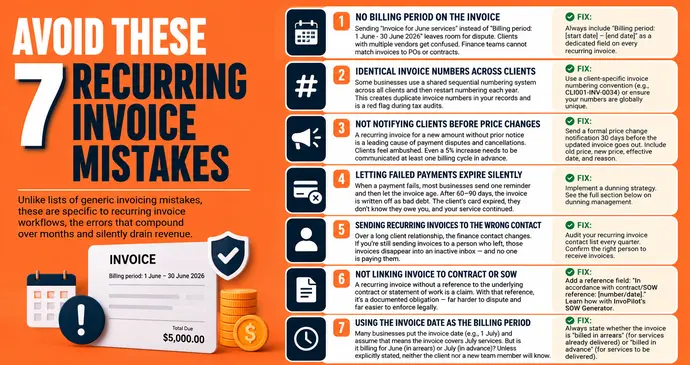
Unlike lists of generic invoicing mistakes, these are specific to recurring invoice workflows, the errors that compound over months and silently drain revenue.
Mistake 1: No Billing Period on the Invoice
Sending “Invoice for June services” instead of “Billing period: 1 June – 30 June 2026” leaves room for dispute. Clients with multiple vendors get confused about what period they’re paying for. Finance teams cannot match invoices to purchase orders or contracts without a clear billing period.
Fix: Always include “Billing period: [start date] – [end date]” as a dedicated field on every recurring invoice.
Mistake 2: Identical Invoice Numbers Across Clients
Some businesses use a shared sequential numbering system across all clients and then restart numbering each year. This creates duplicate invoice numbers in your records and is a red flag during tax audits.
Fix: Use a client-specific invoice numbering convention (e.g., CLI001-INV-0034) or ensure your invoice numbers are globally unique across your entire business.
Mistake 3: Not Notifying Clients Before Price Changes
A recurring invoice for a new amount without prior notice is one of the leading causes of payment disputes and sudden cancellations. Clients feel ambushed. Even a 5% price increase needs to be communicated at least one billing cycle in advance.
Fix: Send a formal price change notification 30 days before the updated recurring invoice goes out. Include the old price, new price, effective date, and the reason. This protects the relationship and prevents chargebacks.
Mistake 4: Letting Failed Payments Expire Silently
This is the biggest revenue leak in recurring billing. When a client’s payment fails — expired card, insufficient funds, bank block — most businesses send one reminder and then let the invoice age. After 60–90 days, the invoice is written off as bad debt.
What actually happened: the client’s card expired, they don’t even know they owe you money, and your service continued while you received nothing.
Fix: Implement a dunning strategy. See the full section below on dunning management.
Mistake 5: Sending Recurring Invoices to the Wrong Contact
Over a long client relationship, the finance contact changes. If you are still sending invoices to a person who left the company six months ago, those invoices are disappearing into an inactive inbox — and no one is paying them.
Fix: Audit your recurring invoice contact list every quarter. Send a brief email to accounts payable contacts confirming they are still the right person to receive invoices.
Mistake 6: Not Linking Invoice to Contract or SOW
A recurring invoice without a reference to the underlying contract or statement of work is a claim. A recurring invoice with that reference is a documented obligation. The latter is far harder to dispute and far easier to enforce legally.
Fix: Add a reference field to your recurring invoice: “In accordance with contract/SOW reference: [number/date].” Learn how to create that reference document using InvoPilot’s SOW Generator.
Mistake 7: Using the Invoice Date as the Billing Period
Many businesses put the invoice date (e.g., 1 July) and assume that means the invoice covers July services. But is it billing for June (in arrears) or July (in advance)? Unless explicitly stated, neither the client nor a new team member will know.
Fix: Always state on the invoice whether it is “billed in arrears” (for services already delivered) or “billed in advance” (for services to be delivered). This one line eliminates an entire category of disputes.
What Is Dunning? The Hidden Revenue Killer in Recurring Billing
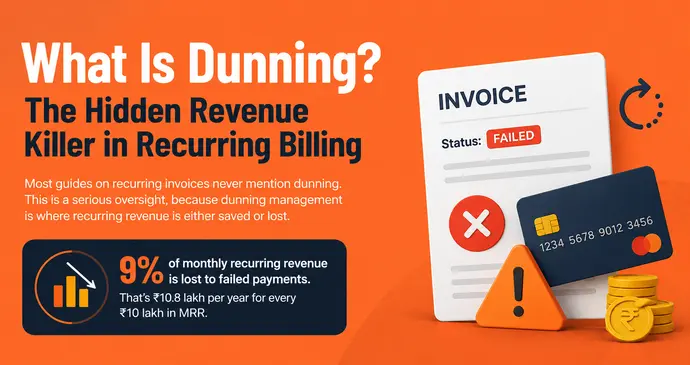
Most guides on recurring invoices never mention dunning. This is a serious oversight, because dunning management is where recurring revenue is either saved or lost.
The Definition
Dunning is the structured process of following up on failed or overdue payments from recurring customers. The word comes from 17th-century English slang for persistent debt collection but modern dunning is far more strategic and less adversarial.
In a recurring billing context, dunning is not about chasing bad debtors. It is about recovering involuntary payment failures situations where the client wants to pay but the payment didn’t go through due to:
- Expired or replaced credit card
- Bank fraud detection block
- Insufficient funds (temporary)
- Payment processor technical failure
- Incorrect billing details
Research from subscription analytics platform Baremetrics consistently shows that businesses lose around 9% of monthly recurring revenue to failed payments. For a business with ₹10 lakh in monthly recurring revenue, that’s ₹90,000 per month or ₹10.8 lakh per year lost not because clients wanted to leave, but because the payment failed and was never recovered.
Involuntary Churn vs Voluntary Churn
This distinction is crucial for understanding where recurring invoice revenue disappears.
- Voluntary churn: The client consciously decides to cancel your service or stop paying.
- Involuntary churn: The client’s payment fails, the invoice goes unresolved, and the relationship quietly ends without either party making an active decision.
Research from Paddle suggests involuntary churn accounts for 20–40% of all subscription business churn. This means that if your business loses 10 clients in a year, 2–4 of them may not have chosen to leave — their payment just failed and nobody caught it in time.
For freelancers and small agencies managing a handful of recurring clients manually, this shows up as invoices that simply never get paid and never get chased.
A Simple Dunning Strategy for Small Businesses
You do not need enterprise software to implement dunning. Here is a practical sequence:
Day 0: Payment due. Invoice sent as normal.
Day 3 (if unpaid): Gentle reminder. “Just checking in — your invoice for [period] is due. Let me know if you have any questions.”
Day 7 (if unpaid): Check-in with payment link. “Your invoice is now 7 days past due. Here’s a direct payment link for your convenience.”
Day 14 (if unpaid): Card update request (if auto-pay). “We noticed your payment hasn’t gone through — your card on file may have expired. Can you update your payment details?”
Day 21 (if unpaid): Service pause or escalation notice. This is where you decide whether to pause service and invoke your contract terms.
The key insight: most people at Day 3–7 are not ignoring you intentionally. They are busy. A brief, non-confrontational nudge recovers the vast majority of late payments without damaging the relationship.
For deeper context on what late payments cost your business, see 73 Late Payment Statistics Every Business Owner Needs to Know in 2026.
Recurring Invoice Software — What to Actually Look For
There is no shortage of recurring invoice software options. Instead of a comparison table (which will be outdated within months), here is a framework for evaluating what matters.
Non-Negotiable Features
1. Automated scheduling — The software must send invoices automatically on your chosen date without manual intervention.
2. Billing period auto-population — It should insert the correct billing period on each invoice, not just the send date.
3. Payment failure alerts — Instant notification when an auto-payment fails, so you can trigger dunning immediately.
4. Audit trail — A record of every invoice sent, opened, and paid. Essential for disputes and tax audits.
5. Tax/GST compliance — For Indian businesses, the software must handle GSTIN, HSN/SAC codes, and CGST/SGST/IGST automatically.
Nice-to-Have Features
- Auto-charge / tokenized card storage
- Client portal for self-serve invoice review and payment
- Late payment fee automation
- Multi-currency support (for international clients)
- Integration with accounting software for auto-reconciliation
What to Avoid
Avoid software that generates recurring invoices but doesn’t track payment status separately per cycle. Some tools mark an invoice as “paid” once the recurring series is activated — without actually confirming payment for each period. This is an accounting error waiting to happen.
For generating individual professional invoices quickly — including for recurring setups — InvoPilot’s Invoice Generator gives you a polished, GST-ready PDF with zero sign-up. For multi-invoice management, you’ll want a dedicated billing platform.
QuickBooks Recurring Invoice: How It Works
QuickBooks is one of the most common platforms businesses use for recurring invoicing. Here’s how the recurring invoice feature works at a functional level.
In QuickBooks Online, you create a recurring invoice by going to New → Invoice, filling in all invoice details, then selecting Make Recurring (found under the gear or settings icon on the invoice). You then configure:
- Type: Scheduled (auto-send), Reminder (prompts you to review before sending), or Unscheduled (template only)
- Frequency: Daily, weekly, monthly, yearly, or custom
- Start date and end date (or “never end”)
- Days in advance to create: How many days before the send date QuickBooks prepares the invoice
For auto-pay, you link a saved payment method and enable autopay — QuickBooks will charge the card on the invoice due date.
What QuickBooks does well: It handles the scheduling reliably and integrates invoicing with your accounting ledger, which makes reconciliation automatic.
What to watch for: QuickBooks does not always send payment failure alerts promptly. Monitor your recurring invoice dashboard regularly, especially in the first few months of a new recurring setup. Also note that QuickBooks’ free features are limited — the full recurring invoice functionality with auto-charge requires a paid subscription.
For businesses looking for a free, no-sign-up alternative for creating individual invoice documents, InvoPilot’s free billing software can serve as a lightweight complement.
PayPal Recurring Invoice: How It Works
PayPal offers recurring invoicing natively through its invoicing dashboard. This is different from PayPal’s subscription billing (which is card-based) — the recurring invoice feature sends an actual invoice to the client’s email on a schedule.
To set up a PayPal recurring invoice:
- Log into your PayPal Business account
- Go to Tools → Invoicing
- Create a new invoice
- Under Schedule, toggle on Recurring Invoice
- Set the frequency (weekly, monthly, annually) and end date
- Add items, taxes, and payment terms
- Send or schedule
PayPal’s recurring invoice then auto-generates and sends on your chosen schedule. The client can pay via PayPal balance, card, or bank transfer.
What PayPal does well: It works globally, handles multi-currency seamlessly, and requires no additional software for businesses already using PayPal.
What to watch for: PayPal’s invoicing is less sophisticated than dedicated billing platforms. There is no built-in dunning system — if a payment fails or a client ignores an invoice, you need to follow up manually. PayPal also charges transaction fees (typically 3–5% depending on your country and transaction type), which eats into margin on recurring client payments.
For a comparison of invoicing approaches and tools, see 10 Best Invoice Home Alternatives in 2026.
Free Recurring Invoice Templates by Industry
Here are real-world recurring invoice content structures by industry — not just generic line items, but the actual descriptions and fields that reduce disputes and get invoices paid faster.
Recurring Invoice Template: Digital Marketing Retainer
Billing Period: 1 June 2026 – 30 June 2026
Line Item 1: Monthly SEO retainer — keyword strategy, on-page optimisation, 4 blog posts, monthly rank report — ₹35,000
Line Item 2: Google Ads management (% of spend) — ₹8,000
Subtotal: ₹43,000 | GST (18%): ₹7,740 | Total: ₹50,740
Payment Terms: Net 15 | Due Date: 15 July 2026
Recurring Invoice Template: IT Support / Managed Services
Billing Period: June 2026
Line Item 1: Monthly managed IT support — 40 hours included, remote helpdesk, patch management — ₹25,000
Line Item 2: Cloud backup service (per GB) — 500 GB @ ₹2/GB — ₹1,000
Subtotal: ₹26,000 | GST (18%): ₹4,680 | Total: ₹30,680
Recurring Invoice Template: Freelance Copywriter Retainer
Billing Period: June 2026
Line Item 1: Monthly content retainer — 8 blog posts, 4 LinkedIn articles, 2 email newsletters — ₹20,000
Subtotal: ₹20,000 | GST (18%): ₹3,600 | Total: ₹23,600
Note: Invoice 6 of 12 — Annual retainer agreement dated 1 January 2026.
Recurring Invoice Template: Property Management Fee
Billing Period: June 2026
Line Item 1: Monthly property management fee — 5 units, Andheri West, Mumbai — ₹15,000
Line Item 2: Maintenance coordination (pass-through, actuals) — ₹3,200
Subtotal: ₹18,200 | GST (18%): ₹3,276 | Total: ₹21,476
To create any of these invoices as a polished, downloadable PDF in under 2 minutes — with GST fields, bank details, and your logo — use InvoPilot’s free Invoice Generator. No sign-up. No watermark.
Relationship Between Recurring Invoices and Cash Flow
Here is the strategic layer that most businesses running on recurring invoices miss entirely.
Recurring invoices are not just billing admin — they are the foundation of your predictable revenue model. The moment you convert a transactional client into a recurring one, your business fundamentally changes. You shift from reactive (create an invoice when work is done) to proactive (revenue is scheduled before the month begins).
But predictable revenue is only valuable if you can forecast and access it reliably. Three things break that:
1. Invoice-to-payment lag — The time between sending a recurring invoice and receiving payment. If your invoice is due on the 15th but clients routinely pay on the 25th, your cash flow forecast is chronically 10 days short. This is fixable with better payment terms and auto-pay.
2. Invoice dispute delays — A disputed recurring invoice can freeze payment for weeks. The solution is the specific, detailed invoice format described in the Anatomy section above.
3. Silent churn from unresolved failures — Covered in the dunning section. This is the biggest and most preventable recurring revenue loss.
For a framework on how invoice timing affects working capital, see What Is Invoice to Cash Process and How to Optimize It?
If you use prorated billing alongside recurring invoices — for example, when a client joins mid-month — make sure your recurring invoice software handles the prorated first cycle correctly before locking into the regular schedule.
Frequently Asked Questions
What does recurring invoice mean?
A recurring invoice is a billing document automatically generated and sent to the same customer at regular intervals — weekly, monthly, quarterly, or annually — for the same ongoing product or service. It documents a standing billing agreement and eliminates the need to manually create a new invoice each cycle.
What does recurring billing mean?
Recurring billing is the automated collection of payment from a customer on a fixed schedule. It often runs alongside recurring invoices but is not the same thing: recurring billing is the charge, while recurring invoicing is the document. Recurring billing may happen without an invoice being issued; recurring invoicing may require the client to manually approve payment rather than being auto-charged.
What is an example of a recurring bill?
A classic example of a recurring bill is a monthly rent payment, a monthly retainer fee from a marketing agency, a software subscription charged annually, or a weekly cleaning service fee. In each case, the same amount (or a predictable amount) is charged at a fixed interval for an ongoing service.
What is a recurring tax invoice?
A recurring tax invoice is a recurring invoice that also meets the legal requirements of a tax invoice under the applicable tax law — such as GST in India or VAT in the UK and EU. For it to be a valid tax invoice, it must include the supplier’s and recipient’s tax registration numbers (GSTIN/VAT number), a sequential invoice number, the taxable amount, and the correct tax rate and amount. A recurring invoice that lacks these details is not a valid tax invoice and cannot be used by the recipient to claim input tax credit.
How do I create a recurring invoice for free?
You can create a professional, GST-ready invoice using InvoPilot’s free Invoice Generator — no sign-up, no watermark, instant PDF. For fully automated recurring scheduling, you will need a billing platform that supports automated invoice dispatch on a set schedule. InvoPilot’s generator is ideal for creating the invoice document itself with all the correct fields.
Can a recurring invoice have different amounts each month?
Yes. A recurring invoice can have a variable amount if the billing model supports it — for example, a usage-based retainer where the monthly fee varies based on hours worked or resources consumed. In this case, the invoice structure recurs (same format, same client, same service description) but the line item amounts are updated each cycle. This is sometimes called a variable recurring invoice or usage-based recurring invoice.
How long should I keep recurring invoice records?
For GST compliance in India, businesses are required to keep invoice records for at least 6 years from the date of filing the relevant return. For other jurisdictions, the rule is typically 5–7 years. For businesses with long-term retainer relationships, it is good practice to maintain the full invoice history for the duration of the client relationship plus the statutory retention period.
What happens when a recurring invoice payment fails?
When a recurring invoice payment fails, the invoice remains outstanding. You should immediately trigger a dunning process: notify the client, check whether the failure was due to an expired card or bank issue, and provide an easy way to update payment details or settle the invoice. If multiple attempts fail without response, evaluate whether to pause services per your contract terms. Most payment failures are unintentional — a systematic dunning approach recovers the majority of them.