
Quick Answer: A sales invoice is a formal document issued by a seller to a buyer that records the goods or services sold, their quantities, agreed prices, applicable taxes, and payment terms. It acts as a legal payment request and an official record of the transaction essential for bookkeeping, GST or tax compliance, and cash flow management.
A business runs on trust — and trust runs on paperwork. Whether you’re a freelancer billing your first client, a small business owner managing dozens of orders, or a growing enterprise handling bulk B2B transactions, one document sits at the heart of every sale: the sales invoice.
Yet, despite how central it is, many business owners get it wrong — missing key elements, skipping proper payment terms, or using formats that aren’t GST-compliant.
This guide covers everything you need to know about sales invoices: the exact definition, what to include, the different types, a real-world example, a step-by-step creation guide, and how to generate one for free using InvoPilot’s free invoice generator.
What Is a Sales Invoice?
A sales invoice is an official accounting document issued by a seller to a buyer after a sale is completed. It details the products or services provided, the quantities, unit prices, applicable taxes (such as GST or VAT), and the total amount due along with payment terms and a due date.
In simpler terms, it’s a formal, itemized bill that asks your customer to pay you.
A sales invoice serves three core roles simultaneously:
- Payment request – tells the buyer how much they owe and when
- Legal record – serves as written proof of the transaction
- Accounting document – feeds directly into your bookkeeping, GST filing, and revenue tracking
Sales Invoice vs Invoice – Is There a Difference?
This is one of the most searched questions on Google: Is there a difference between a sales invoice and an invoice?
Short Answer:
No, they refer to the same document. The term “sales invoice” is simply a more specific way to describe an invoice used in the context of a sales transaction. In accounting, both terms are used interchangeably.
However, in some ERP and accounting software contexts, a “sales invoice” is specifically the outgoing invoice from the seller’s side (accounts receivable), while a “purchase invoice” refers to the same document from the buyer’s side (accounts payable).
| Term | Perspective | Purpose |
|---|---|---|
| Sales Invoice | Seller (outgoing) | Request payment from buyer |
| Purchase Invoice | Buyer (incoming) | Record of what was purchased |
| Invoice | General | Either perspective |
If you also use purchase orders in your workflow, see our guide on Purchase Order Templates to understand how a PO flows into a sales invoice.
Key Elements of a Sales Invoice
To be legally valid, professionally credible, and easy to process especially for GST filing in India your sales invoice must include these essential components:
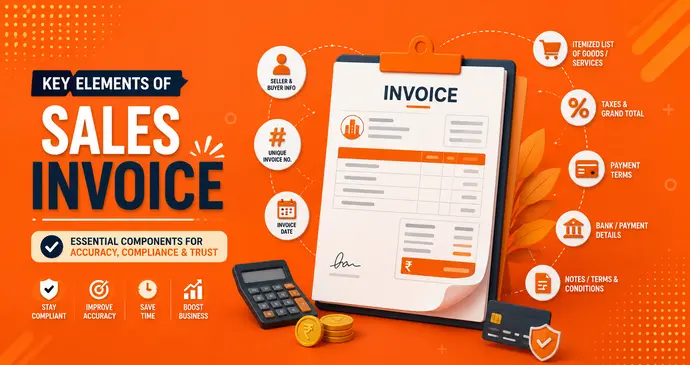
1. The Word “INVOICE” as the Header
Label the document clearly so there’s zero ambiguity about what it is.
2. Seller Information
- Business/Company name
- Complete address
- Phone number and email
- GSTIN (GST Identification Number) – mandatory for GST-registered businesses in India
- Business logo (recommended for brand trust)
3. Buyer Information
- Customer’s full name or company name
- Billing address
- GSTIN of the buyer (for B2B transactions)
- Contact details
4. Unique Invoice Number
Every invoice must carry a unique, sequential invoice number (e.g., INV-2026-001). This is critical for:
- Tracking payments
- Audit compliance
- GST return filing under the GST Act
5. Invoice Date
The exact date the invoice is created. This determines:
- The payment due date
- The tax period for GST
- Revenue recognition date
6. Itemized List of Goods or Services
For each line item:
- Description of product or service
- Quantity
- Unit price (rate)
- Discount (if any)
- Line total (quantity × rate − discount)
7. Subtotal, Taxes, and Grand Total
- Subtotal – total before tax
- GST/VAT breakdown – CGST, SGST, IGST (for Indian businesses) or VAT, listed separately with applicable rates
- Grand Total – the final amount due
For a detailed look at VAT invoicing specifically, read our guide on VAT Invoices.
8. Payment Terms
- Due date (e.g., “Payment due by July 15, 2026” or “Net 30”)
- Accepted payment methods – bank transfer, UPI, credit/debit card, cheque, PayPal, etc.
- Late payment fee (if applicable) – for example, 1.5% per month on overdue balances
9. Bank or Payment Details
Include your bank account number, IFSC code, UPI ID, or a payment link so the buyer can pay without back-and-forth.
10. Notes or Terms & Conditions (Optional but Recommended)
- Any special instructions
- Return/refund policy
- Delivery terms
- Warranty information
Sales Invoice Example
Below is a real-world sales invoice example for a graphic design service:
INVOICE
| Field | Details |
|---|---|
| From | DesignCo Studio, 12 MG Road, Bengaluru 560001 |
| To | TechStart Pvt. Ltd., 7 Nehru Place, New Delhi 110019 |
| Invoice No. | INV-2026-047 |
| Invoice Date | June 17, 2026 |
| Due Date | July 17, 2026 (Net 30) |
Line Items:
| # | Description | Qty | Unit Price | Total |
|---|---|---|---|---|
| 1 | Brand Logo Design | 1 | ₹15,000 | ₹15,000 |
| 2 | Business Card Design | 2 sides | ₹3,500 | ₹3,500 |
| 3 | Social Media Templates (10 posts) | 1 set | ₹8,000 | ₹8,000 |
| Subtotal | ₹26,500 | |||
| CGST @ 9% | ₹2,385 | |||
| SGST @ 9% | ₹2,385 | |||
| Grand Total | ₹31,270 |
Payment via: NEFT/IMPS to Axis Bank | A/c: 9190****8821 | IFSC: UTIB0002341 Late fee: 2% per month after due date
Types of Sales Invoice
Not all sales invoices are the same. The type you use depends on the nature of the transaction, the stage of the deal, and the industry you operate in.
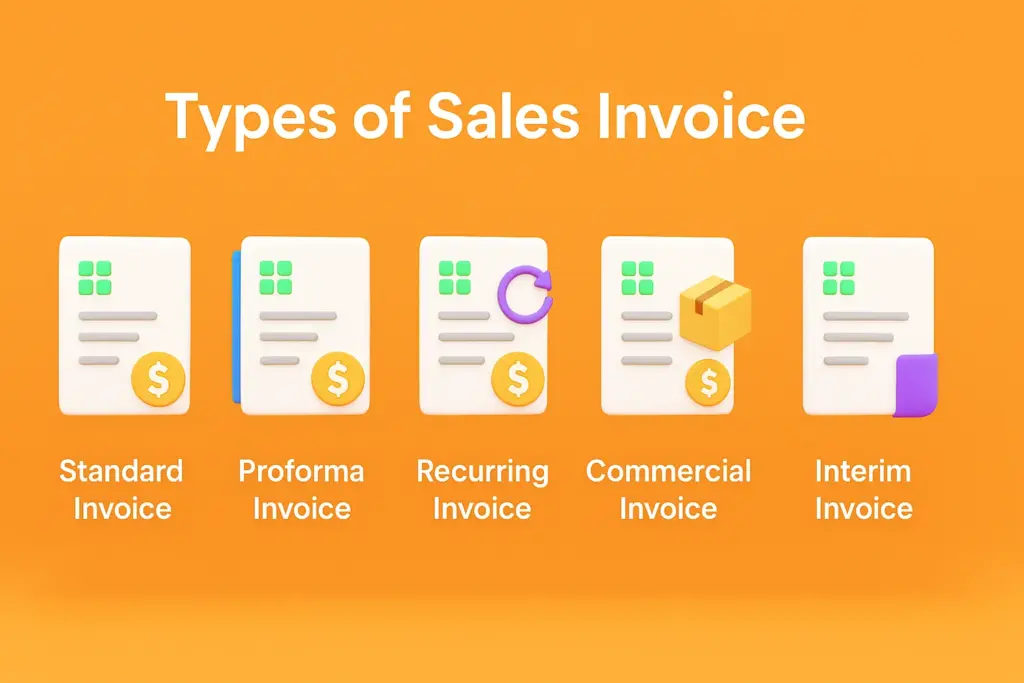
1. Standard Invoice
The most common type. Used for straightforward, one-time sales of products or services. Sent after the goods/services are delivered.
Best for: Retail sales, service businesses, freelancers
2. Proforma Invoice
A preliminary, estimated invoice sent before the actual sale is completed. It is not a payment demand — it’s more like a confirmed quote.
Best for: Import/export transactions, large B2B deals requiring advance approval
👉 Learn more: What Is a Proforma Invoice? | Free Proforma Invoice Generator
3. Commercial Invoice
Used specifically in international trade. It includes details required for customs clearance — country of origin, harmonized codes (HS codes), shipping terms (Incoterms), and declared value.
👉 Learn more: What Is a Commercial Invoice?
4. Recurring Invoice
Generated automatically at fixed intervals — weekly, monthly, or annually. Common for subscription-based businesses, SaaS companies, and retainer agreements.
Best for: Subscription services, monthly retainers, SaaS billing
5. Credit Invoice (Credit Note)
Issued when a seller needs to reduce the amount owed — for example, when a product is returned, a service was underdelivered, or an error was made on the original invoice. It carries a negative total.
6. Debit Invoice (Debit Note)
The opposite of a credit invoice. Issued to increase the amount owed — when additional charges apply that weren’t in the original invoice.
7. Interim Invoice
Issued partway through a long-term project to collect partial payment at milestones, rather than waiting until project completion.
Best for: Construction companies, consultants, large IT projects
8. Final Invoice
The closing invoice at the end of a project, confirming the total amount owed after accounting for any interim payments already made.
9. Past-Due (Overdue) Invoice
Sent when a customer has missed a payment deadline. It typically includes the original amount, late fees, and a new due date.
If you regularly deal with late payments, read our guide: How to Handle Late Invoice Payments
| Invoice Type | When to Use |
|---|---|
| Standard | Regular, one-time sales |
| Proforma | Before a deal is finalized |
| Commercial | International trade / customs |
| Recurring | Subscription or retainer billing |
| Credit Note | Refunds, returns, overcharges |
| Debit Note | Additional charges post-invoice |
| Interim | Mid-project milestone billing |
| Final | End of long-term project |
| Past-Due | Chasing overdue payments |
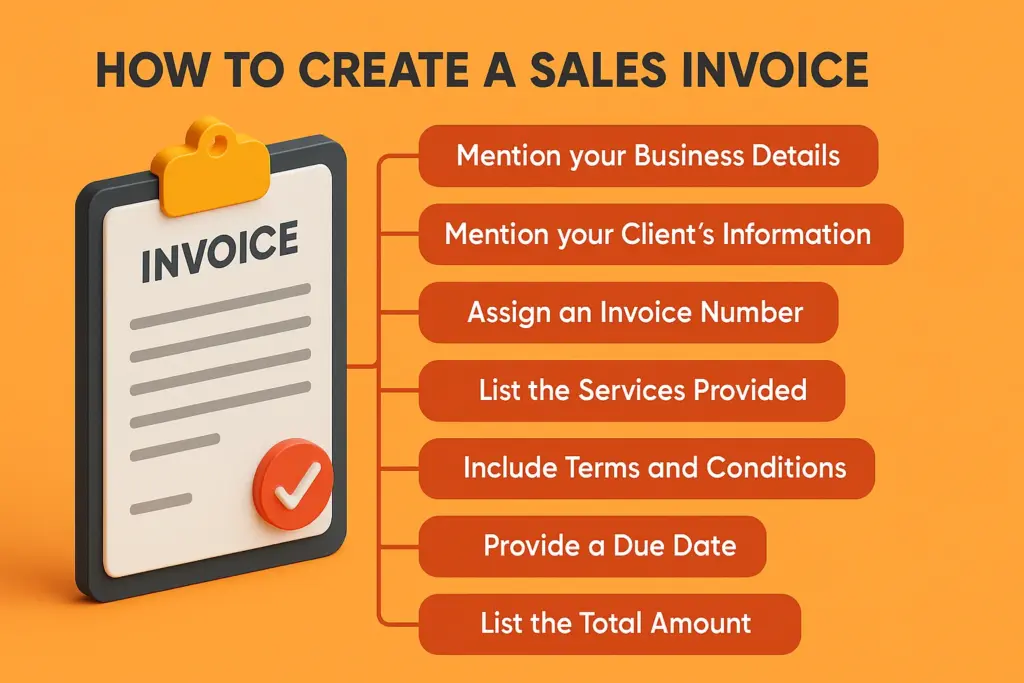
How to Create a Sales Invoice (Step-by-Step)
You can create a sales invoice manually using Word or Excel, use a free template, or use an online tool. Here is a universal step-by-step process that works for any method:
Step 1: Choose Your Invoice Method
Decide whether you’ll use:
- Pen & paper (not recommended for professional use)
- Word or Excel template (works, but time-consuming)
- Free online tool like InvoPilot Invoice Generator (fastest and most professional)
- Accounting software (best for high-volume invoicing)
Step 2: Add Your Business Details
At the top of the invoice, include:
- Your business name and logo
- Full address
- Phone, email, and website
- GSTIN (if GST-registered)
Step 3: Add Your Client’s Information
Below your details, add:
- Client name or company name
- Billing address
- Client’s GSTIN (for B2B in India)
- Contact email
Step 4: Assign a Unique Invoice Number
Use a consistent, sequential numbering system. Examples:
- INV-001, INV-002 (simple)
- INV-2026-047 (includes year)
- INV-JUN-001 (includes month)
Keep a log of issued invoice numbers to avoid duplicates critical for GST compliance.
Step 5: Set the Invoice Date and Due Date
- Invoice date = today’s date (date of issuance)
- Due date = invoice date + your payment terms (e.g., Net 30 = 30 days from invoice date)
Common payment terms:
- Due on receipt – immediate payment expected
- Net 7 / Net 15 / Net 30 – payment due within 7, 15, or 30 days
- 2/10 Net 30 – 2% discount if paid within 10 days, otherwise full amount due in 30 days
Step 6: List All Line Items
For every product sold or service rendered, add:
- Clear description (be specific – “Brand logo design, 3 concepts + 2 revisions” not just “design work”)
- Quantity (units, hours, sets)
- Unit price / rate
- Line total
Pro tip: Specificity in your line items reduces payment disputes and builds client trust.
Step 7: Apply Discounts (If Any)
If you’re offering a bulk discount, early-payment discount, or promotional offer, show it as a separate line:
Early Payment Discount (5% if paid within 7 days): − ₹1,325
Step 8: Calculate Taxes
For Indian businesses, apply the correct GST rate:
- Intra-state supply: Split evenly as CGST + SGST (e.g., 18% total = 9% CGST + 9% SGST)
- Inter-state supply: Apply IGST at the full rate (e.g., 18% IGST)
For GST calculations, use our free GST Calculator.
Step 9: Show the Grand Total Clearly
Make the final payable amount visually prominent. Include:
- Subtotal (before tax)
- Tax breakdown
- Grand Total (in bold or a highlighted box)
Step 10: Add Payment Instructions
Tell your buyer exactly how to pay:
- Bank name, account number, IFSC code (for NEFT/IMPS/RTGS)
- UPI ID or QR code
- PayPal link (for international clients – see our guide on PayPal Invoices)
- Credit/debit card payment link
Step 11: Include Terms and Any Notes
- Late payment fee policy
- Return/refund terms
- Thank-you note (a simple “Thank you for your business!” improves client relationships)
Step 12: Send and Track
- Email the invoice as a PDF
- Follow up 3–5 days before the due date with a polite reminder
- Track payment status (paid / unpaid / overdue)
Sales Invoice Format or Template
A good sales invoice template saves you time and ensures you never miss a critical field. Here’s what a standard format looks like:
┌─────────────────────────────────────────────────────┐
│  [LOGO]              INVOICE                        │
│                                                     │
│  FROM:                        INVOICE #: INV-001    │
│  [Your Business Name]         DATE: DD/MM/YYYY      │
│  [Address]                    DUE DATE: DD/MM/YYYY  │
│  [City, State, PIN]                                 │
│  [Phone | Email]                                    │
│  GSTIN: XXXXXXXXXXXX                                │
│                                                     │
│  BILL TO:                                           │
│  [Client Name / Company]                            │
│  [Client Address]                                   │
│  GSTIN: XXXXXXXXXXXX                                │
├─────────────────────────────────────────────────────┤
│  #  │ Description │ Qty │ Rate  │ Amount            │
│  1  │             │     │       │                   │
│  2  │             │     │       │                   │
├─────────────────────────────────────────────────────┤
│                         Subtotal: ₹                 │
│                         CGST (9%): ₹                │
│                         SGST (9%): ₹                │
│                      GRAND TOTAL: ₹                 │
├─────────────────────────────────────────────────────┤
│  Payment: [Bank Details / UPI / Card Link]          │
│  Terms: [Net 30 | Late fee: 2% per month]           │
│  Notes: Thank you for your business!                │
└─────────────────────────────────────────────────────┘
🔗 Download free, ready-to-use invoice templates in Google Docs, Word, and PDF format: Invoice Templates by InvoPilot
Why Sales Invoices Matter for Your Business
Sales invoices are not just a formality. They directly impact your business’s financial health, legal standing, and client relationships.
1. Cash Flow Management
Invoices set clear payment expectations. Businesses that invoice promptly and consistently get paid faster. According to general accounting practices, sending an invoice within 24 hours of service completion can reduce average payment time significantly.
Pair your invoicing process with our Business Loan EMI Calculator to understand your cash flow needs better.
2. Legal Protection
A signed or delivered sales invoice creates a legally binding obligation for payment. If a dispute arises, your invoice is your primary evidence in any legal or arbitration proceeding.
3. GST/Tax Compliance (India)
Under the GST Act in India, registered businesses are legally required to issue a GST invoice for every taxable supply. Failure to do so can result in penalties. Your invoices are also used to claim Input Tax Credit (ITC).
4. Accurate Bookkeeping
Every invoice is an accounting entry. It records:
- Revenue earned (for P&L statement)
- Accounts receivable (money owed to you)
- Tax collected (GST payable)
5. Audit Trail
Tax authorities can audit your business at any time. A proper sequence of invoices with matching payment records is your best defense. Missing or duplicate invoice numbers are red flags during GST audits.
6. Inventory Tracking
Each sales invoice reduces your stock count. Integrated with inventory management, invoices give you real-time visibility into what has been sold, preventing stock-outs and overstocking.
7. Business Analytics
When you review your invoices over a month or quarter, you get direct insights:
- Which products or services generate the most revenue
- Which clients generate the highest volume
- Seasonal trends in your sales
- Average invoice size and payment cycles
Sales Invoicing Best Practices
Follow these practices to make your invoicing process faster, more professional, and more effective at getting you paid:
1. Invoice immediately. Send the invoice the same day the goods are delivered or the service is completed — not days later.
2. Use a consistent numbering system. Never reuse or skip invoice numbers. A clean sequence is required for GST compliance and makes audits painless.
3. Be specific in your descriptions. Vague line items like “Consulting” lead to disputes. Write “3 hours of SEO consultation on June 10, 2026 @ ₹2,000/hr.”
4. Set clear payment terms upfront. Agree on payment terms (Net 15, Net 30, etc.) before starting work, and reflect them on every invoice.
5. Use a professional template. A well-designed invoice communicates professionalism and increases the perceived credibility of your business. Try our free invoice templates.
6. Offer multiple payment options. The easier you make it for someone to pay, the faster they will. Accept bank transfer, UPI, credit card, and digital wallets.
7. Follow up proactively. Send a reminder 3 days before the due date and again on the due date if unpaid. A friendly follow-up is not rude — it’s standard business practice.
8. Charge a late fee — and state it upfront. A 1.5–2% monthly late fee on overdue invoices is industry standard and encourages timely payment. State it clearly on every invoice.
9. Keep digital copies. Store every invoice digitally (PDF format) in a cloud folder organized by client and financial year. This makes GST filing and audits far easier.
10. Automate where possible. Use invoicing tools that auto-generate invoice numbers, apply tax rates, and send payment reminders. This saves hours each week and eliminates human error.
Sales Invoice vs Purchase Order vs Receipt
These three documents are all part of the same transaction but they serve different purposes and come at different stages.
| Document | Issued By | Issued When | Purpose |
|---|---|---|---|
| Purchase Order (PO) | Buyer | Before the sale | Buyer’s formal request to purchase goods/services |
| Sales Invoice | Seller | After delivery/completion | Formal request for payment |
| Receipt | Seller | After payment is received | Confirmation that payment was made |
Think of it as a sequence: PO → Delivery → Sales Invoice → Payment → Receipt
For purchase orders, explore: Free Purchase Order Templates and Purchase Order Generator
Free Sales Invoice Generator Tool
Creating a sales invoice from scratch every time is tedious and prone to errors. InvoPilot’s free invoice generator lets you:
- Create a professional sales invoice in under 2 minutes
- Add your logo, business details, and GST info
- Auto-calculate GST (CGST, SGST, IGST), totals, and discounts
- Download as a clean PDF instantly
- No account required, completely free
Conclusion
A well-crafted sales invoice is much more than a bill — it’s a core business tool that protects your revenue, keeps you GST-compliant, and signals professionalism to every client you work with.
The key is to keep it clear, complete, and consistent: include all required fields, use a sequential invoice number, specify your payment terms upfront, and send it promptly after every sale.
Frequently Asked Questions
What is a sales invoice?
A sales invoice is an official document issued by a seller to a buyer after a sale, listing the products or services sold, their prices, applicable taxes, and the payment terms. It acts as both a formal payment request and a legal record of the transaction.
What is the difference between a sales invoice and an invoice?
There is no functional difference the terms are used interchangeably. “Sales invoice” simply specifies that the invoice is related to a sales transaction. In accounting, a sales invoice appears on the seller’s accounts receivable, while the same document is called a “purchase invoice” from the buyer’s perspective.
What are the three types of invoices?
The three most common types of invoices are:
- Standard Invoice – used for regular, completed sales
- Proforma Invoice – a preliminary estimate sent before a sale
- Recurring Invoice – automatically generated for subscription or retainer billing
Other types include credit notes, debit notes, commercial invoices, and interim invoices.
How do I create a sales invoice?
To create a sales invoice:
- Add your business details and logo
- Add your client’s information
- Assign a unique invoice number and date
- List all products/services with quantities and prices
- Apply GST or other applicable taxes
- Show the grand total
- Add payment terms, due date, and payment instructions.
Use InvoPilot’s free invoice generator to do this in under 2 minutes.
Is a sales invoice legally binding?
Yes, A sales invoice, once delivered and accepted (or not disputed), creates a legally binding obligation for payment. It can be used as evidence in court, in arbitration, or during a GST audit in India.
What is the difference between a sales invoice and a receipt?
A sales invoice is issued before payment — it’s a request for payment. A receipt is issued after payment — it’s a confirmation that payment was received. Both are important documents but serve different purposes in the transaction cycle.
Does a sales invoice need a GST number in India?
If your business is GST-registered (annual turnover above ₹20 lakh for services or ₹40 lakh for goods), then yes you must issue a GST invoice that includes your GSTIN, the buyer’s GSTIN (for B2B), HSN/SAC codes, and a clear GST breakdown. Failure to do so can attract penalties.
What is a proforma invoice vs a sales invoice?
A proforma invoice is issued before the sale it’s a draft or estimate that commits to the prices and terms but is not a payment demand. A sales invoice is issued after the sale or delivery it is an official, legally binding payment request.
How long should I keep sales invoices?
In India, businesses should keep sales invoices for a minimum of 6 years from the end of the relevant financial year, as per GST regulations. For income tax purposes, keeping records for at least 6 years is also recommended.
Can I send a sales invoice by email?
Yes, and it’s the preferred method today. Email your invoice as a PDF attachment with a brief, professional covering message. Reference your invoice number and due date in the email subject line for easy tracking (e.g., “Invoice INV-2026-047 | Due: July 17, 2026”).
Create Invoices Instantly – Free & Easy!
Generate professional invoices in seconds with our Free Online Invoice Generator.
👉 Try the Invoice Generator Now